
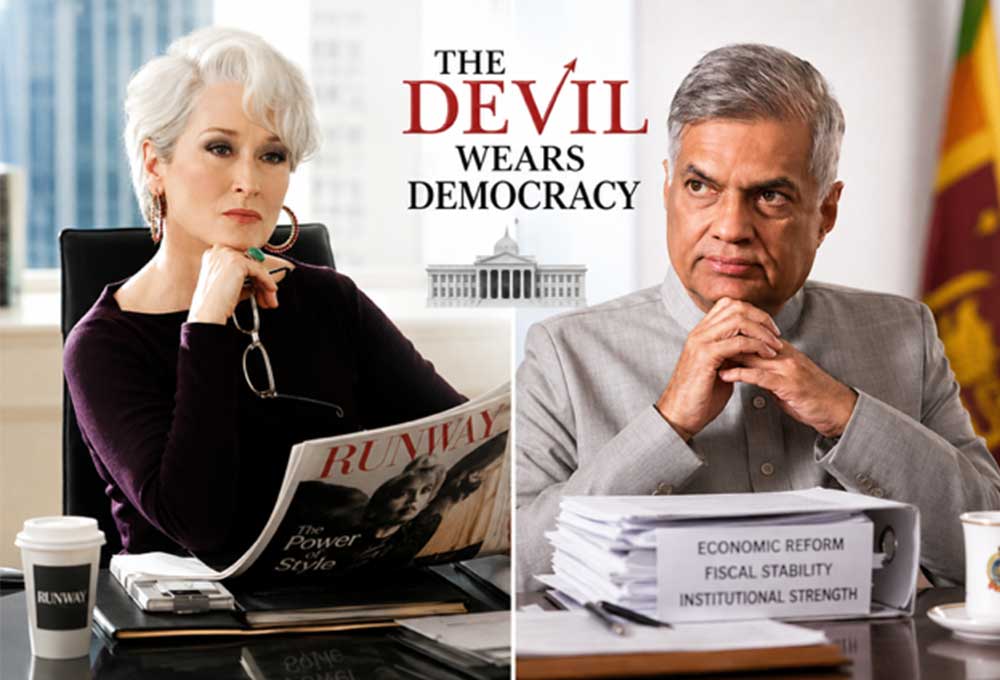
When Prada Meets Politics
There are some people who enter a room and immediately change the atmosphere. Conversations stop, posture improves, and everyone suddenly develops an urgent interest in unfinished reports.
Miranda Priestly, the formidable editor-in-chief of Runway magazine, possesses this gift.
So, in a very different arena, does Ranil Wickremesinghe.
At first glance, comparing the queen of fashion with a Sri Lankan political leader sounds absurd. One inhabits a world of designer labels, fashion weeks and impossible deadlines. The other has spent decades navigating elections, budgets, constitutional crises and economic reforms.
One wears Prada.
The other wears patience.
Yet beneath these obvious differences lies a remarkably similar leadership archetype: the intelligent, disciplined, institution-first survivor who would rather be respected than adored.
The Art of Being Respected Rather Than Loved
Miranda Priestly has never appeared particularly interested in being liked. She does not organise staff retreats, distribute motivational quotes or ask employees how they are feeling. Her management philosophy is refreshingly uncomplicated: your emotions are your responsibility; your mistakes are very much hers.
Ranil has often projected a similar image.
Throughout his political career, he has rarely been mistaken for a populist showman. While others were kissing babies, dancing on campaign stages and promising miracles, he often looked more comfortable explaining fiscal deficits and structural reforms.
Most politicians arrive carrying promises.
Ranil often seemed to arrive carrying a policy brief.
If Miranda’s slogan is “Everybody wants to be us,” Ranil’s might simply be:
“Have you read the report?”
The Cerulean Blue Theory of the Sri Lankan Economy
One of the most memorable scenes in The Devil Wears Prada is Miranda’s famous “cerulean blue” lecture. Andy sees an ordinary blue sweater. Miranda sees a chain of decisions stretching from fashion designers to manufacturers, retailers and consumers.
Experts see systems where everyone else sees simplicity.
One suspects Ranil approaches macroeconomics exactly the same way.
A Sri Lankan asks:
“Why has bread become more expensive?”
An ordinary politician replies:
“The previous government.”
A television panellist says:
“International conspiracies.”
A Facebook expert declares:
“Trust me. I have documents.”
Ranil responds:
“To answer that properly, we need to begin with global commodity markets, exchange-rate dynamics and fiscal policy adjustments…”
Three hours later, the bread is still expensive, but everyone has accidentally completed a diploma in economics.
Miranda would approve.
Somewhere in Sri Lanka, three civil servants have instinctively opened a PDF.
Masters of Institutions
Miranda does not simply work for Runway magazine.
She embodies it.
Every decision is filtered through one question:
“What protects the institution?”
Office friendships, personal feelings and popularity are secondary.
Ranil has often projected the same instinct.
While others focus on applause, he frequently appears more interested in whether institutions function, laws interact coherently and economies remain stable.
Most people enjoy watching the performance.
Miranda and Ranil are more interested in understanding how the stage was built.
Perfectionism and the Fear of a Typo
Miranda’s greatest strength is also her greatest weakness.
She notices everything.
The wrong shoes.
The wrong wording.
The wrong timing.
Employees behave as though she can detect errors through walls.
One imagines she could spot a misplaced comma from a moving vehicle.
Ranil evokes a similar image.
He looks like the sort of person who has actually read the annexures, appendices and footnotes that everyone else confidently claimed to have read.
While most people skim the executive summary, he probably wants to discuss page 247.
Imagine Miranda attending a Sri Lankan committee meeting.
The committee proudly announces it has met seventeen times.
Miranda asks,
“Excellent. What have you achieved?”
The committee proudly replies,
“We’ve scheduled the eighteenth meeting.”
At that point, even the air-conditioning would apologise.
Survival as a Competitive Sport
Perhaps the strongest similarity is resilience.
Throughout The Devil Wears Prada, there is always someone predicting Miranda’s downfall. Rivals emerge, conspiracies form and boardroom whispers grow louder.
Yet somehow she remains standing while everyone else disappears.
Sri Lankan politics has often generated the same pattern around Ranil.
For decades, commentators repeatedly predicted the end of his political career.
Eventually, the prediction itself became so routine that people stopped asking whether Ranil would survive and started wondering how.
If Miranda can survive fashion coups, Ranil can survive political seasons.
At this point, even Netflix would reject the script as unrealistic.
When Expertise Meets the Influencer Age
Perhaps the greatest challenge facing both Miranda’s world and modern politics is the decline of traditional authority.
Miranda belongs to an era when editors shaped trends.
Today, influencers can do much the same thing with a mobile phone.
Politics has experienced an equally dramatic shift.
Policy experts now compete with content creators.
Detailed reform plans compete with thirty-second videos.
Spreadsheets compete with slogans.
Miranda would look upon this development with visible horror.
Ranil would probably produce a forty-page policy paper explaining it.
Unfortunately, nobody reads it because they’re watching a sixty-second summary on social media.
Final Verdict: The Runway Never Ends
The brilliance of Miranda Priestly is that she is neither hero nor villain.
She is competence without comfort.
Excellence without sentimentality.
Success without apology.
That is precisely why the comparison with Ranil Wickremesinghe feels less ridiculous than it first appears.
Both are admired and criticised for remarkably similar reasons.
Both inspire respect more easily than affection.
Both believe institutions matter more than popularity.
Both have the rare ability to make an entire room feel unprepared without ever raising their voices.
Miranda walks into Runway magazine and people panic.
Ranil walks into an economic discussion and people suddenly pretend they have read the Budget.
Both operate according to a simple philosophy:
Not what feels good.
But what works.
tc,
The Catalyst
About the Author