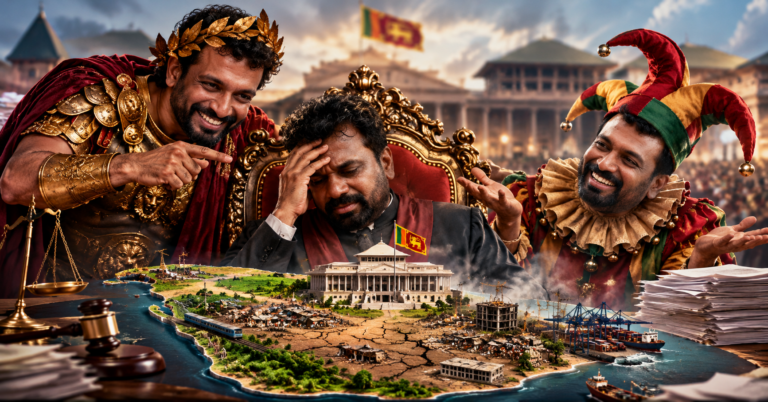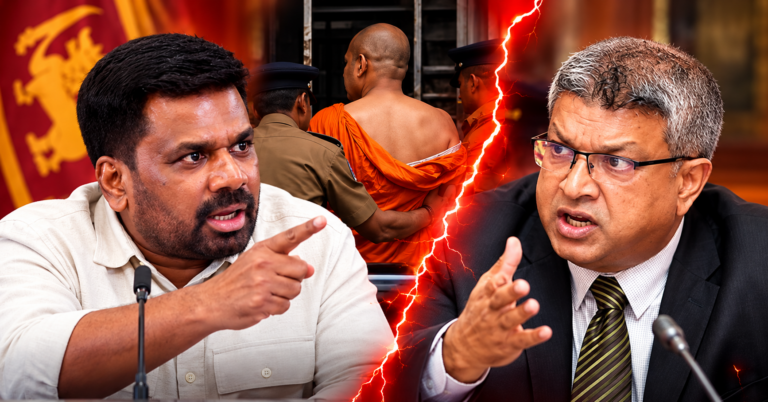

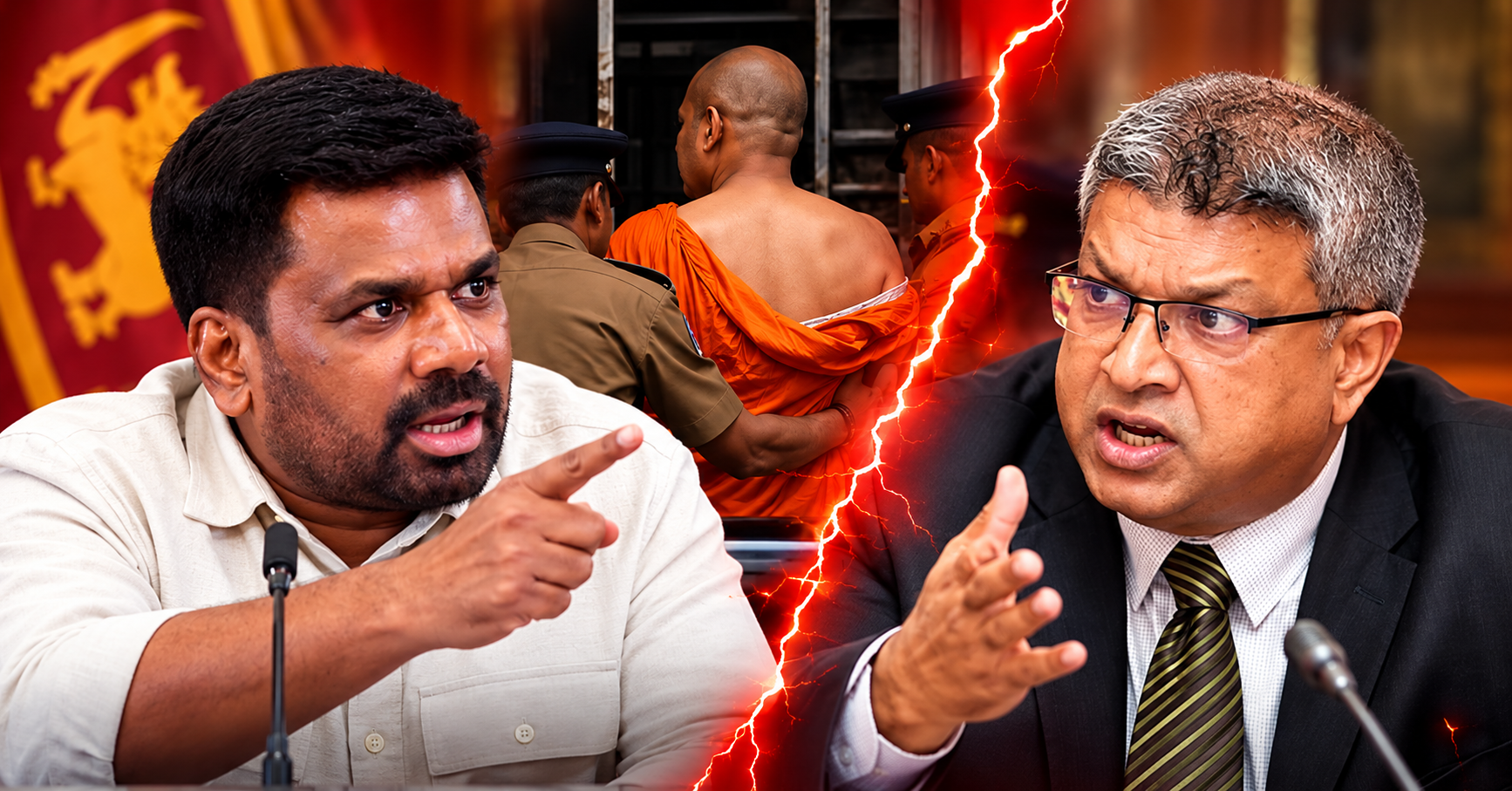
“Take off that man’s robes!” — Serious questions emerge over who ordered the removal of Gnanasara Thero’s saffron robes, whether the President approved the decision, and whether the controversy signals a growing power struggle within the JVP-NPP government.
A heated verbal exchange reportedly took place on Thursday morning (October 8) between President Anura Kumara Dissanayake and Justice Minister Harshana Nanayakkara over the controversial removal of the saffron robes of the imprisoned Buddhist monk, Venerable Galagoda Aththe Gnanasara Thero, before he was produced in court wearing prison attire.
The alleged confrontation was revealed by our political correspondent, citing sources within the President’s Office.
The incident reportedly occurred just hours before President Dissanayake was scheduled to meet senior representatives of Sri Lanka’s principal Buddhist monastic orders to discuss the growing controversy surrounding the treatment of Gnanasara Thero.
According to our political correspondent, Justice Minister Harshana Nanayakkara was responsible for the decision that resulted in Gnanasara Thero being presented before the court without his traditional monastic robes.
The controversy intensified after the Mahanayake Theros of the country’s principal Buddhist monastic orders sent a letter to the Commissioner General of Prisons on Wednesday, expressing strong objections to the decision to dress Gnanasara Thero, who is serving a prison sentence pursuant to a court ruling, in ordinary prison clothing before producing him in court.
Following the letter, President Dissanayake reportedly contacted the Commissioner General of Prisons directly to seek an explanation.
According to information obtained by our political correspondent, the Commissioner General allegedly told the President that Justice Minister Harshana Nanayakkara had personally telephoned him and instructed:
“Take off that man’s robes!”
The alleged instruction, reportedly delivered in blunt and disrespectful language, has become a central issue in the controversy.
Our political correspondent reported that President Dissanayake was deeply dissatisfied with both the alleged statement and the political and religious backlash that followed.
However, the allegation that the Justice Minister personally issued such an instruction has not been independently verified, and no publicly established evidence confirming the reported telephone conversation has been presented.
Who Really Ordered the Removal of Gnanasara Thero’s Robes?
The controversy has raised several politically sensitive questions.
Who was ultimately responsible for the decision to remove Gnanasara Thero’s robes? Was President Dissanayake aware of, or did he approve, the decision beforehand? Could the dispute represent an early indication of a power struggle between the Janatha Vimukthi Peramuna (JVP) and the broader National People’s Power (NPP) political alliance?
Our political correspondent has also raised questions about whether the reported confrontation between the President and the Justice Minister was a genuine disagreement or a politically calculated attempt to demonstrate a division of responsibility.
Given the President’s record of political messaging, the correspondent suggested that further investigation is necessary to determine whether the disagreement was deliberately presented to the public after the controversy escalated.
Another possibility being raised is that the government may be attempting to shift responsibility for the decision onto Justice Minister Harshana Nanayakkara following the strong backlash from influential Buddhist religious leaders.
These remain political suspicions rather than established facts. There is currently no verified evidence demonstrating that President Dissanayake authorised the removal of the robes or that the reported disagreement was deliberately staged.
Could Gnanasara Thero’s Robes Become a Political Crisis for the Government?
The controversy has become particularly sensitive for President Anura Kumara Dissanayake’s administration because opposition to the treatment of Gnanasara Thero appears to have extended beyond the monk’s traditional supporters.
According to sources within the President’s Office, even Buddhist monks who previously supported the National People’s Power government have expressed objections to the decision.
This broader religious backlash is reportedly one of the principal reasons behind the alleged disagreement between the President and the Justice Minister on Thursday morning.
The same sources suggest that President Dissanayake is particularly concerned about the possibility of Buddhist monastic groups with different political affiliations uniting around a common position against the government over this issue.
Such a development could create significant political difficulties for the administration, particularly if the controversy evolves from a dispute over prison procedures into a wider confrontation involving the government and the country’s influential Buddhist religious establishment.
The central question now is whether the government will provide a transparent explanation of who authorised the removal of Gnanasara Thero’s robes, under what legal or administrative authority the decision was made, and whether the Justice Minister acted independently or with the knowledge of the President.
Until those questions are answered, the controversy is likely to continue generating political debate over accountability, religious sensitivities and the internal dynamics of the JVP-NPP administration.
About the Author