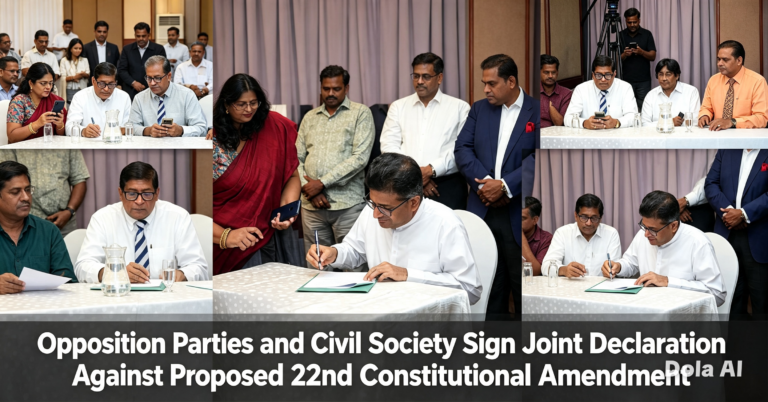

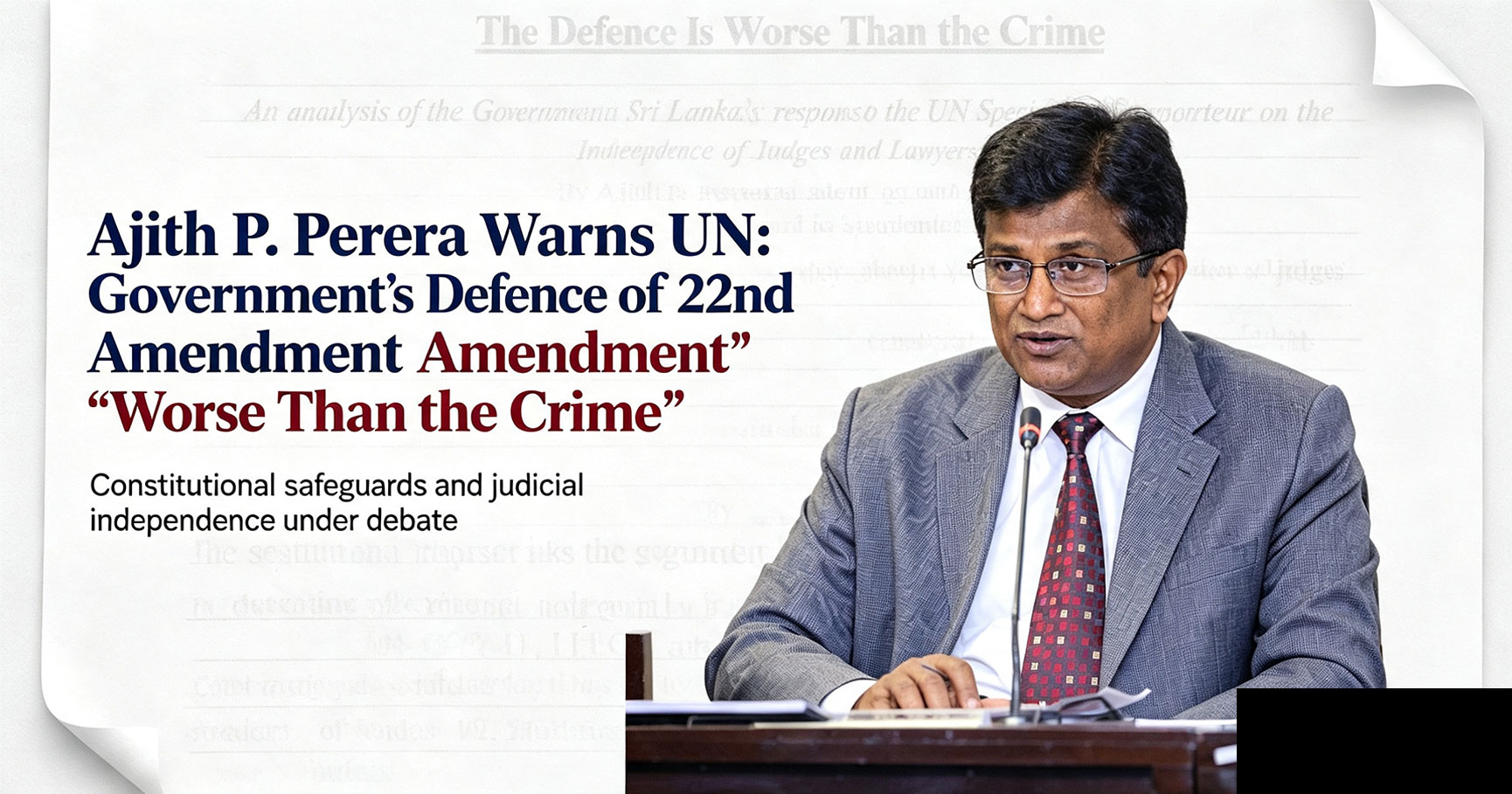
Colombo — In a strongly worded communication to the United Nations Special Rapporteur on the Independence of Judges and Lawyers, Member of Parliament and Constitutional Council member Ajith P. Perera has accused the Sri Lankan Government of failing to answer critical questions about the proposed 22nd Amendment to the Constitution, warning that the response “strengthens the case against the amendment.”
Perera’s detailed analysis, sent as an official submission to the UN, argues that the government’s reply to the Special Rapporteur—dated 7 August 2026—avoids the core concerns surrounding the plan to extend the retirement ages of Supreme Court and Court of Appeal judges, including its immediate application to sitting judges.
“Assurances instead of evidence”
The Special Rapporteur had asked seven specific questions, including:
- why the amendment must apply to serving judges,
- what consultations were conducted,
- what safeguards exist against political influence,
- and whether any assessment was made on public confidence in the judiciary.
Perera states that the government did not answer five of the seven questions, and only partially addressed the remaining two.
“The government was asked for evidence. It supplied assurances,” he writes.
He notes that the government repeatedly cites general constitutional protections—Articles 105, 107, 108, 111, 111C and 111L—but fails to explain how altering Article 107(5) for current judges avoids the appearance of executive or legislative influence.
No proof of ‘broader judicial reform’
The government claims the amendment is part of a “broader judicial reform process,” but Perera says no documentation has been provided to support that claim.
His analysis highlights the absence of:
- the Cabinet Memorandum said to initiate the reform,
- any judicial‑reform policy or roadmap,
- expert reports,
- stakeholder submissions,
- or recommendations from the Judicial Service Commission or Law Commission.
The only documents attached to the government’s reply were the two Bills themselves.
Consultation “not demonstrated”
Perera notes that the government did not identify a single consultation with the judiciary, BASL, legal professionals, civil society or academics—despite being directly asked by the UN.
He cites the Bar Association’s public statement on 29 July 2026, which confirmed that the proposal advanced without a comprehensive consultative process.
A later meeting between the President and BASL on 12 August occurred after Cabinet approval and gazetting of the Bills, which Perera argues cannot be considered meaningful consultation.
No assessment of public confidence
The Special Rapporteur asked whether the government had assessed the impact of the amendment on public confidence in the courts.
Perera states that the government provided no assessment, only a claim that confidence would not be harmed.
He warns that serving judges may be required to rule on the constitutionality of legislation that directly affects their own tenure—creating a serious appearance‑of‑bias problem.
Backlog argument “unsupported”
The government cites delays and backlogs in the justice system as justification for extending judges’ retirement ages. But Perera notes that:
- 95% of pending cases are in District Courts and Magistrates’ Courts,
- not in the Supreme Court or Court of Appeal.
He argues that extending the tenure of senior judges does not address the real source of delay, and that the government has not explained why judicial vacancies and staff shortages have not been resolved through ordinary measures.
Application to sitting judges remains unjustified
Perera says the government has not explained why the amendment must apply immediately to current judges rather than future appointees, nor how conflicts of interest will be managed.
He warns that altering the tenure of identifiable sitting judges without transparent safeguards risks violating Article 14(1) of the ICCPR, which guarantees an independent and impartial tribunal.
“The defence is worse than the crime”
Perera concludes that the government’s reply not only fails to address the UN’s concerns but exposes deeper weaknesses in the amendment process:
- no consultation,
- no evidence,
- no assessment,
- no safeguards,
- and no documented reform programme.
“By exposing the absence of consultation, evidence, assessment and tailored safeguards, the response strengthens the case against the amendment,” Perera writes. “In that sense, the defence is worse than the crime.”
About the Author