
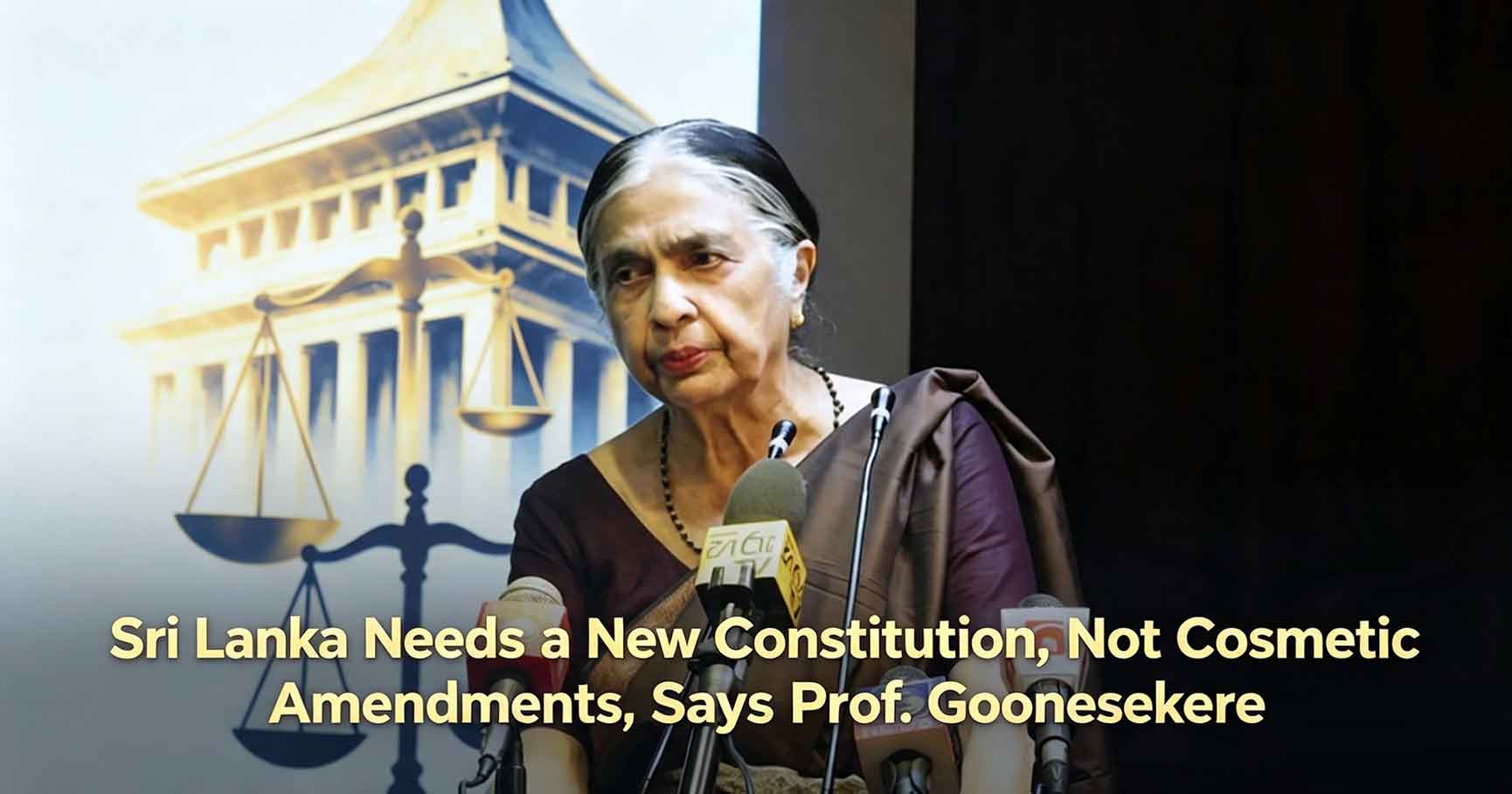
Sri Lanka’s constitutional debate entered a decisive new phase this week as eminent legal scholar and human rights advocate Professor Savitri Goonesekere delivered a forceful critique of the country’s governance model, warning that the nation is trapped in a “democratic deficit” that cannot be resolved without dismantling the executive presidency.
Speaking at a seminar organised by the Young Lawyers’ Association, Prof. Goonesekere urged the legal community, political leaders, and citizens to confront the structural failures embedded in Sri Lanka’s constitutional framework and commit to a modern, democratic constitution that reflects the sovereignty of the people.
Professionals Under Pressure Amid Polarised Politics
Prof. Goonesekere opened her address by highlighting the increasingly hostile environment faced by professionals—particularly lawyers—who attempt to speak on matters of public interest.
She warned that in Sri Lanka’s polarised political climate, professional opinions are often delegitimised if they appear to align with opposition viewpoints.
“If by any chance the opposition’s stance happens to coincide with that of professionals, then there’s a deliberate delegitimization of the professionals.”
She noted that the Bar Association of Sri Lanka, long regarded as a defender of democratic norms, is now routinely accused of partisanship simply for questioning government actions.
Constitutionalism as a Guardrail Against Authoritarianism
Prof. Goonesekere stressed that constitutionalism is not an academic ideal but a practical mechanism to prevent the abuse of state power.
“Constitutionalism must prevent the abuse of state power. You can’t have an authoritarian constitution.”
Tracing Sri Lanka’s constitutional evolution—from the Westminster-style system of 1948 to the 1972 autochthonous constitution and the powerful 1978 executive presidency—she argued that each shift toward concentrated authority has weakened institutions and eroded public accountability.
Executive Presidency Identified as the Root Cause
A central theme of her speech was the urgent need to abolish the executive presidency, which she described as the structural engine of corruption, institutional decay, and a pervasive “boss‑man culture” in the public sector.
“The executive presidency of 1978 has destabilized what were good public institutions… and contributed to corruption.”
Despite multiple reform attempts—including the 2000 draft constitution, the 2015 reform process, and bipartisan discussions in 2019—she noted that successive governments lacked the political will to deliver meaningful change.
“No More Amendments”: Call for a New Constitution
Prof. Goonesekere insisted that Sri Lanka must abandon piecemeal constitutional amendments and instead adopt a completely new constitution.
“The time has come to say no more amendments. What we want is a new constitution with a dismantling of the executive presidency.”
She emphasised that extensive research, reports, and draft frameworks already exist, making the process achievable within a short period—provided there is bipartisan consensus.
Key Pillars for a Future Constitution
The speaker outlined several essential components for any new constitutional framework:
- Abolition of the executive presidency
- Clear articulation of people’s sovereignty
- Strengthened separation of powers
- Judicial independence, including secure tenure, protected salaries, and proper impeachment procedures
- Power‑sharing and pluralism to address the national question
- Expanded fundamental rights, including socio‑economic rights
- Reform of presidential immunity provisions
- Strong conflict‑of‑interest rules
- Protection of the right to be heard (audi alteram partem)
- Recognition of public perception as a cornerstone of trust in governance
A Warning — and a Hope
Reflecting on Sri Lanka’s turbulent political history, Prof. Goonesekere urged citizens to remain vigilant and demand democratic accountability.
“We lived through dark times… but we must hold this government to deliver on democracy and not any other system.”
She concluded with a message of cautious optimism, expressing hope that Sri Lanka can finally enact a constitution that reflects the sovereignty of its people and ensures transparent, accountable governance.
About the Author