
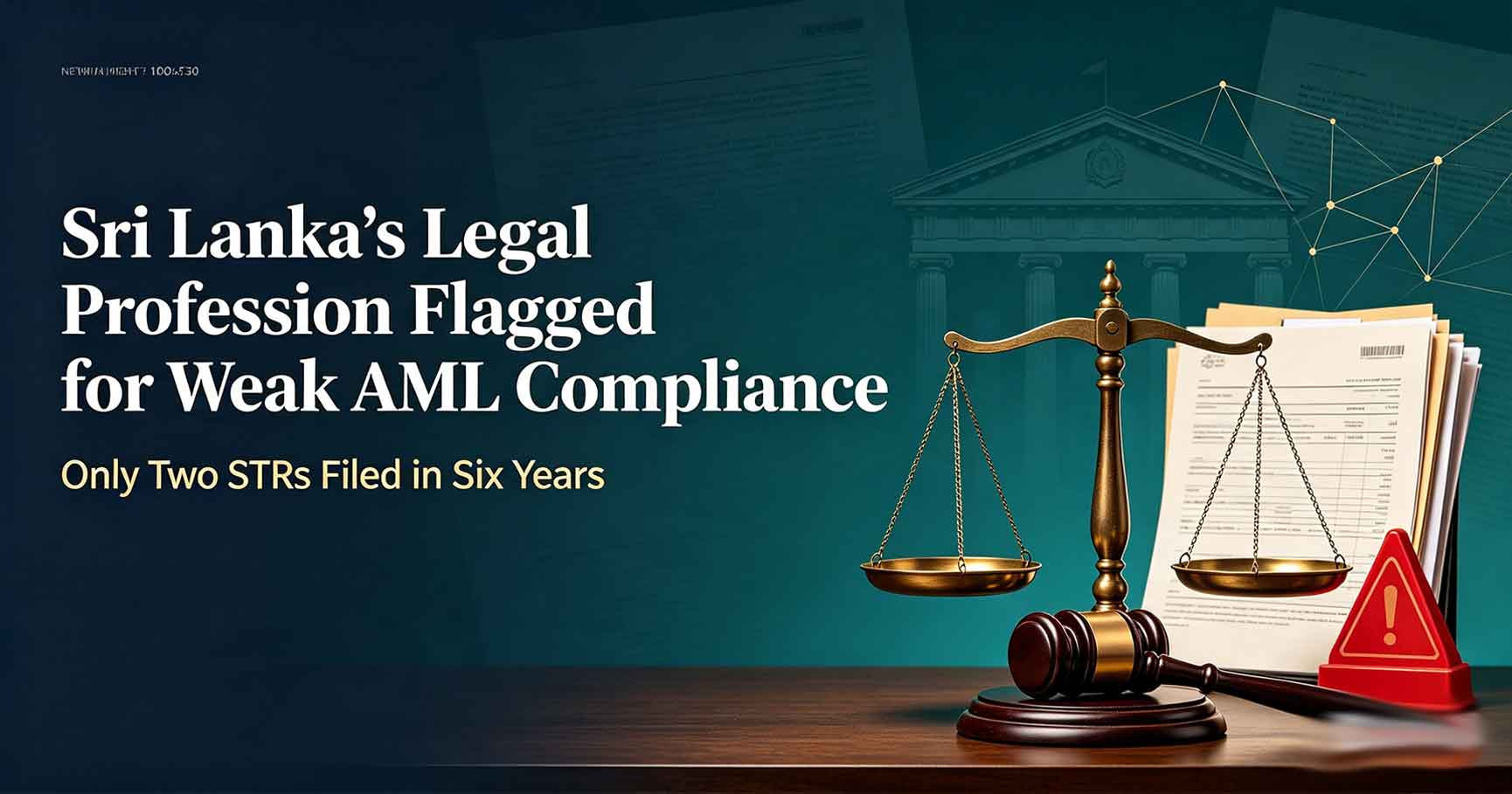
Sri Lanka’s legal sector has come under sharp scrutiny after Central Bank Governor Dr. Nandalal Weerasinghe revealed that lawyers and notaries submitted only two Suspicious Transaction Reports (STRs) to the Financial Intelligence Unit (FIU) between 2020 and 2026 — a figure he described as “alarming” and far below international expectations.
The disclosure was made at the inaugural National Anti‑Money Laundering Symposium organised by the Bar Association of Sri Lanka (BASL), where regulators urged the profession to urgently strengthen compliance, and BASL leadership conceded the shortfall.
Regulators warn of systemic weakness
Dr. Weerasinghe reminded participants that lawyers, notaries and other independent legal professionals are classified as Designated Non‑Financial Businesses and Professions (DNFBPs) under the Financial Transactions Reporting Act, and are legally required to file STRs within two working days of forming a suspicion.
He said the near‑absence of reporting raised concerns about the effectiveness of AML/CFT implementation within the profession, especially as Sri Lanka prepares for its next Financial Action Task Force (FATF) mutual evaluation.
Sri Lanka was downgraded in its last two evaluations, and the Governor stressed that the country must avoid a repeat.
Legal reforms and rising expectations
Parliament recently passed three key amendments updating the Prevention of Money Laundering Act, the Financial Transactions Reporting Act, and laws on terrorist financing. The reforms aim to:
- align with evolving FATF standards
- address deficiencies flagged in earlier assessments
- incorporate recommendations from the IMF’s 2023 governance diagnostic
- prepare for the upcoming Asia‑Pacific Group (APG) on‑site assessment scheduled from 26 October to 6 November
The FIU will continue as the national hub for analysing and disseminating financial intelligence, while also coordinating AML/CFT implementation across reporting institutions.
BASL acknowledges gaps, pledges reform
BASL President Rajeev Amarasuriya admitted the profession’s reporting record was inadequate, telling participants that the numbers must improve and warning that a second symposium may be necessary if they do not.
He described lawyers as “gatekeepers” vulnerable to misuse in property transactions, company incorporations, trust formation and asset management — legitimate activities that can be exploited to conceal illicit funds.
Compliance, he said, is now an issue inside the lawyer’s office, not an external regulatory concern.
Amarasuriya urged lawyers to adopt a risk‑based approach, asking not only whether a transaction is legally permissible, but:
- why it is structured a certain way
- who the real beneficial owner is
- what the source of funds is
- why particular jurisdictions or corporate vehicles are used
He acknowledged the tension between AML obligations and lawyer‑client confidentiality, but stressed that privilege cannot be used to shield criminal activity.
Judiciary emphasises privilege boundaries
Former Supreme Court Justice Buwaneka Aluwihare, chair of the national AML/CFT Taskforce, said extending AML obligations to lawyers reflects their central role in transactions involving property, companies and trusts — areas vulnerable to misuse.
He clarified that legal professional privilege remains protected, but does not extend to a lawyer’s participation in financial or transactional activity that may conceal criminal proceeds.
The upcoming APG evaluation, he said, will test not only whether Sri Lanka has laws and institutions, but whether they are effective in practice.
Economic stakes: trust, investment and governance
Speakers repeatedly linked AML/CFT compliance to Sri Lanka’s broader economic recovery. Money laundering, Amarasuriya argued, is not just a criminal law issue but an economic governance problem that distorts markets, enables corruption, undermines legitimate businesses and erodes investor confidence.
He said trusted institutions require transparency, accountability and integrity, and the legal profession has a responsibility to help protect all three.
Takeaway
With an APG assessment weeks away and only two STRs filed in six years, regulators say Sri Lanka’s legal profession must urgently demonstrate real‑world compliance. BASL leaders agree the gap is serious — and insist the profession must act now to avoid becoming a weak link in the national AML/CFT system.
About the Author