
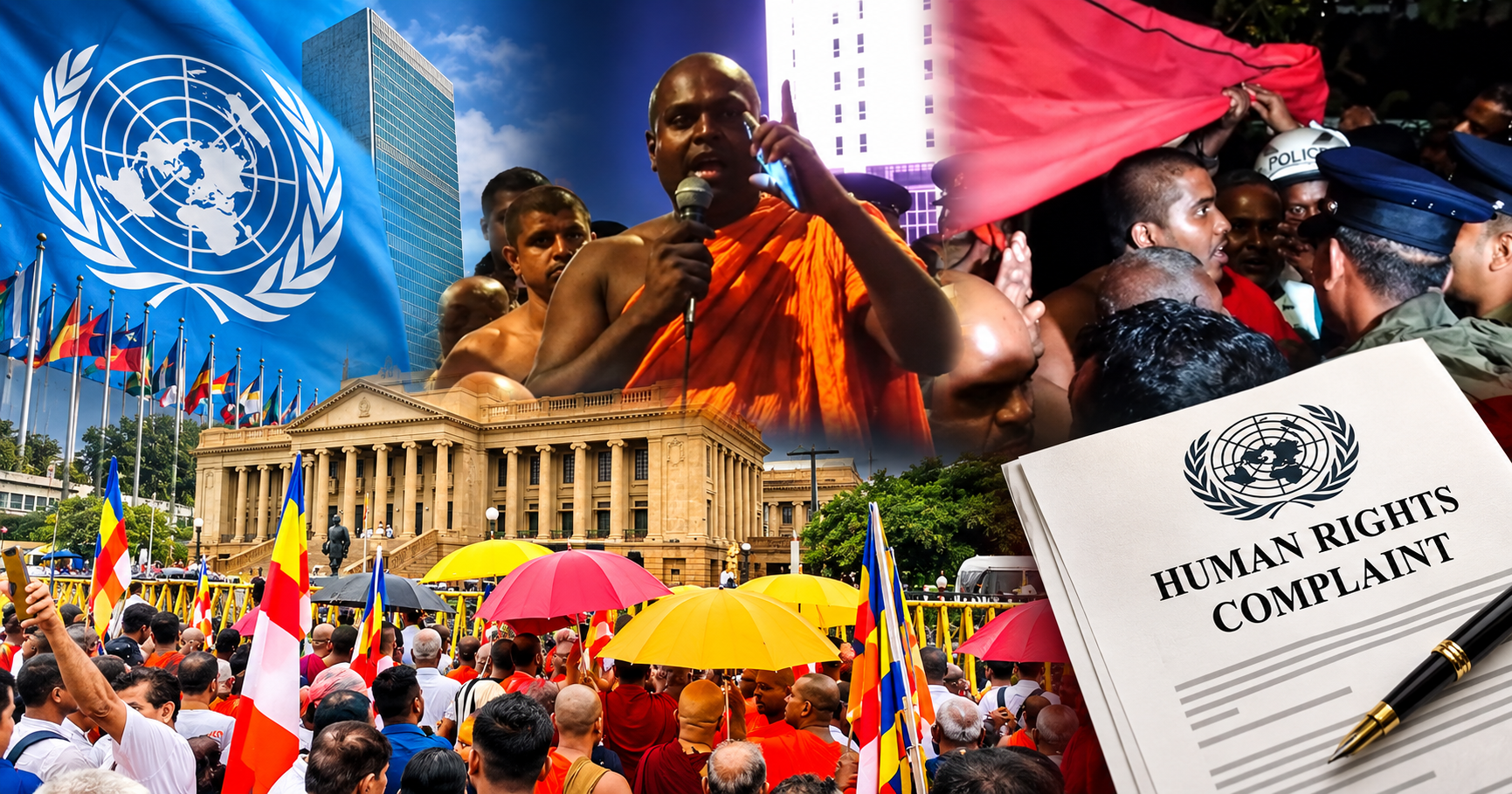
Colombo, October 16, 2026 – An urgent human rights complaint addressed to the United Nations High Commissioner for Human Rights (OHCHR), UN Special Rapporteurs, Amnesty International, and Human Rights Watch has called for an independent international investigation into allegations that Sri Lankan authorities used police powers, judicial procedures, and state security mechanisms to restrict peaceful demonstrations under President Anura Kumara Dissanayake’s administration.
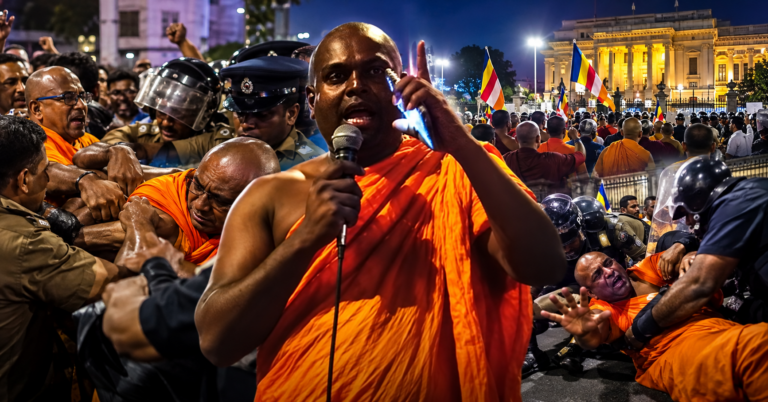
The complaint, prepared by journalist Panduka Herath, focuses on incidents reported on October 15 and 16 near the Presidential Secretariat in Colombo, where Buddhist monks and civilian protesters gathered to demand the release of imprisoned monk Ven. Galagoda Aththe Gnanasara Thero.
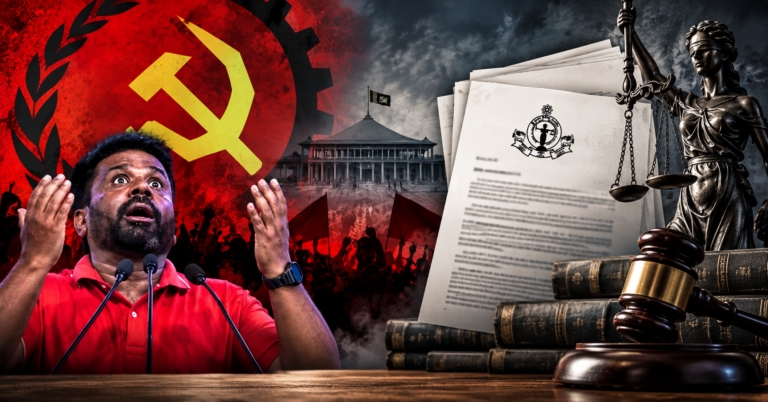
Citing police documents identifying 54 individuals and an application for a judicial order under Section 106(1) of the Code of Criminal Procedure Act, the complaint raises serious questions about the legality and proportionality of restrictions on peaceful assembly. It also calls for investigations into allegations of physical assaults, possible political interference, and the involvement of presidential security personnel.
The complaint urges international human rights bodies to seek an official explanation from the Sri Lankan government, examine potential violations of constitutional protections and the International Covenant on Civil and Political Rights (ICCPR), and ensure that peaceful protesters are protected against intimidation and reprisals.
The allegations remain subject to independent verification, and the complaint does not establish that the President or security authorities acted unlawfully.
URGENT HUMAN RIGHTS COMPLAINT – SRI LANKA
Date: 16 October 2026
To:
The United Nations High Commissioner for Human Rights
Office of the United Nations High Commissioner for Human Rights (OHCHR)
Geneva, Switzerland.
The United Nations Special Rapporteur on the Rights to Freedom of Peaceful Assembly and of Association.
Amnesty International, Human Rights Watch, and Other International Human Rights Organizations.
Subject: Urgent Request for an Independent Investigation and International Intervention Concerning Allegations of the Use of Police Powers, Judicial Orders, and State Security Mechanisms to Restrict the Right to Freedom of Peaceful Assembly in Sri Lanka
Dear High Commissioner / Special Rapporteur,
We respectfully submit this urgent complaint to draw your immediate attention to serious concerns regarding the protection of the rights to freedom of peaceful assembly, freedom of expression, and the democratic right to protest against government actions under the administration of His Excellency President Anura Kumara Dissanayake of the Democratic Socialist Republic of Sri Lanka.
This complaint primarily concerns incidents reported on 15 and 16 October 2026 in the vicinity of the Presidential Secretariat in Colombo, including police applications for judicial orders, the deployment of security personnel, and restrictions imposed or sought to be imposed on the activities of protesters.
These incidents should not be viewed merely as a legal dispute arising from a single demonstration. Rather, they raise fundamental questions as to whether the right of Sri Lankan citizens to peacefully express dissent against the exercise of state power is being effectively protected in practice.
1. Background to the Protest
On 15 October 2026, a protest march known as the “Freedom March” (Nidahase Pada Yathrawa), attended by Buddhist monks and civilian participants, reportedly reached the vicinity of the Presidential Secretariat in Colombo.
The demonstration called for the release of Venerable Galagoda Aththe Gnanasara Thero, the General Secretary of the Bodu Bala Sena organization, who is currently serving a prison sentence.
During the demonstration, protesters presented their demands to the Secretary to the President. A number of Buddhist monks and other participants subsequently remained in the surrounding area as part of their continuing protest.
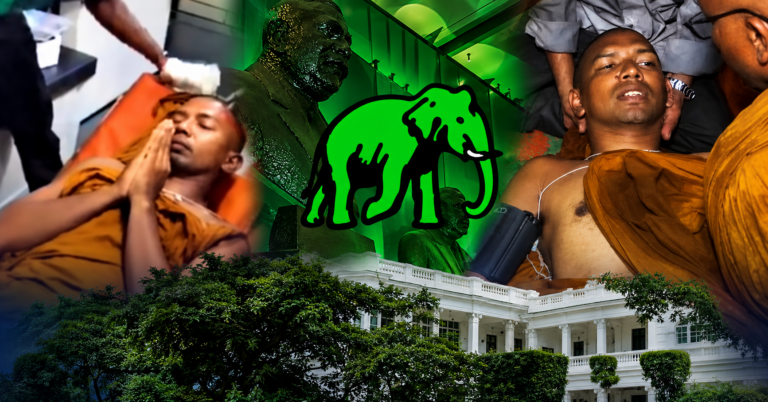
Allegations have emerged that police officers and security personnel engaged in confrontations with protesters and that certain Buddhist monks and civilians were subjected to physical assaults.
These allegations require an independent and impartial investigation to establish the circumstances of the incidents, identify those responsible for any unlawful conduct, and determine whether the actions of law enforcement authorities complied with applicable domestic and international human rights standards.
2. First Documentary Evidence – Individuals Identified in Police Proceedings and Applications for Judicial Orders
The first page of the police document attached to this complaint indicates that the police sought a judicial order in connection with a demonstration relating to Venerable Galagoda Aththe Gnanasara Thero, General Secretary of the Bodu Bala Sena organization.
Among the individuals identified in the document are:
- Venerable Ulapane Sumangala Thero;
- Venerable Vitharandeniye Nanda Thero;
- Venerable Medille Pannaloka Thero;
- Several other Buddhist monks and individuals associated with the demonstration.
The first page identifies 30 individuals, while the second page continues the list up to 54 individuals.
The central human rights concern arising from this document is whether the police measures seeking to restrict the assembly rights of identified organizers and participants were necessary, reasonable, and proportionate.
The mere identification of individuals participating in a peaceful demonstration should not, in itself, provide sufficient justification for restricting their fundamental rights.
It is therefore essential to determine the legal and factual grounds relied upon by the police in seeking restrictions against the named individuals.
3. Second Documentary Evidence – Application for a Judicial Order under Section 106(1) of the Code of Criminal Procedure Act
The second attached page refers to an application for a judicial order under Section 106(1) of the Code of Criminal Procedure Act, No. 15 of 1979.
According to the document, the police sought restrictions concerning protest activities within the Colombo Police Division, particularly in the vicinity of the Presidential Secretariat and surrounding areas, commencing at 6:00 a.m. on 16 October 2026.
It is important to examine how the court assessed the grounds advanced by the police, including considerations relating to public order, road access, public safety, and security.
While maintaining public order is a legitimate responsibility of the State, that responsibility must not be exercised in a manner that unnecessarily or disproportionately restricts peaceful demonstrations.
Accordingly, an independent legal examination is required to establish:
- The precise scope of the judicial order;
- Its duration and period of enforcement;
- The geographical area covered by the restrictions;
- The individuals to whom the order applies;
- The factual evidence presented by the police;
- Whether the restrictions satisfy the requirements of legality, necessity, and proportionality under international human rights law.
4. Constitutional Guarantees and International Human Rights Obligations
The Constitution of the Democratic Socialist Republic of Sri Lanka guarantees fundamental freedoms, including:
Article 14(1)(a): Freedom of speech and expression, including publication.
Article 14(1)(b): Freedom of peaceful assembly.
Sri Lanka is also a State Party to the International Covenant on Civil and Political Rights (ICCPR).
Under the ICCPR:
Article 19 protects the right to freedom of opinion and expression.
Article 21 recognizes and protects the right of peaceful assembly.
Article 21 permits restrictions on peaceful assembly only where such restrictions are imposed in conformity with the law and are necessary in a democratic society in pursuit of a legitimate objective, including national security, public safety, public order, public health or morals, or the protection of the rights and freedoms of others.
Furthermore, the United Nations Human Rights Committee’s General Comment No. 37 (2020) on Article 21 of the ICCPR emphasizes that States have a positive obligation to facilitate peaceful assemblies and protect participants.
Restrictions, prohibitions, and the dispersal of peaceful assemblies must be assessed against strict requirements of legality, necessity, and proportionality.
The dispersal of an assembly should be considered only where justified by the applicable human rights standards, rather than as a routine response to peaceful public dissent.
These international obligations are particularly relevant when examining the use of police powers and judicial procedures to restrict demonstrations directed at government authorities.
5. Role of the Police, Armed Forces, and State Security Agencies
The allegations concerning the conduct of police officers and presidential security personnel during the demonstration warrant independent investigation.
It is also necessary to establish whether members of the Sri Lanka Army or other military personnel were deployed in connection with the protest.
If military personnel were involved, the following matters should be examined:
- The legal authority under which they were deployed;
- The nature and scope of the operational instructions issued to them;
- Their specific responsibilities and actions during the demonstration;
- Whether their involvement complied with domestic law and international human rights obligations.
Furthermore, it is essential to determine whether the President or any other political authority issued unlawful instructions intended to suppress a peaceful demonstration.
Such an inquiry must be conducted independently and on the basis of verifiable evidence, without presuming wrongdoing by any individual or institution.
With regard to the judiciary, the central concern is the protection of judicial independence and the need to ensure that restrictions imposed following police applications are consistent with constitutional guarantees and international human rights standards.
Any investigation should respect the independence of the judiciary while examining the legal basis, necessity, and proportionality of restrictions affecting fundamental freedoms.
6. Urgent Requests to International Human Rights Mechanisms and Organizations
In light of the foregoing concerns, we respectfully request the Office of the United Nations High Commissioner for Human Rights, the relevant United Nations Special Procedures mandate holders, Amnesty International, Human Rights Watch, and other international human rights organizations to consider the following measures.
1. Independent and Impartial Investigation
Urge the Sri Lankan authorities to initiate an independent, impartial, prompt, and transparent investigation into the incidents reported on 15 and 16 October 2026 in the vicinity of the Presidential Secretariat in Colombo.
2. Investigation into Alleged Physical Assaults
Examine allegations that Buddhist monks and civilian protesters were physically assaulted by police officers or other security personnel and seek accountability where unlawful conduct is established.
3. Review of the Application of Section 106(1)
Assess whether the use of Section 106(1) of the Code of Criminal Procedure Act to seek restrictions on peaceful demonstrations is consistent with Sri Lanka’s constitutional obligations and international human rights standards.
4. Protection of Identified Protesters
Investigate the circumstances in which lists of protest organizers and participants were prepared and used, including any risk of intimidation, surveillance, harassment, or reprisals arising solely from their participation in peaceful demonstrations.
5. Disclosure and Examination of Operational Instructions
Seek information regarding operational orders and instructions issued to the Sri Lanka Police, presidential security personnel, and any other security agencies involved in the management of the demonstration.
6. Investigation into Possible Political Interference
Examine whether any unlawful instructions, interventions, or directives were issued by the President or other political authorities in connection with measures taken against the demonstrators.
7. Protection Against Intimidation and Reprisals
Call upon the Sri Lankan authorities to guarantee that protesters, journalists, human rights observers, lawyers, and witnesses can exercise their legitimate functions without intimidation, harassment, arbitrary interference, or retaliation.
8. Urgent Communication to the Government of Sri Lanka
Request the relevant United Nations Special Procedures mandate holders to consider transmitting an Urgent Appeal or other appropriate communication to the Government of Sri Lanka, seeking an official explanation concerning the reported incidents and the measures taken by law enforcement authorities.
9. Continued International Monitoring
Encourage continued monitoring of the legal and practical environment governing the exercise of the right to freedom of peaceful assembly in Sri Lanka, particularly where demonstrations involve criticism of government policies or actions.
7. Final Appeal
The right to peaceful protest is a fundamental characteristic of a democratic society governed by the rule of law.
Disagreement with government policies, criticism of political authorities, or calls for the release of an imprisoned individual must not, in themselves, constitute grounds for restricting the fundamental rights of citizens.
Regardless of one’s political or religious views concerning the objectives of a particular demonstration, the fundamental rights of peaceful protesters must be protected equally and without discrimination.
Our concern is not limited to the circumstances of a single protest. It extends to the broader obligation of the State to ensure that police powers, security mechanisms, and judicial procedures are exercised consistently with constitutional protections and international human rights obligations.
We respectfully call for the full observance of the principles of:
- The rule of law;
- Respect for human dignity;
- Freedom of peaceful assembly;
- Freedom of expression;
- Necessity and proportionality in the use of State powers;
- Accountability and effective remedies for human rights violations.
We therefore urge your offices and organizations to give immediate attention to the present situation in Sri Lanka, seek relevant information from the competent authorities, and support appropriate measures aimed at ensuring an independent investigation and the effective protection of fundamental human rights.
We respectfully request that this complaint be considered for urgent attention in view of the potential implications for the exercise of peaceful assembly rights and the protection of individuals involved in public demonstrations.
Thank you for your consideration and attention to this urgent matter.
Yours faithfully,
Panduka Herath
Designation: Journalist
Email: reformlkcom@gmail.com
Telephone: Not provided
Date: 16 October 2026
Supporting Evidence and Annexes
Annex 01 – Police Document (Page 1)
First page of the police document identifying individuals numbered 01 to 30 in connection with the demonstration.
Annex 02 – Police Document (Page 2)
Second page identifying individuals numbered 31 to 54, together with information concerning the police application and matters relating to Section 106(1) of the Code of Criminal Procedure Act.
Annex 03 – Photographic and Video Evidence
Photographs and video footage relating to the demonstration and the reported conduct of law enforcement and security personnel.
Annex 04 – Medical Records and Witness Statements
Medical reports concerning individuals allegedly injured during police operations, together with relevant witness statements.
Annex 05 – Certified Copy of the Judicial Order
Certified copy of the judicial order issued on 16 October 2026.
REQUEST FOR URGENT CONSIDERATION
We respectfully request acknowledgment of receipt of this complaint and consideration of appropriate action within the respective mandates of the organizations and United Nations human rights mechanisms addressed.
We remain available to provide additional documentary evidence, witness information, photographic material, video recordings, and other relevant documentation upon request.
Submitted by:
Panduka Herath
Journalist
Sri Lanka
Email: reformlkcom@gmail.com
Date: 16 October 2026
About the Author