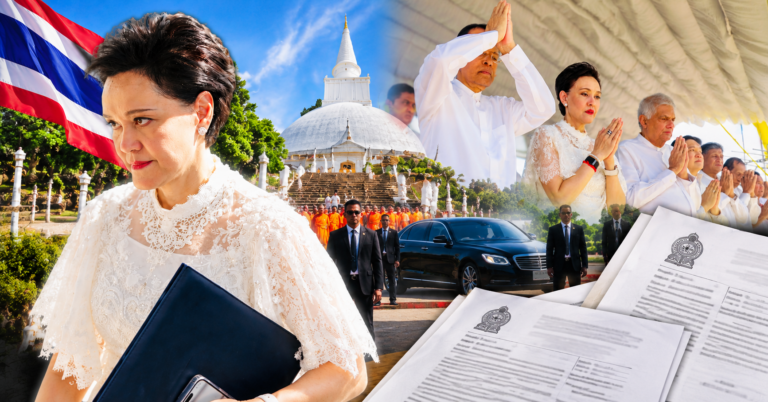

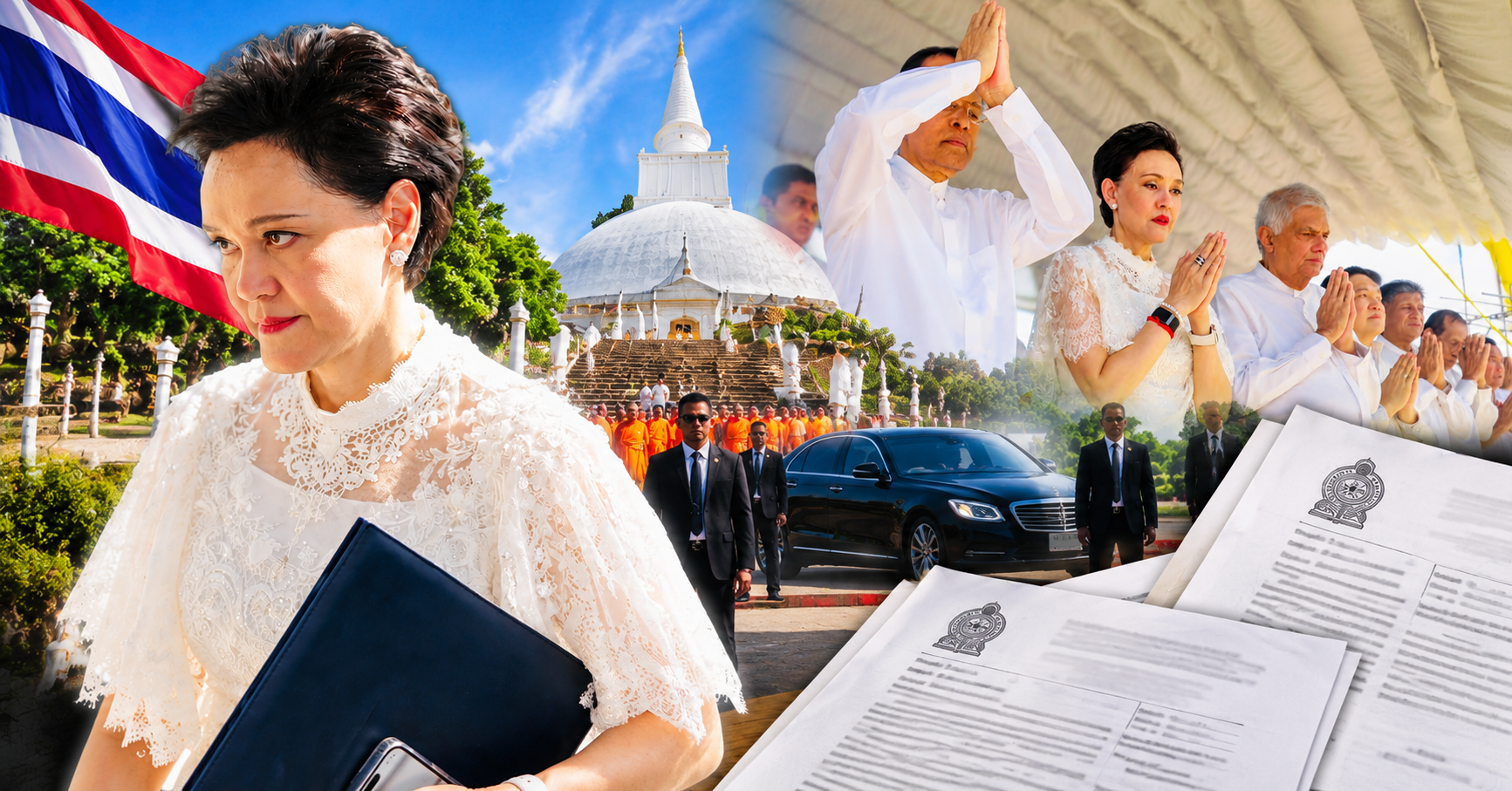
Royal Thai Embassy notified Sri Lanka 47 days in advance; Presidential Secretariat requested protocol and VIP facilities weeks before the visit. Questions remain over the reception and security arrangements provided to Thailand’s Deputy Prime Minister Suphajee Suthumpun during her visit to Mihintale.
SPECIAL INVESTIGATIVE REPORT | COLOMBO, SRI LANKA | OCTOBER 20, 2026
A controversy has emerged over the Sri Lankan government’s handling of a visit by Thailand’s Deputy Prime Minister and Minister of Commerce, Suphajee Suthumpun, who travelled to the historic Buddhist site of Mihintale on October 18, 2026, to participate in a religious ceremony commemorating the 2,286th anniversary of the Parinibbana of Arahant Mahinda Thero.
A collection of official correspondence obtained for this investigation reveals that Sri Lankan authorities had been formally notified of the Thai delegation’s visit well in advance and that the Presidential Secretariat had specifically requested diplomatic protocol assistance, airport courtesies and VIP facilitation.
The documents include communications from the Royal Thai Embassy in Colombo, the Presidential Secretariat, the Ministry of Buddhasasana, Religious and Cultural Affairs, the Anuradhapura District Secretariat and the Mihintale Rajamaha Viharaya.
Together, they establish a documented timeline of preparations extending from July through September 2026.
However, questions have arisen over whether the arrangements requested by senior government officials were fully implemented when the Thai Deputy Prime Minister arrived in Sri Lanka.
The controversy has prompted criticism of the National People’s Power (NPP) administration’s handling of diplomatic protocol and its coordination of high-level foreign visits.
While critics have alleged that the visiting Thai dignitary was denied an appropriate diplomatic reception and security arrangements, the available documents do not independently establish that no such facilities were provided.
Royal Thai Embassy Gave 47 Days’ Advance Notice
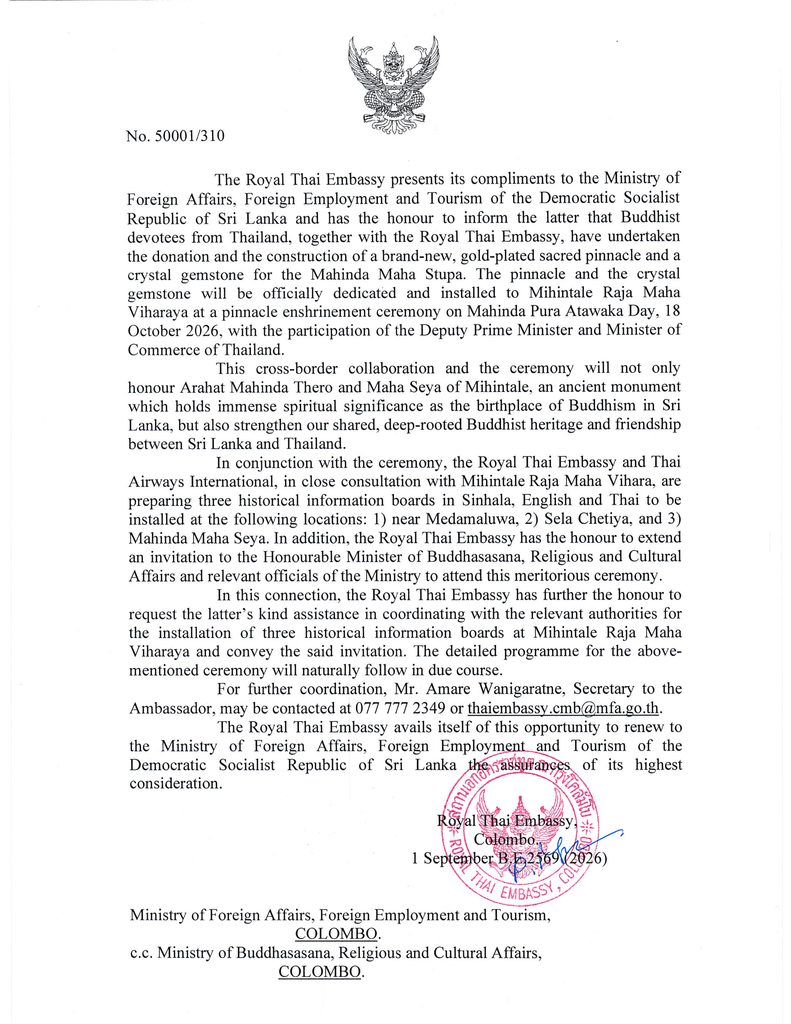
One of the most significant documents is a diplomatic note issued by the Royal Thai Embassy in Colombo on September 1, 2026, bearing reference number 50001/310.
Addressed to Sri Lanka’s Ministry of Foreign Affairs, Foreign Employment and Tourism, the communication formally informed the government that Buddhist devotees from Thailand, together with the Royal Thai Embassy, had undertaken the donation and construction of a gold-plated sacred pinnacle and a crystal gemstone for the Mahinda Maha Stupa at Mihintale.
The embassy stated that the religious ceremony would take place on October 18, 2026, with the participation of Thailand’s Deputy Prime Minister and Minister of Commerce.
The diplomatic note specifically described the significance of the occasion:
“This cross-border collaboration and the ceremony will not only honour Arahat Mahinda Thero and Maha Seya of Mihintale … but also strengthen our shared, deep-rooted Buddhist heritage and friendship between Sri Lanka and Thailand.”
The embassy also informed the Sri Lankan authorities that three historical information boards would be installed at Mihintale in Sinhala, English and Thai.
These were intended for locations near Medamaluwa, Sela Chetiya and Mahinda Maha Seya.
The Royal Thai Embassy further requested assistance in coordinating with the relevant authorities and extended an invitation to the Minister of Buddhasasana, Religious and Cultural Affairs and ministry officials.
The significance of this correspondence is clear: the Sri Lankan government received formal diplomatic notification of the Deputy Prime Minister’s intended participation 47 days before the scheduled ceremony.
Consequently, any suggestion that the authorities were unaware of her expected attendance would need to be reconciled with this diplomatic communication.
Presidential Secretariat Requested VIP and Protocol Facilities
An even more consequential document was issued by the Presidential Secretariat on September 24, 2026.
Bearing reference number PS/ADA/S.Addl.Sec/04/2026, the letter was addressed to the Secretary of the Ministry of Foreign Affairs, Foreign Employment and Tourism.
Its subject was explicitly stated as:
“Provision of Protocol and VIP Facilitation for the Visiting Thai Delegation.”
The letter, signed by G.G.S.C. Roshan, Senior Additional Secretary to the President, on behalf of the Secretary to the President, referred to religious observances scheduled for October 18.
It also noted that approximately 200 participants from Thailand were expected to attend, alongside senior Buddhist religious dignitaries.
Most importantly, the Presidential Secretariat requested the Foreign Ministry to coordinate arrangements for appropriate protocol assistance, airport courtesies and VIP facilitation at Bandaranaike International Airport upon the delegation’s arrival and departure.
The Anuradhapura District Secretary, Ranjith Wimalasooriya, was identified as the designated focal point for coordinating these arrangements.
Copies of the letter were also directed to the Chief of Protocol at the Foreign Ministry and the relevant management at Bandaranaike International Airport.
This communication establishes that the Presidential Secretariat itself recognised the need for formal arrangements for the visiting delegation.
It also raises a legitimate question: What specific measures were subsequently taken to implement the Presidential Secretariat’s instructions?
Although the letter establishes that arrangements were requested, it does not by itself demonstrate whether they were subsequently delivered or withheld.
Ministry Correspondence Confirms Extensive Government Coordination
Additional documents from the Ministry of Buddhasasana, Religious and Cultural Affairs reveal that the ceremony was the subject of several rounds of official communication.
Letters dated September 4, September 11, September 18 and September 19 refer to preparations for the donation and installation of the sacred pinnacle and gemstone at the Mahinda Maha Stupa.
The correspondence involved the Anuradhapura District Secretariat, the Mihintale Divisional Secretariat and relevant government authorities.
An earlier letter from the Anuradhapura District Secretariat, dated September 2, 2026, also addressed arrangements for the ceremony.
Further correspondence from the Mihintale Rajamaha Viharaya, including letters dated July 28 and August 18, established the religious and historical importance of the event.
The August 18 letter from the temple authorities requested official coordination for the ceremony and outlined arrangements for the participation of religious dignitaries and the visiting Thai delegation.
These records demonstrate that the event was neither unexpected nor organised without the knowledge of the relevant government institutions.
Rather, multiple branches of the Sri Lankan administration had been involved in preparations over several weeks.
Nevertheless, coordination of a religious ceremony does not automatically mean that a foreign dignitary’s attendance constitutes an official state visit.
That distinction is central to the government’s subsequent explanation.
Foreign Ministry Rejects Allegations of Diplomatic Neglect
The Ministry of Foreign Affairs has disputed allegations that the Thai Deputy Prime Minister was denied appropriate diplomatic facilities.
In its explanation issued on October 19, the ministry stated that Suphajee Suthumpun had travelled to Sri Lanka on a private visit to attend the religious ceremony.
According to the ministry, she was not accompanied by other Thai government officials in an official delegation.
The ministry also maintained that the VIP lounge and other requested courtesy facilities had been provided by the Sri Lankan authorities.
This official position is important because it directly contradicts claims that no diplomatic reception or VIP arrangements were extended.
However, the explanation leaves questions about the precise nature of the arrangements made, particularly regarding security coordination and the implementation of the Presidential Secretariat’s earlier request.
The distinction between an official and private visit may determine the level of ceremonial reception required, but it does not necessarily eliminate the need to assess appropriate security arrangements for a serving senior foreign government official.
Whether such an assessment was undertaken, and what arrangements resulted from it, has not been established by the documents examined.
A Missed Opportunity for Sri Lanka–Thailand Relations?
The visit carried significance beyond the religious ceremony itself.
Sri Lanka and Thailand share longstanding Theravada Buddhist traditions, including historical exchanges that have influenced the development and preservation of Buddhism in both countries.
Mihintale occupies a particularly important place in Sri Lankan Buddhist history as the site traditionally associated with the introduction of Buddhism to the island by Arahant Mahinda Thero.
The participation of a senior Thai political figure in a ceremony at this location therefore represented an opportunity to reinforce cultural and religious ties.
Suphajee Suthumpun’s position as Thailand’s Minister of Commerce also gave the visit potential relevance to bilateral economic relations.
Thailand is an important regional economy, and cooperation in trade, tourism, investment and cultural exchanges remains relevant to Sri Lanka’s international economic engagement.
However, the documents reviewed do not establish that formal bilateral meetings or commercial discussions were requested or scheduled during this particular visit.
It would therefore be speculative to conclude that a specific diplomatic or economic opportunity was lost.
Nevertheless, the controversy raises broader questions about how Sri Lanka identifies and manages opportunities arising from visits by senior foreign officials, including those travelling in a private capacity.
Seven Questions the Government Should Answer
The documentary record and the Foreign Ministry’s subsequent explanation leave several matters requiring clarification:
1. Implementation of Presidential Instructions: Which specific protocol and VIP facilities requested by the Presidential Secretariat on September 24 were provided to the visiting Thai delegation?
2. Airport Reception: Which Sri Lankan officials, if any, were assigned to receive Deputy Prime Minister Suphajee Suthumpun upon her arrival at Bandaranaike International Airport?
3. Security Arrangements: Were special security assessments or protective arrangements made for her travel between the airport and Mihintale?
4. Classification of the Visit: What formal communication established that the Deputy Prime Minister’s visit was private rather than official?
5. Diplomatic Coordination: Did the Foreign Ministry’s Protocol Division consult the Royal Thai Embassy regarding the level of reception and security appropriate for the visit?
6. Interagency Responsibility: How were responsibilities divided among the Presidential Secretariat, Foreign Ministry, Ministry of Buddhasasana and local administrative authorities?
7. Official Documentation: Will the government disclose relevant records confirming which facilities were requested, approved and ultimately provided?
Answers to these questions would help establish whether the controversy reflects a genuine administrative failure, a disagreement over diplomatic expectations or a misunderstanding of the arrangements actually implemented.
NPP Government Faces Questions Over Diplomatic Coordination
The controversy has provided opposition critics with an opportunity to question the NPP administration’s approach to diplomatic engagement.
Critics argue that the visit of a serving Deputy Prime Minister from a country with longstanding religious and cultural ties to Sri Lanka should have been handled with particular care, irrespective of whether it was officially classified as private.
They also point to the Presidential Secretariat’s September 24 letter as evidence that the need for protocol assistance had been identified at the highest administrative level.
However, the existence of that request does not establish that the government failed to comply with it.
The Foreign Ministry maintains that the requested VIP facilities were provided, and the available correspondence does not independently disprove that assertion.
The central issue is therefore not simply whether a formal state welcome was organised, but whether the arrangements actually delivered were consistent with the visit’s classification, the requests of the Thai authorities and the security requirements of the visiting dignitary.
A transparent account of those arrangements would allow the government’s handling of the visit to be assessed on documented facts rather than competing political allegations.
Conclusion: Advance Notice Was Clear, but Full Implementation Remains to Be Established
The documents examined in this investigation establish several important facts.
The Royal Thai Embassy formally informed Sri Lanka’s Foreign Ministry on September 1 that Thailand’s Deputy Prime Minister and Minister of Commerce would participate in the October 18 religious ceremony.
The Presidential Secretariat subsequently requested appropriate diplomatic protocol and VIP facilities on September 24.
Multiple government institutions had also been involved in coordinating preparations for the Mihintale ceremony.
These records demonstrate that the visit was known to the Sri Lankan authorities well in advance.
What remains less clear is the full extent of the reception, security and protocol arrangements implemented on the day.
The Foreign Ministry has maintained that requested VIP facilities were provided, while critics have challenged the adequacy of the government’s handling of the visit.
The decisive question is whether the Sri Lankan authorities implemented the arrangements they had been asked to coordinate, and whether those arrangements were appropriate for a serving Deputy Prime Minister of a longstanding regional partner.
The release of the relevant protocol and administrative records would help resolve that question.
For an administration facing scrutiny over its management of international relations, providing a clear, documented explanation would serve both public accountability and Sri Lanka’s diplomatic relationship with Thailand.
About the Author