
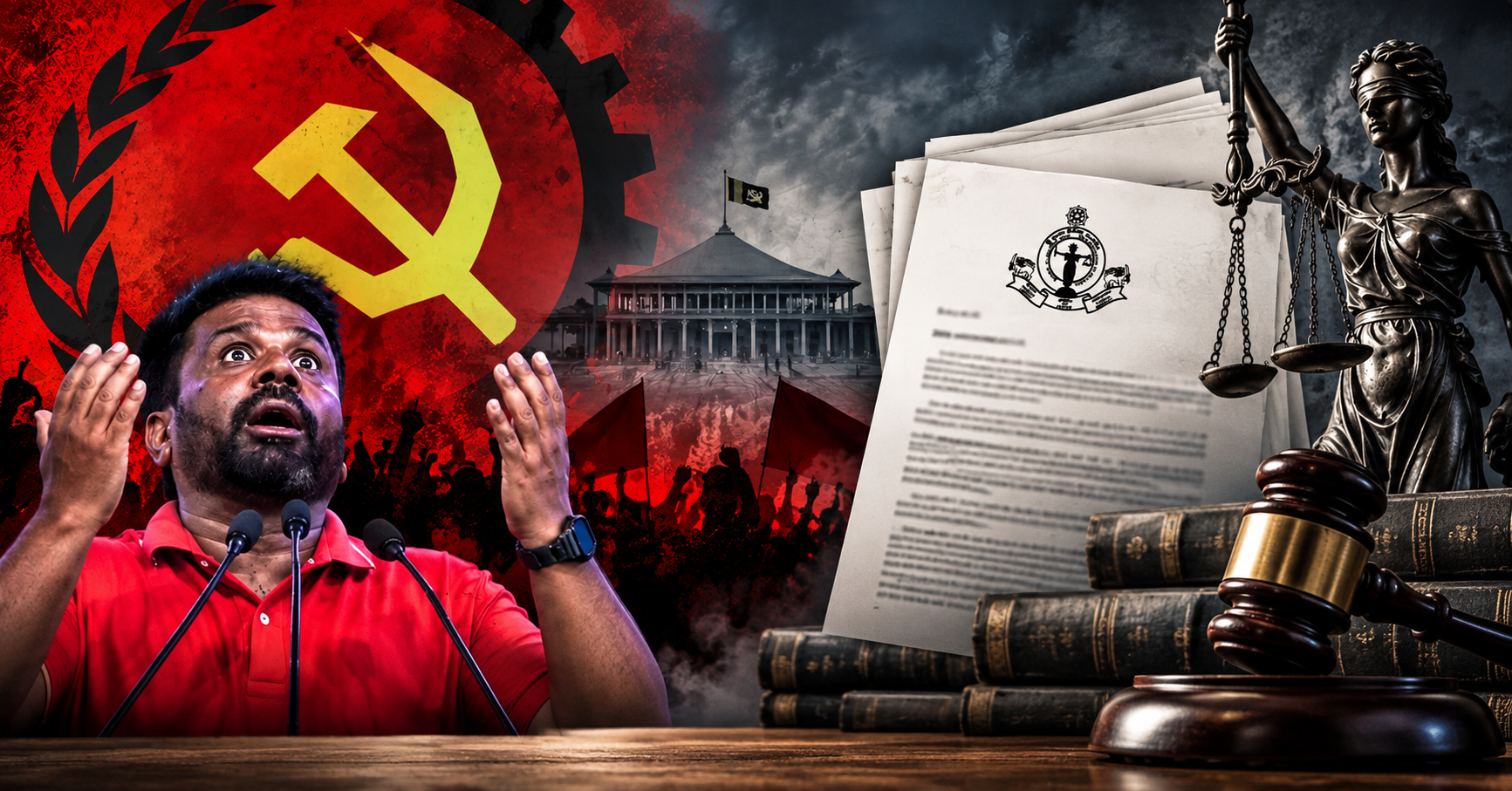
The Bar Association of Sri Lanka (BASL) issued a special statement on October 21, 2026, raising serious concerns about democracy, the rule of law, and the fundamental rights of citizens in Sri Lanka.
In its seven-page statement, the BASL expressed grave concern over two proposed pieces of legislation introduced by the Government: the Protection of the State from Terrorism Bill (PSTA) and the Organised Crime Bill (OCB).
The Association particularly highlighted the expansion of executive powers, the weakening of judicial oversight, potential restrictions on peaceful protests and freedom of expression, and the risk that vague legal definitions could bring ordinary citizens within the scope of criminal law.
This is no longer merely a legal debate over two proposed laws. It has become a fundamental question concerning Sri Lanka’s democratic future and the civil liberties of its people.
Seven Major Concerns Raised in the Statement
1. Risk of Curtailing Judicial Powers
The BASL warns that the PSTA could weaken independent judicial oversight of arrests, detention, and executive decisions.
2. Detention Without Judicial Approval
The Association raises serious concerns about granting the executive authority to issue detention orders, potentially undermining personal liberty.
3. Risk of Peaceful Protests Being Classified as Terrorism
Broad and ambiguous definitions of terrorism could adversely affect lawful demonstrations, freedom of expression, and legitimate social activism.
4. Legal Risks for Individuals Not Directly Involved in Criminal Activities
The broad definitions of criminal groups under the Organised Crime Bill could expose individuals who have not directly participated in criminal offences to investigations and legal consequences.
5. Concerns Over Personal Relationships, Tattoos, and Online Activities
The BASL questions provisions allowing tattoos, personal associations, and online activities to be considered when determining membership in an organised criminal group. These characteristics do not, by themselves, constitute criminal offences.
6. Extensive Powers for the Police and Executive
The Association emphasises the need for effective judicial supervision over searches, arrests, measures affecting property, and powers to obtain information.
7. Threats to Fundamental Rights and the Rule of Law
The BASL expresses concern that certain provisions of both Bills may conflict with constitutionally guaranteed rights and the principles of the rule of law.
Full English Statement
21 October 2026
The Government of Sri Lanka has gazetted the Protection of the State from Terrorism Bill (PSTA), followed by the Organised Crime Bill (OCB). Both Bills have subsequently been placed on the Order Paper of Parliament.
Although these Bills have been presented as legal reforms, the Bar Association of Sri Lanka is concerned that, individually and collectively, they confer excessive powers on the executive in relation to arrest, detention and search; restrict judicial oversight at the very moments when the protection of personal liberty is most critical; and create criminal liability with potentially far-reaching consequences for freedom of association, expression and movement.
For these reasons, the Bar Association of Sri Lanka expresses its grave concern regarding the enactment of both Bills in their present form.
These Bills must be considered against the background of Sri Lanka’s historical experience.
The Prevention of Terrorism (Temporary Provisions) Act, No. 48 of 1979, as amended, was introduced as a temporary measure but has remained part of the legal framework for more than four decades.
Under successive governments, it has been used arbitrarily, not merely to address genuine threats to the State, but also to detain individuals for prolonged periods without trial and to suppress political opponents, activists, journalists, students and public dissent.
This conduct has not been confined to one government. It has occurred under successive administrations representing different political ideologies.
The experience of senior attorney-at-law Hejaaz Hizbullah, a member of the BASL, provides a clear example of how the Prevention of Terrorism Act has been implemented.
He was arrested on 14 April 2020 and detained under the PTA for 22 months (662 days) before being released on bail in February 2022.
He was held for approximately eighteen months before an indictment was filed.
His detention extended beyond even the maximum eighteen-month period permitted under detention orders under the PTA. When granting bail, the Court of Appeal observed that the law’s “extremely draconian features” had been abused.
Once such powers are granted, experience demonstrates how they may be exercised. Their use creates a chilling effect on lawyers, journalists, activists and ordinary citizens who might otherwise express their opinions freely.
The proposed PSTA, intended to replace the PTA, and the OCB must be examined against this background.
A law capable of being used legitimately may also be abused. In light of Sri Lanka’s experience, the BASL cannot dismiss the possibility that the same challenges and abuses may recur under new legislative names.
A democratic country that grants such powers to its police and executive risks becoming a police state.
In a country governed by the rule of law, one of the primary purposes of the law is to protect individuals from arbitrary State action.
This is why our criminal justice system has developed the presumption of innocence until guilt is proven, together with the general principle that bail should ordinarily be granted unless exceptional circumstances justify otherwise.
These are not merely technical legal principles. They are the safeguards through which police and executive power remain subject to the supervision of an independent judiciary.
Both Bills seek, in different ways, to undermine these principles.
Protection of the State from Terrorism Bill (PSTA)
The BASL participated in good faith in the consultation process for drafting the PSTA by nominating President’s Counsel Saliya Pieris and President’s Counsel Chanaka de Silva to the committee appointed to review the Prevention of Terrorism Act.
However, the gazetted Bill differs significantly from the draft approved by the committee.
The BASL’s representatives informed the Association that these changes had not been referred back to the committee before publication, nor had they been brought to the attention of its chairperson or members.
The principal changes that reduce judicial control over arrest and detention or expand executive authority are as follows.
Mandatory remand: The gazetted Bill makes it mandatory for a Magistrate to remand a suspect, substantially restricting the Magistrate’s discretion to assess the material against the suspect and determine whether remand is justified.
Restrictions on bail: Bail may be granted only by the High Court. In respect of offences punishable by life imprisonment, bail may be granted only in exceptional circumstances.
Combined with mandatory remand, these provisions create a risk of prolonged detention even where the evidence against a suspect is weak. Suspects would be compelled to seek remedies before the High Court, which may be more expensive and less accessible.
This risks perpetuating the adverse consequences already experienced under the PTA.
Extension of detention without judicial approval: The requirement to obtain a Magistrate’s approval to extend detention beyond the initial two-month period, which was included in the committee-approved draft, has been removed.
This weakens judicial oversight of the continued deprivation of personal liberty.
Restriction orders: The gazetted Bill provides for restriction orders to be reviewed through revision or judicial review proceedings before the High Court or Court of Appeal.
For a person whose movement and association have been restricted for up to three months, this represents a more difficult legal remedy in practice.
Proscription of organisations: The gazetted Bill concentrates the power to proscribe organisations in the President.
This departs from the committee’s framework, under which the Minister was required to have reasonable grounds for the relevant belief, while the authority to issue orders was vested in the President and the power of review remained with the Minister.
Expansion of offences, exemptions and executive powers: The Bill significantly expands the scope of offences and exemptions and permits the creation of criminal liability through subsidiary legislation and executive orders.
The definition of a “specified person” has been expanded to include members of Provincial Councils, thereby broadening the category of persons whose information may be treated as confidential and extending the reach of offences under the Bill.
Restrictions on protection for legal advice: The protection afforded to legal advice has been narrowed, potentially excluding advisory work undertaken by members of the BASL.
Furthermore, during the consultation process, one BASL representative expressed dissent regarding the definition of terrorism, administrative detention and the proscription of organisations.
In view of the significant departures from the committee-approved draft, and because neither the committee report nor the dissent expressed by the BASL representative had been made public, the BASL wrote to the Minister of Justice and National Integration, Harshana Nanayakkara, on 8 October 2026.
The Association drew attention to these concerns and requested that the changes be corrected, including through amendments at the committee stage.
The BASL specifically highlighted their implications for personal liberty, judicial oversight and fundamental rights.
However, as of 21 October 2026, no response had been received from the Ministry of Justice and National Integration.
The BASL therefore considers several provisions of the gazetted Bill vague and excessively broad, extending beyond what is necessary and proportionate to any legitimate objective.
Against this background, the BASL filed a petition before the Supreme Court seeking a special determination under Article 121 of the Constitution.
The Association contends that the provisions adversely affect fundamental rights and are inconsistent with constitutional guarantees under Articles 10, 11, 12, 13, 14 and 14A.
These include freedom of expression, assembly, association and movement; protection from torture and cruel treatment; equality before the law; protection against arbitrary arrest and detention; and the right to information.
The BASL further contends that the provisions are inconsistent with Article 4(d), read together with Article 3 of the Constitution.
It also argues that the proposed restrictions fail to satisfy the permissible limitations on the exercise of fundamental rights under Article 15 of the Constitution.
In these proceedings, the Supreme Court’s jurisdiction is limited to determining whether a Bill or any of its provisions is inconsistent with the Constitution.
Its jurisdiction does not extend to deciding whether a Bill is wise, necessary or justified as a matter of public policy.
Accordingly, the policy decision as to whether the Bill and its particularly severe provisions are genuinely necessary remains with the Government.
Organised Crime Bill (OCB)
The Organised Crime Bill has been presented as legislation intended to implement the United Nations Convention against Transnational Organized Crime and protect society from organised criminal groups.
While the BASL recognises the need to address organised crime, it points out that no public consultation was conducted during the drafting of the Bill.
In particular, the BASL was neither consulted nor informed about the drafting of such legislation.
The composition of the committee responsible for preparing the Bill has also not been disclosed to the public.
The Organised Crime Bill Seeks to Establish a Parallel System of Control
The OCB classifies all offences punishable by imprisonment for four years or more, together with approximately 50 offences listed in its First Schedule, as “serious crimes”.
These include copyright and trademark infringements, excise and forest conservation offences, and gambling licensing offences.
Where such an offence is committed by a member of an “organised criminal group”, the extraordinary powers contained in the Bill become applicable.
An organised criminal group is defined as a structured group of three or more persons acting together to obtain a financial or other material benefit.
Such a group is not required to have a hierarchy of roles, continuity of membership or a developed organisational structure.
These provisions appear to extend considerably beyond what is necessary to combat organised crime.
Consequently, a person accused of committing such an offence may be prosecuted under ordinary law, where the presumption of innocence applies and bail is generally available.
Alternatively, the same person may be arrested and detained under a detention order issued by the Secretary to the Ministry responsible for the Sri Lanka Police.
A Magistrate is required to give effect to such an order.
Detention may be authorised for periods of up to two months at a time, extending to a maximum of one year, while bail may be granted only by the High Court.
At no stage before the detention order is issued does a court determine whether detention is necessary.
As a result, the OCB seeks to bypass the ordinary judicial process in relation to arrest and detention for an exceptionally broad range of offences.
The extensive reach of the OCB is illustrated by its treatment of intellectual property offences.
Copyright infringement is already comprehensively addressed under the Intellectual Property Act, No. 36 of 2003.
Nevertheless, under the OCB, even a minor copyright infringement is classified as a “serious crime” and may be prosecuted as organised crime.
Consider, for example, a five-member amateur musical band performing popular songs at a restaurant without prior permission from the songwriter or recording company.
On a literal interpretation of the Bill, the band constitutes a structured group of three or more persons acting together for financial benefit, while the unauthorised performance constitutes a copyright-related offence listed in the First Schedule.
Its members could therefore be arrested and detained for up to one year under a detention order issued by the Secretary.
Their musical instruments and equipment could also be subject to confiscation.
Few people would regard such a musical band as an organised criminal group. Yet the Bill contains nothing that would prevent such an outcome.
Liability Based on Association and Appearance
The OCB also permits courts to consider factors unrelated to criminal conduct when determining whether a person is a “member” of an organised criminal group.
These include clothing styles, hand signals, language used, tattoos, associations with known members, participation in physical or virtual meetings, and visits to particular locations.
The list is open-ended.
Consequently, a young person with tattoos or long hair who spends time with friends wearing similar clothing could potentially have those characteristics used as evidence of membership in an organised criminal group.
Evidence of offences previously committed together with group members is also made admissible for this purpose.
These risks are particularly serious for young people and marginalised communities.
Protests, Trade Unions and Civil Society
Depending on how its provisions are interpreted, the Bill could also affect peaceful protests, trade union activities and civil society organisations.
The First Schedule includes offences under the Penal Code that may arise in the context of public demonstrations.
These include obstructing a public officer in the discharge of official duties and using criminal force to deter a public officer from performing official functions.
A group that organises a protest, meets virtually and acts collectively could therefore become subject to the extraordinary powers contained in the Bill.
Presumption of Innocence and the Right to a Fair Trial
The Bill removes existing restrictions on the admissibility of confessions made to police officers.
It permits statements signed by an accused person while in police custody to be admitted as evidence against that person.
Where an offence is committed by a company, a director may be required to establish, on a balance of probabilities, that the offence occurred without their knowledge or that they exercised due diligence.
The Bill also excludes persons convicted under its provisions from eligibility for any early-release scheme.
These provisions undermine the presumption of innocence.
When combined with the proposed detention powers, they represent an expansion of State authority that threatens freedom of association, freedom of movement and personal liberty.
Sri Lanka’s experience under the Prevention of Terrorism Act demonstrates the dangers of granting extensive arrest and detention powers without effective judicial oversight.
These concerns must be assessed not merely by examining individual provisions, but by considering the cumulative effect of the powers granted and the inadequacy of safeguards against their abuse.
Particularly in light of the manner in which the PTA has been implemented, it cannot be ruled out that the OCB could also be used as an instrument to suppress public dissent and legitimate protests.
Granting such arbitrary powers risks reproducing the same challenges and abuses associated with the PTA, including its chilling effect on dissent, freedom of association and lawful livelihoods.
Legislation introduced to combat organised crime must not become an instrument of a police state.
Its introduction must not undermine the principles of legality, due process, judicial independence and the rule of law, which are essential to a democratic society.
Position of the Bar Association of Sri Lanka
The BASL recognises the State’s responsibility to protect the public from terrorism and serious organised crime.
However, these legitimate objectives cannot justify weakening constitutional safeguards or concentrating powers that permit the deprivation of personal liberty without effective and timely judicial oversight.
The State’s powers of arrest, detention, investigation and prosecution must remain subject to the Constitution, the rule of law and the safeguards of due process.
The judiciary must remain central to decisions affecting personal liberty, rather than being reduced to an institution that merely implements decisions taken by the executive.
Judicial oversight, procedural fairness and the principles of natural justice are essential safeguards against arbitrary State action.
Sri Lanka has experienced the consequences of their absence far too often.
The BASL Therefore Calls Upon the Government To:
1. Withdraw the Protection of the State from Terrorism Bill in its present form.
If the Bill is to proceed, the Government must restore the safeguards contained in the committee-approved draft, including through amendments at the committee stage.
2. Publish the committee report and the dissenting views expressed during the consultation process.
The Government must explain the basis on which the gazetted Bill departed from the committee-approved draft and identify whose advice led to those changes.
3. Withdraw the Organised Crime Bill.
Any alternative legislation must be subjected to full and meaningful public consultation, including consultation with the Bar Association of Sri Lanka.
Its scope must be confined to organised crime in accordance with the relevant Convention.
The powers of arrest, remand, detention and search must remain subject to effective judicial authority and supervision.
4. Repeal the Prevention of Terrorism (Temporary Provisions) Act without delay.
This must be done in recognition of the need to protect fundamental rights and ensure that the criminal justice system operates in accordance with constitutional principles and the rule of law.
The BASL will continue to present its position before the Government, Parliament and the Supreme Court.
In keeping with its commitment to upholding the rule of law, protecting fundamental rights and safeguarding constitutional democracy in Sri Lanka, the Association reserves its rights under Article 121 of the Constitution in relation to the Organised Crime Bill.
Signed:
Rajeev Amarasuriya President Bar Association of Sri Lanka
Nalin de Silva Secretary Bar Association of Sri Lanka
About the Author