
COLOMBO / SOUTH ASIA — As engineering student Saharat Chuaikaew troubleshoots a university database in Bangkok, his anxieties echo across the region — but nowhere more sharply than in Sri Lanka, where young graduates face one of the most punishing job markets in Asia.
Chuaikaew, weeks away from finishing his degree at King Mongkut University of Technology Thonburi (KMUTT), worries that artificial intelligence is erasing the entry‑level engineering roles that once offered a stable path into Thailand’s industrial workforce. “You don’t need the junior engineer to do the work,” he said. “It’s hard to find a job.”
For Sri Lanka’s youth, the situation is even more severe — shaped not only by global shocks but by years of domestic economic turmoil, fuel shortages, and a historic collapse in purchasing power.
Sri Lanka’s youth face the sharpest edge of Asia’s crisis
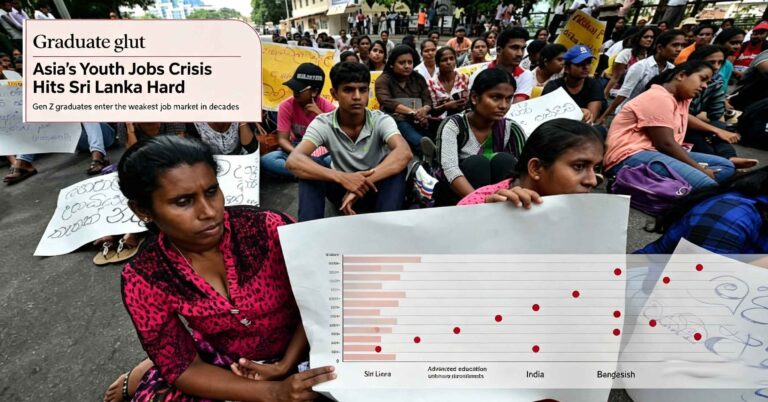
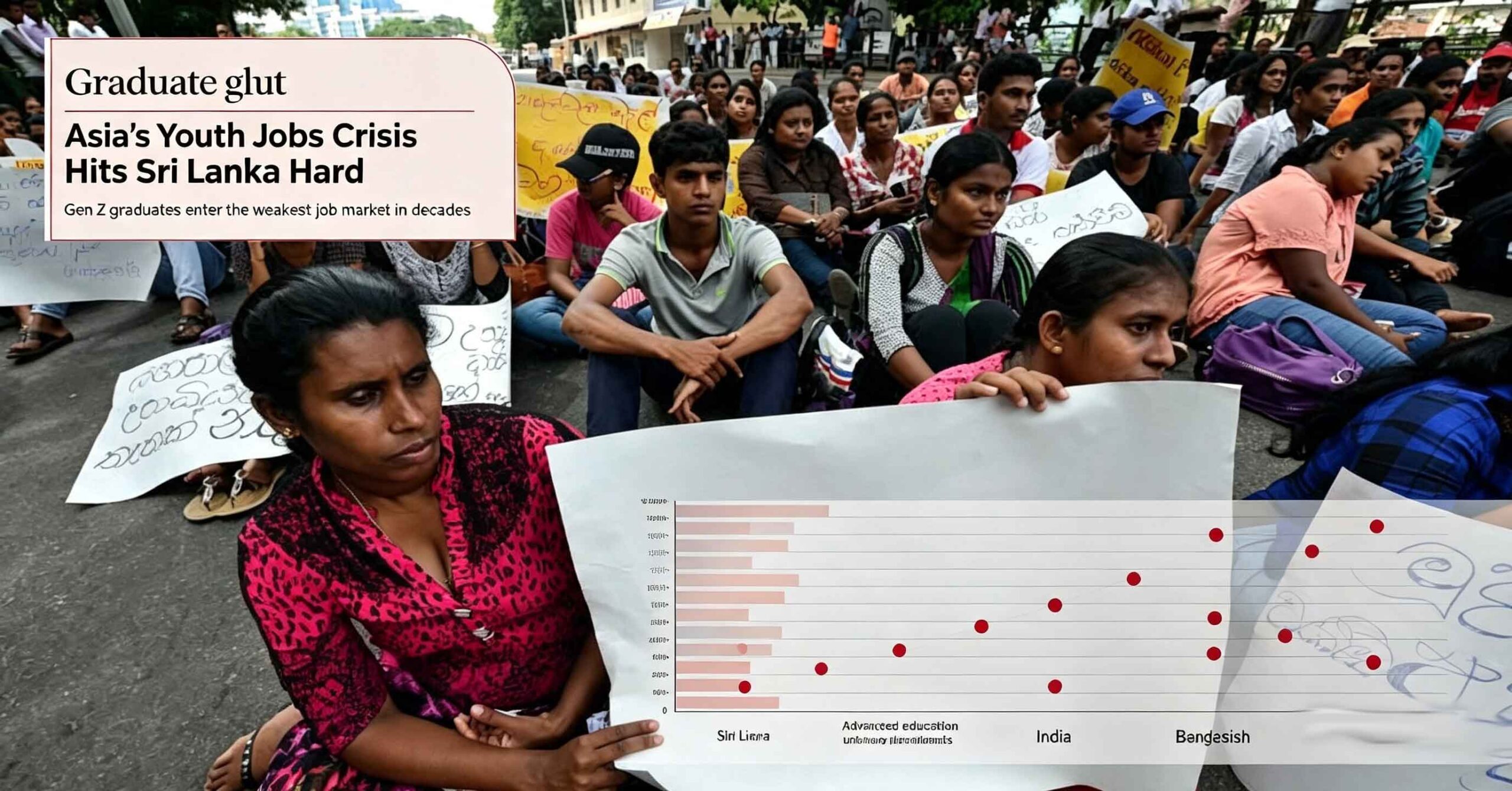
Across Asia, the World Bank estimates 1.2 billion young people will enter developing‑country labor markets over the next decade — the largest youth wave ever recorded. But Sri Lanka’s graduates are entering this historic cohort with some of the highest unemployment rates in the region, especially among those with advanced education.
IMF research shows:
- Sri Lanka’s unemployment rate among highly educated youth is about 43%
- One of the highest figures in South Asia
- Far above Thailand’s 13.2% and Indonesia’s rising graduate unemployment
This means Sri Lanka’s most qualified young people — engineers, accountants, IT graduates, and science majors — are the ones struggling most to find work.
The country’s recent economic crisis magnified the pressure. As Chuaikaew prepared to graduate in Thailand, Sri Lankan youth were:
- Working four‑day weeks under emergency fuel‑saving measures
- Queuing for petrol for hours during rationing
- Facing record inflation that wiped out purchasing power
- Watching job vacancies shrink as companies cut costs or closed entirely
For many Sri Lankan families, the promise of higher education no longer guarantees stability. Instead, it often leads to prolonged unemployment, underemployment, or migration.
A global slowdown meets Sri Lanka’s domestic shocks
Gen Z graduates across Asia are entering a global economy roughly one‑third weaker than the one their parents faced in the early 2000s. But Sri Lanka’s downturn has been deeper and more prolonged:
- The 2022 economic collapse triggered the worst inflation in the country’s history
- Fuel and electricity shortages disrupted transport, schooling, and industry
- Public sector hiring freezes left thousands of graduates without traditional pathways
- Private sector firms slashed recruitment amid currency volatility and debt restructuring
These pressures compound the global shocks — pandemic inflation, Russia’s invasion of Ukraine, and energy market volatility — that have strained households across Asia.
Sri Lanka is especially vulnerable because it relies heavily on imported fuel. Like Thailand, which sources 60% of its oil from the Persian Gulf, Sri Lanka’s energy security is tied to global shipping routes and geopolitical tensions.
Skill mismatch deepens frustration
The Philippines Commission on Higher Education warns that graduates increasingly dominate unemployment statistics — a trend mirrored in Sri Lanka.
“Even when job opportunities exist, there is a persistent mismatch between available and graduate skills,” said Chair Shirley Castañeda Agrupis.
Sri Lanka’s universities produce tens of thousands of graduates each year, but employers often cite gaps in digital literacy, English proficiency, and industry‑specific technical skills. Meanwhile, AI and automation accelerate the decline of traditional entry‑level roles.
A generation squeezed between AI and austerity
For young people in Sri Lanka, the crisis is not only about job scarcity — it is about the erosion of pathways that once defined upward mobility.
- AI reduces demand for junior technical roles
- Companies prefer experienced hires who can work with automation
- Public sector jobs — long seen as stable — have shrunk dramatically
- Migration has surged as graduates seek opportunities abroad
Sri Lanka’s youth are entering the largest global labor cohort in history — but with the fewest opportunities in decades.
A regional story with a Sri Lankan epicenter
Chuaikaew’s concerns in Thailand reflect a broader Asian anxiety. But Sri Lanka stands out as a case where global shocks collided with domestic crisis, producing one of the most challenging environments for young graduates anywhere in the region.
As Asia’s Gen Z steps into a turbulent labor market, Sri Lanka’s youth face a uniquely steep climb — one shaped by economic collapse, political upheaval, and a rapidly changing technological landscape.
Their struggle is not just to find jobs, but to rebuild confidence in a future that has become increasingly uncertain.
About the Author