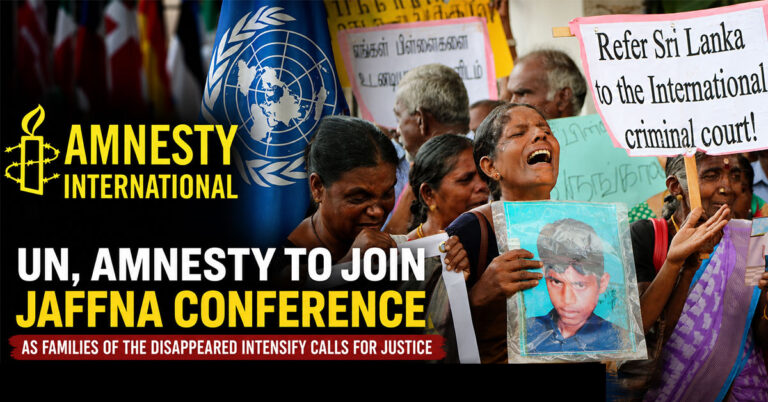

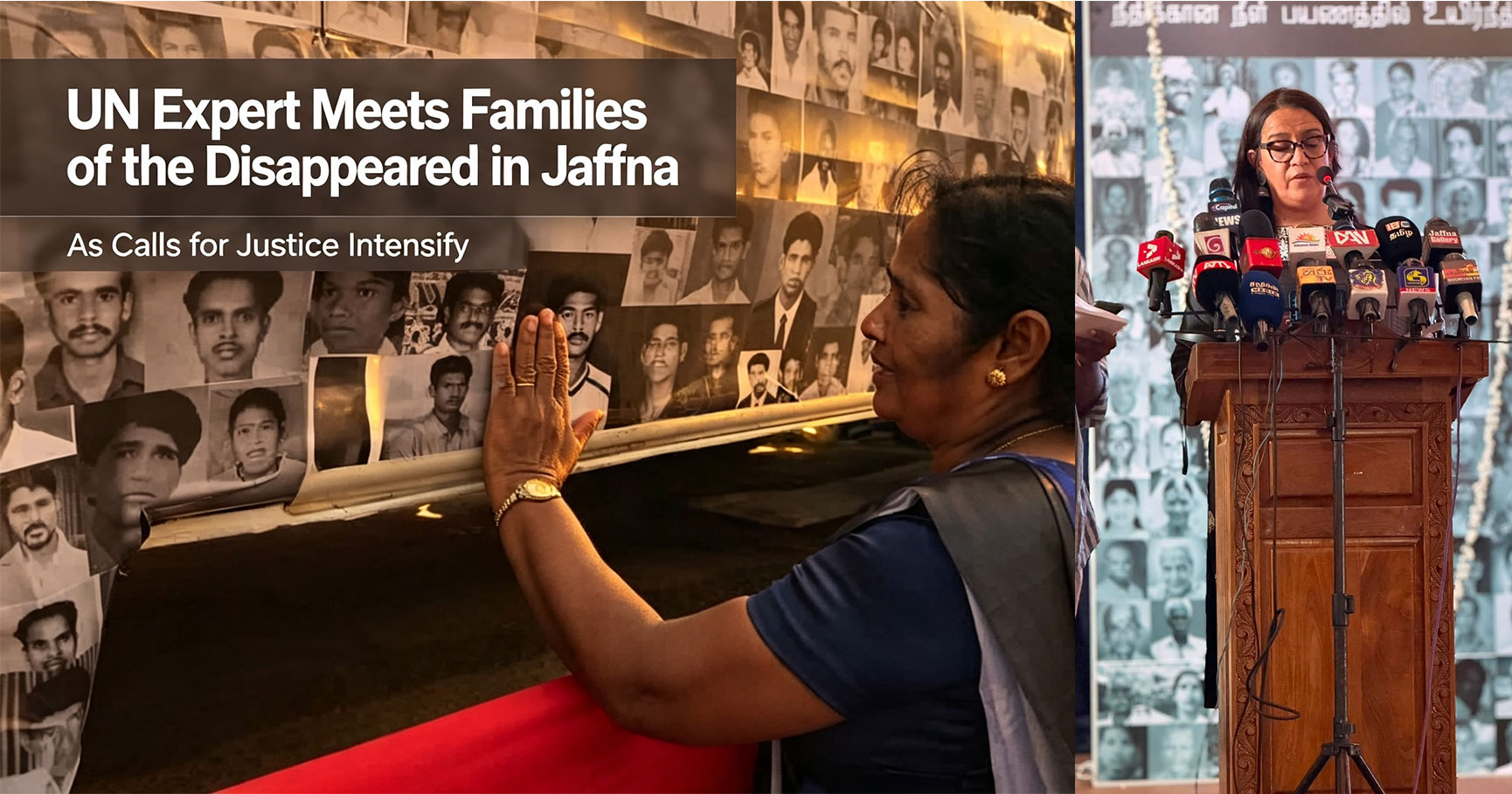
A United Nations expert on enforced disappearances met families of the forcibly disappeared in Jaffna today, as thousands of Tamil families continue a decades‑long struggle for truth, justice and accountability.
Ana Lorena Delgadillo Pérez, a member of the UN Working Group on Enforced or Involuntary Disappearances, was a key guest at the “Long Road to Justice” International Conference held at the Thanthai Selva Auditorium to mark the International Day of the Victims of Enforced Disappearances.
Before the conference commenced, relatives and participants gathered at the memorial for victims of the 1974 World Tamil Research Conference massacre, where they paid tribute to those killed. From there, participants marched to the auditorium, symbolically linking past atrocities with the ongoing struggle for answers about Sri Lanka’s disappeared.
A gathering of families, diplomats and activists
The event drew diplomatic representatives, families of the disappeared from across the Tamil homeland, political leaders, civil society activists and university students. Many attendees have spent years searching for relatives who vanished during Sri Lanka’s conflict — including those abducted, arrested, detained or who surrendered to the military and were never seen again.
Sri Lanka remains one of the countries with the highest numbers of enforced disappearances globally. It has the second‑highest number of cases registered with the UN Working Group, after Iraq. During its review of Sri Lanka last year, the UN Committee on Enforced Disappearances noted that the Office on Missing Persons (OMP) had received 16,966 complaints, but had traced only 23 individuals.
Behind those stark figures are families who have spent decades seeking answers from institutions that have repeatedly failed to deliver truth or accountability.
A struggle carried by mothers and relatives
Across the Tamil homeland, mothers and relatives of the disappeared have held continuous roadside protests for years, demanding to know what happened to their children. Some have died without ever receiving an answer. Others continue their struggle despite surveillance, harassment and intimidation.
Successive governments have established commissions and offices to address disappearances, but families say these mechanisms lack independence, credibility and political will. The OMP, created as a permanent state institution, has been widely criticised for failing to investigate the role of security forces or deliver meaningful accountability.
International human rights organisations have echoed these concerns. Human Rights Watch warned last year that Sri Lanka has one of the world’s highest rates of enforced disappearances and that successive governments have refused for decades to reveal the fate of victims or prosecute those responsible.
“Justice cannot be left to the state alone”
Families of the disappeared say justice cannot be entrusted solely to a state that has repeatedly failed to investigate its own military and political leadership. They reject attempts to treat enforced disappearance as a historical issue resolved through compensation, death certificates or administrative processes.
At today’s conference, families documented the history of their struggle, preserving testimonies of those who disappeared and of the mothers who refused to stop searching for them. Organisers said the event aimed not only to commemorate victims, but to reaffirm that the fight for truth and justice remains ongoing — and international engagement is essential.
About the Author