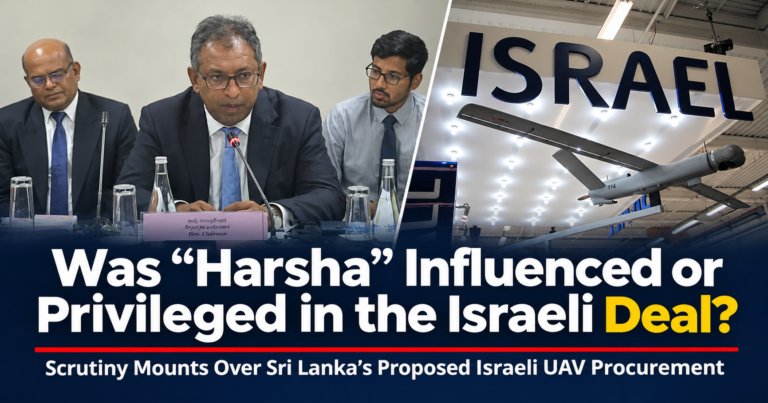

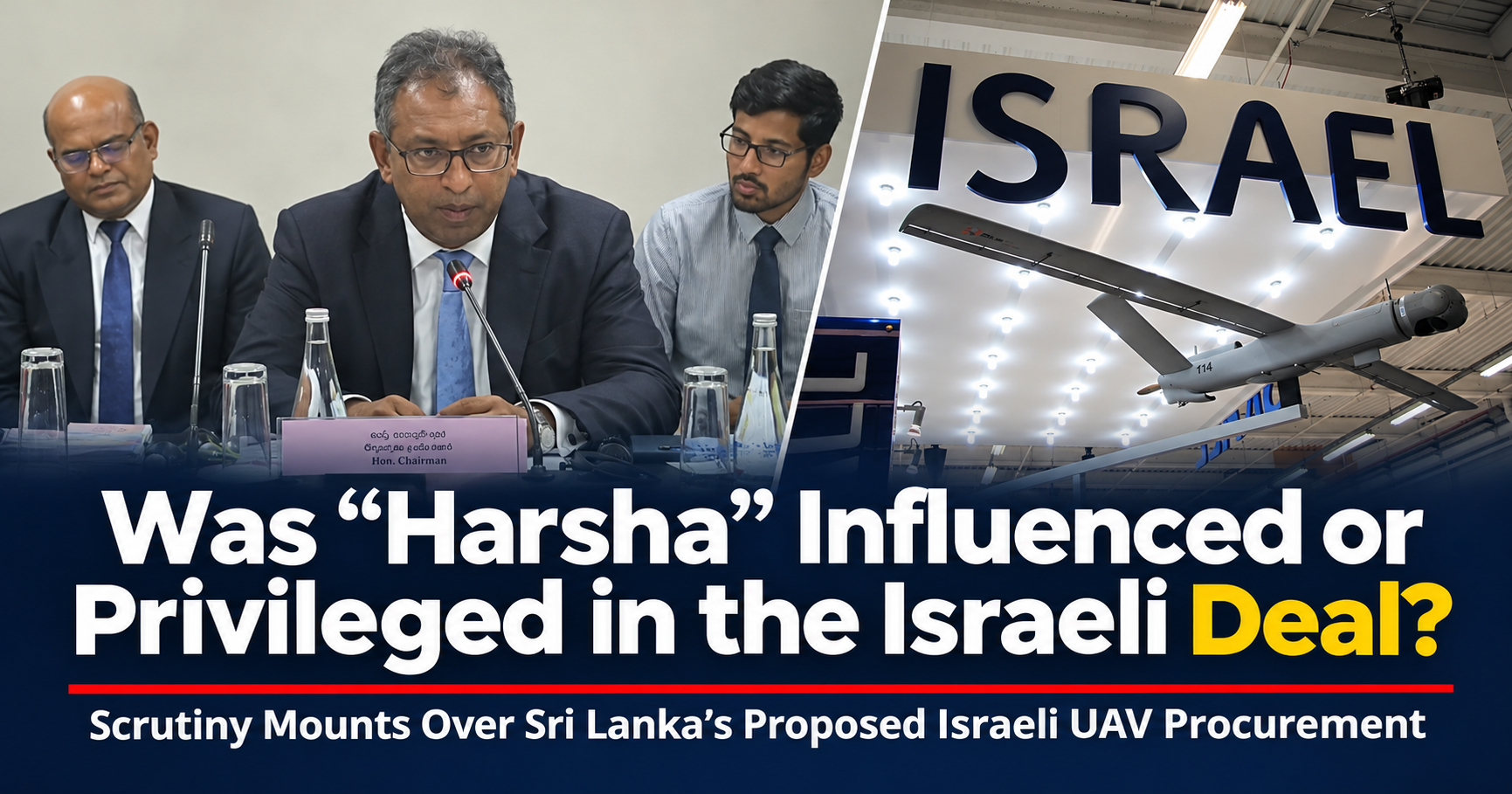
The process leading to the signing of an agreement between the Sri Lankan and Israeli governments—through BlueBird Aero Systems, a company in which Israel Aerospace Industries (IAI), an Israeli aerospace and defence technology company, holds a shareholding—for the “collection of intelligence from countries in the Asian region under an urgent requirement” has reached a controversial stage.
Accordingly, our defence correspondent stated that Harsha de Silva, who intervened in his capacity as Chairman of the Parliamentary Committee on Public Finance and as a person responsible for budgetary and financial scrutiny, had acted under some form of influence or privilege. He stated that this may have been pressure exerted through the party leadership or may have resulted from Harsha’s very close relationship with the United States.
The Parliamentary Proceedings report dated November 4, 2026, states that Harsha de Silva, as Chairman of the Committee on Public Finance, presented the committee’s report on a provision of Rs. 4,261 million for UAVs for the Sri Lanka Air Force under Supplementary Estimate No. 08 of 2026.
At that committee meeting, he discussed four main matters:
- Presiding over the committee discussion on the supplementary estimate;
- Examining the legal basis for the transfer of funds and the budgetary procedure;
- Questioning Air Force officials about the UAV system’s operational requirements, range, endurance, cost and use; and
- Considering whether a clear threshold would be needed for similar transfers of funds in the future.
But that is not the issue. There are matters that could raise suspicions about the conduct of Harsha de Silva as Chairman of the Committee on Public Finance.
They are as follows:
The committee discussion was convened quickly
It has been revealed that this matter was not part of the committee’s normal weekly responsibilities, that the discussion was convened at 8.00 a.m. that day at the request of a minister, that action was taken rapidly, and that the report was presented for parliamentary approval on the same day or within a very short period.
This gives rise to suspicion because it is unclear:
- Whether sufficient time was provided to consider defence expenditure of Rs. 4.261 billion;
- Whether written briefing papers were given to committee members in advance;
- Whether a decision was made solely on the basis of officials’ oral submissions; and
- Whether the procurement, technical evaluation and price-comparison documents were examined.
However, if there was a genuine urgent security requirement, convening a meeting at short notice is not automatically unlawful. The issue is whether that urgency was properly documented.
The boundary between financial approval and procurement approval
The main matter considered by Harsha de Silva’s committee was the supplementary estimate and the transfer of budget funds. However, it is unclear whether the selection of BlueBird/IAI, the G2G method, the decision not to call for tenders and the fairness of the price were examined at the same time.
The point of suspicion here is this:
Did Parliament approve the allocation of funds, or did that approval effectively become a procurement mandate for a specific supplier?
The Committee on Public Finance generally examines expenditure and financial control. It should not act as the final procurement committee. Therefore, the committee report should contain the following information:
- The authority responsible for selecting the supplier;
- The legal basis for direct procurement or the G2G arrangement;
- The technical evaluation;
- A market-price comparison;
- The status of Cabinet approval; and
- The status of the Attorney General’s review.
If the funds were approved without such information, there is a risk that financial approval could be used as procurement approval.
The nature of the chairman’s questioning
According to publicly available video recordings, Harsha de Silva mainly questioned the following matters:
- The transfer of funds from one capital allocation to another;
- Whether a limit or threshold was needed for such a transfer;
- The UAV system’s endurance, range and hourly operating cost;
- How it would be used for ISR and disaster relief; and
- Monitoring fishing boats from southern India.
This can be presented as a responsible examination. However, the matter that may raise suspicion is whether sufficient questions were asked about procurement integrity, given the greater attention paid to procedural questions concerning the transfer of funds and the operational benefits.
Was the “threshold” proposal useful in this transaction?
Harsha de Silva has proposed that there should be a threshold in the future for such capital-to-capital transfers of funds. This may be reasonable as a governance reform.
However, the political suspicion that may arise is whether:
- The absence of a threshold was presented as a problem in order to expedite approval of this transaction;
- The introduction of a new threshold is an attempt to reduce parliamentary scrutiny;
- Special exemptions for defence transactions would be created when introducing a threshold; and
- It could be used in the future to keep large transfers of funds outside parliamentary scrutiny.
Therefore, although a threshold may be a good governance mechanism, it should not become a loophole that weakens parliamentary authority.
Harsha can now respond in his capacity as committee chairman. We have more information. Whether that information is released will depend on Harsha’s response.
Meanwhile, yesterday, the 14th, former minister Rauff Hakeem accused the government in Parliament while questioning it about this matter. He pointed out that making an “urgent” direct purchase without calling for tenders, suspicions regarding commissions, and the use of UAVs to collect intelligence about other countries were problematic issues.
During the debate, Hiruni Wijesinghe, a government representative described as a lawyer from “Puttalam,” mocked Hakeem’s statement and asked: “We do not have a procurement process from one government through another government… Is the former minister a baby?” The original statement uses disparaging language in describing her.
Parliament has approved the supplementary estimate for a UAV system valued at Rs. 4.261 billion. The Deputy Minister of Defence has described it as an “urgent purchase.”
The transaction is planned to be carried out through BlueBird Aero Systems. Official sources from both IAI and BlueBird confirm that Israel Aerospace Industries (IAI) holds a 50 percent shareholding in BlueBird.
The agreement requires a review by the Attorney General’s Department and Cabinet approval before it can be signed. The Sri Lankan government has officially informed the Israeli government that the signing is targeted for December.
“The government-to-government procurement process does not exist for us” is the main argument of the lawyer from the Malimawa movement who claims to be educated.
Accordingly, what she means is that the purchase will be made through a G2G arrangement without calling for tenders or using another normal competitive method.
Let us now examine how the supplementary estimate was approved
At a meeting of the Committee on Parliamentary Business chaired by the Speaker on November 4, 2026, it was decided that Supplementary Estimate No. 08 of 2026 would be taken up for debate and approval the following day. The estimate proposed allocating Rs. 4,261,000,000 to the Sri Lanka Air Force.
A parliamentary debate was held on November 5, 2026, from 11.30 a.m. to 5.00 p.m. The official parliamentary record states that Supplementary Estimate No. 08 of 2026 was approved thereafter. The proposal was structured so that the funds could be obtained from the Consolidated Fund, another government fund or government borrowing.
The official record does not state whether a vote was held, how many votes were cast, or how many members voted for or against the proposal. It merely states that it was “approved after the debate.”
Accordingly, in relation to the UAV transaction, the parliamentary record states only that the supplementary estimate of Rs. 4.261 billion was approved after the debate on November 5. It does not describe the full G2G procurement process or any exemption from tendering. According to government statements, the agreement was to be reviewed by the Attorney General’s Department and subsequently submitted to the Cabinet.
The date on which Cabinet approval was granted
During the parliamentary debate on November 5, the Deputy Minister of Defence stated that, after parliamentary approval, the agreement would be reviewed by the Attorney General’s Department and then submitted to the Cabinet.
Accordingly, as of November 14, 2026, no specific date on which Cabinet approval was granted for the final UAV purchase agreement had been found in a publicly available official source. As of November 14, 2026, there was no public document that could confirm the exact date of that Cabinet approval.
“The educated lawyer from Puttalam says that we do not have a procurement process from one government to another.”
If interpreted, this means: “A normal tender or competitive procurement process does not apply to a G2G purchase conducted from one government to another.”
What she is saying is that, instead of the usual method of requesting quotations from several private companies, calling for tenders and making a selection, a G2G transaction is carried out through a separate method. In other words, the supplier is selected on the basis of an official agreement between the Sri Lankan government and a foreign government.
However, the use of the words “there is no procurement process” in this statement may be legally very broad and misleading. Even in a G2G transaction, public-procurement steps such as identifying requirements, technical evaluation, assessing price/value for money, obtaining approvals, review by the Attorney General’s Department, examining the contract and controlling payments should still apply. The question is why an ordinary open tender was not held and what official method was used instead. The original text also includes a political insult concerning Anura and 159 others, alleging that they will eventually go to prison.
What is it that Hiruni, who speaks loudly and is described in the original text with a derogatory reference to her background, does not know?
The G2G method should generally be justified as a special or direct purchase within the government procurement framework.
The Constitution
Articles 148–151 of the Constitution of Sri Lanka relate to the control of public finance.
- Article 148: Parliament has full control over public finance.
- Article 149: Public money not allocated for a specific purpose is credited to the Consolidated Fund.
- Article 150: Money may not be withdrawn from the Consolidated Fund unless authorised by Parliament or by law.
- Article 151: The Contingencies Fund may be used for urgent and unforeseen expenditure, after which a supplementary estimate must be submitted to Parliament.
According to Parliament’s official explanation, parliamentary approval for the allocation of funds is not the same as approval of a purchase contract. It grants financial authority to spend the money.
Public Financial Management Act, No. 44 of 2024
Although this Act does not specifically use the term “G2G” for a G2G transaction, it sets out important control requirements relevant to such a transaction.
Section 26 — Supplementary estimates
A supplementary estimate for additional expenditure may be submitted to Parliament when:
- An unforeseen and unavoidable situation has arisen;
- Additional expenditure not covered by the annual budget is required; and
- The expenditure cannot be provided through a virement, the Contingencies Fund or the annual budget reserve.
Under subsection 3 of that section, the Cabinet must approve the request for additional expenditure before it is submitted to Parliament.
What else is it that someone foolish like Hiruni does not know?
There are many differences in how this is interpreted for defence transactions.
If a defence item is a proprietary system that can be obtained from only one supplier, direct contracting may be justified. However, at a minimum, the following matters must be documented:
- The technical reason for selecting the supplier;
- Evidence that other similar systems were examined or were unsuitable;
- A market assessment demonstrating that the price is reasonable;
- Why the purchase is considered an emergency;
- Approval by the relevant procurement committee or the Cabinet;
- Contract review by the Attorney General’s Department; and
- Performance, warranty, maintenance and audit records.
Therefore, although the G2G method may provide the possibility of not calling for tenders, it does not exempt the transaction from procurement planning, technical evaluation, price justification, approval and audit requirements.
So, speak with knowledge.
Our investigation
In relation to this controversial BlueBird transaction:
In this case, Parliament approved an expenditure allocation of Rs. 4.261 billion. It did not approve all the details of the G2G procurement contract.
Furthermore, according to the parliamentary records of November 5, 2026, the agreement was to be:
- Reviewed by the Attorney General’s Department after parliamentary approval; and
- Submitted to the Cabinet.
Hiruni, answer this if you can.
Rather than merely saying, “There is no procurement process because this is a G2G transaction,” prove from publicly available documents whether the following have been demonstrated:
- The legal and technical reason for selecting the G2G method;
- The market evaluation for selecting BlueBird/IAI;
- Approval for single-source or direct contracting;
- The Cabinet decision;
- The Procurement Committee report;
- The assessment of price fairness; and
- The final agreement and the Attorney General’s review.
We have encountered enough fools within the JVP who think they know everything. Learn today that, under Sri Lanka’s legal framework, G2G is a recognised procurement process. However, it is a special procurement route that differs from a normal competitive tender. Even when it is used, responsibilities relating to public funds, parliamentary approval, Cabinet approval, procurement authority, price fairness, review by the Attorney General’s Department and auditing continue to apply. Learn this at least today.
Now ask the foolish JVP members who gave you that line to answer the following questions:
- Why was the G2G method selected without calling for a competitive tender?
- What were the specific reasons for classifying it as an “urgent purchase”?
- What was the technical and commercial evaluation used to select BlueBird Aero Systems/IAI?
- What market assessment confirmed that the price was reasonable?
- Will transferring funds from the helicopter-maintenance budget restrict Air Force operations?
- What will be the costs of spare parts, software updates and maintenance after the three-year maintenance period?
- How will surveillance data collected by the UAVs be used, and will it be shared with foreign institutions?
About the Author