
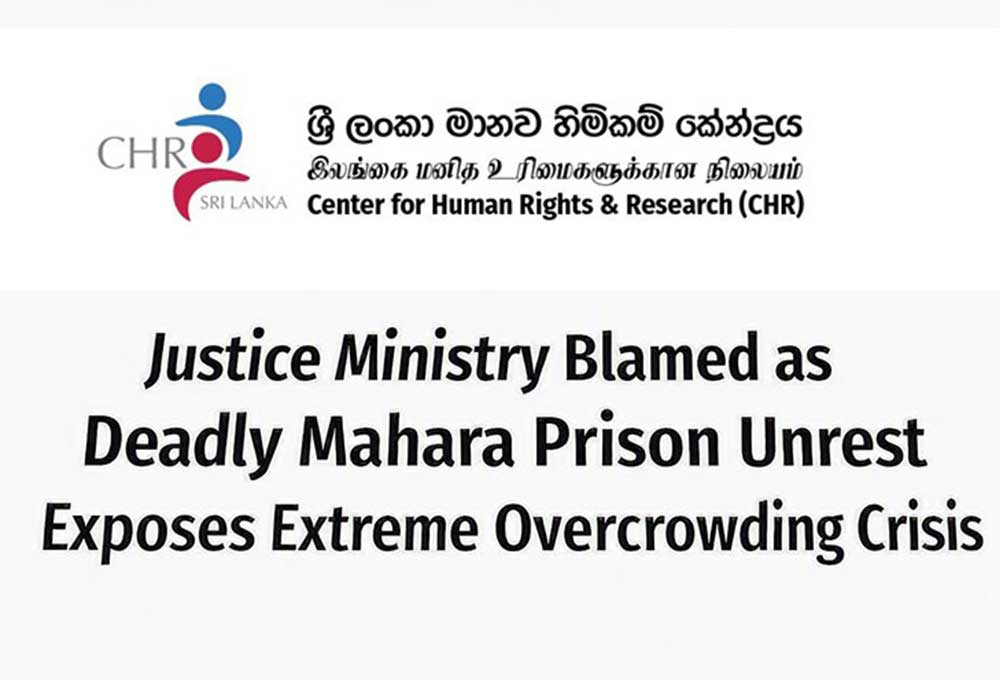
The Centre for Human Rights Research (CHR) Sri Lanka condemns the Government — specifically Justice Minister Harshana Nanayakkara and Ministry Secretary Ayesha Jinasena — for failing to address severe overcrowding in prisons, which has directly contributed to deadly violence at Mahara Prison.
Key points:
Mahara Prison Crisis:
Reports from the Committee for Protecting Rights of Prisoners (CPRP) indicate multiple deaths, numerous injuries, gunfire inside the prison, and prison officers allegedly preventing inmates from helping the wounded. A fire broke out, and clashes occurred outside the prison as families attempted to breach police barricades. A curfew was imposed.
Extreme Overcrowding:
RTI data and BBC Sinhala reporting show prisons operating at three to five times their intended capacity.
Examples:
Mahara: 4,100+ inmates
Welikada (capacity 839): 3,400 inmates
Colombo Remand (capacity 328): 2,782 inmates
Magazine (capacity 499): 3,046 inmates
Negombo (capacity 496): 2,403 inmates
Systemic Administrative Failures:
A National Audit Office report reveals:
15,117 suspects detained due to delays in Government Analyst reports.
1,940 inmates held only because they cannot pay minor fines.
Mixing drug offenders with other prisoners has strengthened underworld networks inside prisons.
Government Negligence:
CHR states that the Ministry of Justice failed to act decisively after the deadly Negombo riots, which killed around 30 people. The repeated outbreaks of violence show a systemic collapse in prison administration and a failure to protect the right to life.
CHR Demands:
Immediate safety measures for inmates and staff.
Unrestricted Human Rights Commission access to Mahara Prison.
An independent investigation into overcrowding, forensic delays, fine-related detentions, prisoner categorisation, and the recent unrest.
A transparent, time-bound plan to reduce overcrowding, speed up forensic reporting, reform detention practices, improve conditions, and protect lives.
Overall Message:
Sri Lanka’s prison system is in a state of crisis due to long-standing, avoidable administrative failures. The Government must act urgently and accountably to prevent further loss of life.
03 August 2026
Press Statement
Safeguarding the lives of inmates and prison officials – Justice Ministry shamefully failed
Centre for Human Rights Research (CHR) Sri Lanka strongly condemns the failure of the Government and, in particular, Justice Minister Harshana Nanayakkara and Secretary to the Ministry of Justice Ms. Ayesha Jinasena, to manage the chronic overcrowding in Sri Lanka’s prisons and to safeguard the lives of inmates and prison officials.
According to an urgent statement issued by the Committee for Protecting Rights of Prisoners (CPRP Sri Lanka), several fatalities have occurred within Mahara Prison, with multiple inmates lying injured. CPRP further reported that prison officers are opening fire and blocking inmates from assisting the wounded. If true, this represents a critical and alarming situation. Official figures earlier reported one death and several injuries, but the actual number of casualties appears to be higher.
Gunshots have been heard from within the prison, a fire broke out in a building, and the situation escalated outside the premises as relatives of inmates and local residents attempted to breach police barricades and clashed with security forces. Water cannons were deployed and a police curfew was imposed in the surrounding area. The situation remains tense and volatile.
This tragedy is the direct and foreseeable consequence of extreme and long-standing overcrowding that the authorities have failed to address with the urgency it demands. According to information revealed through a Right to Information request and reported by BBC Sinhala, at the time of the Mahara unrest the prison held more than 4,100 remand and convicted prisoners. Across the system the picture is equally alarming: Welikada Prison (capacity 839) held 3,400 inmates; Colombo Remand Prison (capacity 328) held 2,782; Magazine Prison (capacity 499) held 3,046; and Negombo Prison (capacity 496) held 2,403 inmates immediately before the deadly July riots — nearly five times its approved capacity.
A recent report by the National Audit Office further exposes the root causes of this crisis. Due to prolonged delays in receiving Government Analyst reports, 15,117 suspects remain detained in 22 prison institutions, unable to secure release. In addition, 1,940 inmates are held across 28 prisons solely because they cannot pay small fines. The Audit Office identifies these systemic delays and failures as primary drivers of overcrowding. It also
highlights that the practice of housing drug-related offenders together with other prisoners, without proper separation, has enabled the expansion of underworld activities inside prisons, creating a serious social crisis.
These findings confirm what human-rights groups have repeatedly warned: Sri Lanka’s prisons are operating at three to five times their designed capacity, largely because of administrative and procedural failures under the Ministry of Justice. A large proportion of those held are short-term remand prisoners awaiting analyst reports. Despite limited transfers, some releases, and announced construction plans, the Ministry has failed to take the urgent and decisive measures required after the Negombo tragedy that claimed approximately 30 lives, including prison officials, and left hundreds injured.
The successive outbreaks of deadly violence at Negombo and now at Mahara demonstrate a systemic failure of prison administration and a grave dereliction of the State’s duty to protect the right to life of both inmates and prison staff. Overcrowding on this scale, driven by avoidable delays in judicial and forensic processes and inadequate management, creates conditions of extreme tension, endangers lives, and undermines any possibility of humane or effective prison management. The Government and the Minister of Justice bear full responsibility for allowing this crisis to escalate unchecked.
Centre for Human Rights Sri Lanka demands that the Government:
- Immediately ensure the safety of all inmates and prison officials at Mahara Prison and across the prison system;
- Facilitate unrestricted access for the Human Rights Commission of Sri Lanka to Mahara Prison without delay;
- Conduct a serious, independent, and transparent investigation into the broader issues of prison overcrowding, the delays in Government Analyst reports, the detention of persons unable to pay small fines, the mixing of categories of prisoners, the circumstances of the recent unrest, and the adequacy of measures taken after the Negombo riots;
- Develop and publicly present a comprehensive, time-bound plan to reduce overcrowding to safe levels, accelerate forensic reporting, reform fine-related detention practices, improve conditions, strengthen staffing and security, and protect the lives and dignity of all persons in custody and those who work in the prisons.
The right to life is non-negotiable. The repeated loss of life inside Sri Lanka’s prisons is a national shame that can no longer be met with temporary measures or inadequate responses. The Government must act decisively and accountably.
Rajith Keerthi Tennakoon
Executive Director/ Centre for Human Rights and Research (CHR) Sri Lanka write down summary
About the Author