

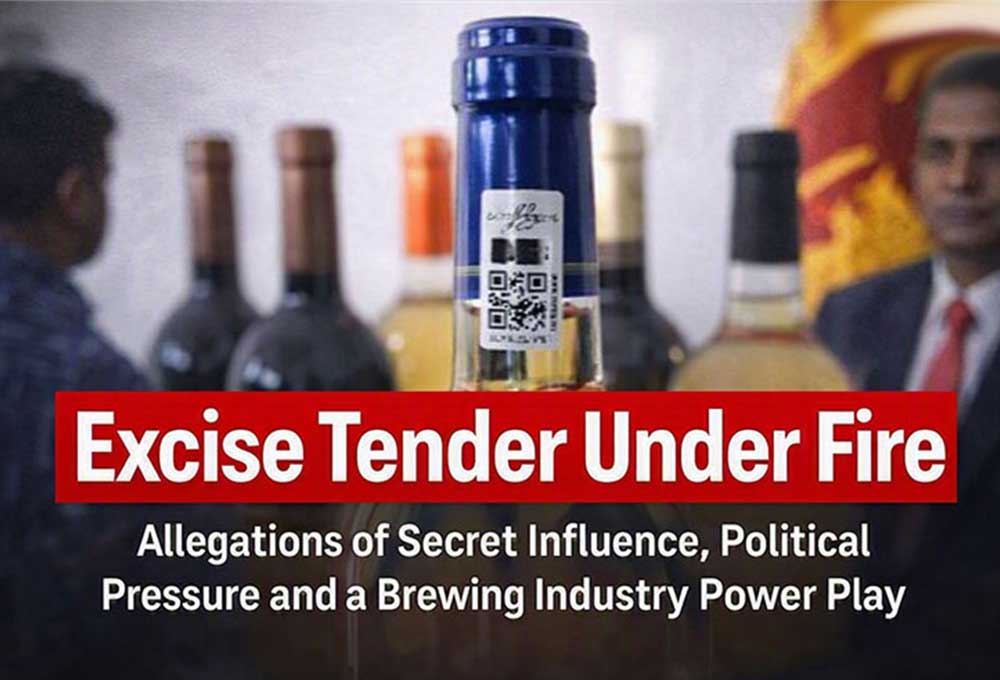
Colombo — A tender process expected to shape Sri Lanka’s excise tax‑stamp system for 2027 has become the centre of a growing controversy, with allegations of covert influence, political pressure and attempts to steer state contracts toward favoured private interests. The claims emerge despite the Excise Department recording one of its strongest revenue performances in recent history.
A System That Delivered — and a Sudden Push for Change
Since the introduction of the secure QR‑coded tax‑stamp system on 3 January 2022, excise revenue has surged dramatically. Official data shows a 60% increase between 2022 and 2025, with the department achieving 104% of its annual target by May 2025. The momentum continued into 2026, with 114.8% growth in the first quarter alone.
The system, widely credited with reducing tax leakages and curbing counterfeit liquor distribution, has saved the government billions. Yet officials are now moving to overhaul it — a shift critics say is neither justified nor transparent.
Three Officials at the Centre of the Storm
A leaked document alleges that three senior figures are engaged in undisclosed discussions regarding the upcoming tender:
Premarathna, Excise Commissioner General
R. Bulathsinhala, Chief Financial Officer

Nihal Premalal, Director at the Revenue Authority, appointed by the Presidential Secretariat
Premalal, described by insiders as an influential figure within the department, is alleged to exert significant control over decision‑making. He is also known for his past role as an organiser for the National People’s Power (NPP) Canada Committee, with reported links to diaspora networks.
Sources claim:
“Nihal Premalal is currently the most influential figure in the Excise Department, and he controls the Commissioner General.”
Alleged Plan to Favour an Unqualified Company
The core allegation is that the trio is attempting to steer the tender toward a company lacking the technical capacity to produce secure tax stamps. Such a move, critics warn, could reopen the door to counterfeit stickers and tax fraud.
Lion Brewery Drawn Into the Controversy
Lion Brewery, one of Sri Lanka’s largest beer manufacturers, is reportedly connected to the discussions. Investigators allege that a company linked to the brewery is being positioned to secure the printing contract.
Industry analysts warn that awarding the tender to a single large player could distort competition and push smaller producers out of the market — especially if the new system becomes fully digital.
Harsha de Silva’s Position Raises Questions

Dr. Harsha de Silva, Chair of the Parliamentary Committee on Public Finance, has publicly criticised the current sticker system, claiming the government pays USD 8 per 1,000 stickers for digital printing, while the actual cost should be USD 0.12.
He argues that the tender must be re‑evaluated to prevent wasteful spending.
However, officials familiar with the system say a sticker costing USD 0.12 per 1,000 would be extremely easy to counterfeit — potentially enabling widespread fraud.
Some sources allege that the recent discovery of fake QR‑coded stickers on illicit liquor bottles was used as a pretext to justify changing the system, rather than a genuine security concern.
Risks to State Revenue and Market Stability
Experts warn that altering a system that has proven effective could have serious consequences:
Tax leakages could rise again, reversing years of progress.
Political interference may undermine public trust in the tender process.
Small manufacturers could be forced out if the system becomes fully digital and cost‑prohibitive.
Calls for Transparency and Accountability
With billions in state revenue at stake, analysts and civil society groups are urging the government to:
Launch an independent investigation into the allegations
Ensure a fully transparent tender process
Strengthen, rather than weaken, the security of tax stamps
Protect small‑scale producers and maintain fair competition
As the 2027 tender approaches, the Excise Department faces mounting pressure to demonstrate that decisions are being made in the public interest — not under the influence of hidden networks or private agendas.
The Sri Lanka Customs Department, under the Ministry of Finance, Economic Stabilization and National Policies, has issued an Invitation for Bids (IFB) for the supply and implementation of Secure Stamps and Secure Stamp System Services (SFSMFS).
Key Details:
Tender No: EDI/AC/20/F/19/2026
Scope: Provision of secure stamps and a secure stamp management system.
Eligibility: Bidders must hold certifications such as ISO 9001, ISO 14298, ISO 27001, ISO 37001, and membership in recognized associations (IOTA, IHMA, ITSA).
Bid Document Fee: USD 100
Submission Deadline: 20 June 2026
Submission Address: Sri Lanka Customs Department, Ministry of Finance, No. 353, Bastian Mawatha, Colombo 12.
Further Info: www.customs.gov.lk or email cact@excise.gov.lk
This tender seeks qualified service providers to enhance the security and authenticity of tax stamps and related systems in Sri Lanka.
About the Author