
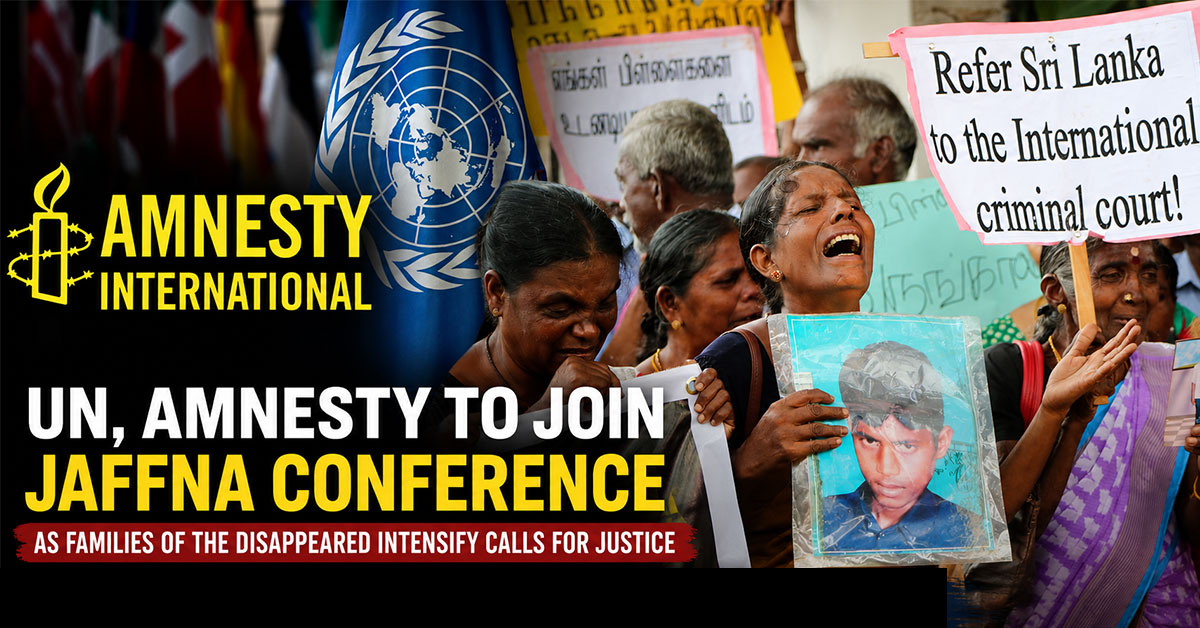
Representatives of the United Nations and Amnesty International are expected to attend a major conference in Jaffna on August 30, where families of Sri Lanka’s forcibly disappeared will once again press for truth, justice and accountability—demands they have sustained for more than a decade.
The conference, titled “The Long Journey for Justice,” is being organised by relatives of the disappeared to coincide with the International Day of the Victims of Enforced Disappearances, observed globally on August 30. It will take place at the Thanthai Chelva Auditorium and is expected to draw families from across the Northern and Eastern Provinces, alongside political representatives, civil society activists, religious leaders and members of the public.
Organisers said representatives from the UN and Amnesty International were expected to participate, though details of the officials and their positions were not immediately available.
A movement sustained by mothers and wives
Families of the disappeared have marked August 30 for years with marches, vigils and demonstrations, often led by mothers and wives who have maintained public campaigns despite intimidation, surveillance and repeated political transitions. Many continue to demand answers about the fate of relatives who were taken away by state forces or disappeared during the final stages of the war.
Their demands remain unchanged: truth about what happened, accountability for those responsible, and credible investigations that meet international standards.
Parallel demonstration in Kilinochchi
In a separate event, the Association of Relatives of the Enforced Disappeared of the North and East will hold a demonstration in Kilinochchi from 9 a.m. to 11 a.m. on August 30. The gathering will take place in front of a temple along the A9 highway, where families are expected to carry pots of burning camphor in remembrance of their missing loved ones.
Organisers said the act symbolises both mourning and resilience, drawing attention to the families’ continuing search for answers. A book documenting their long-running campaign for justice is also expected to be released during the event.
An unresolved legacy
Enforced disappearances remain one of the most painful and politically sensitive legacies of Sri Lanka’s decades of conflict. Tens of thousands of cases remain unresolved, with families repeatedly seeking information from successive governments that have promised inquiries but delivered little progress.
Human rights groups have long argued that domestic mechanisms lack independence and credibility, and that meaningful accountability requires international involvement—an argument echoed by many families attending this year’s events.
As August 30 approaches, organisers say the renewed gatherings are not merely commemorative, but a reminder that the struggle for truth and justice continues, and that families will not abandon their search for answers.
About the Author