


Colombo — Sri Lanka has raised an extraordinary Rs. 46.2 trillion in Treasury bills and bonds between 2023 and mid‑2026, despite the country being rated at one of the world’s lowest sovereign credit grades — CCC — a category Fitch Ratings defines as carrying “a substantial credit risk” and “a real possibility of default.”
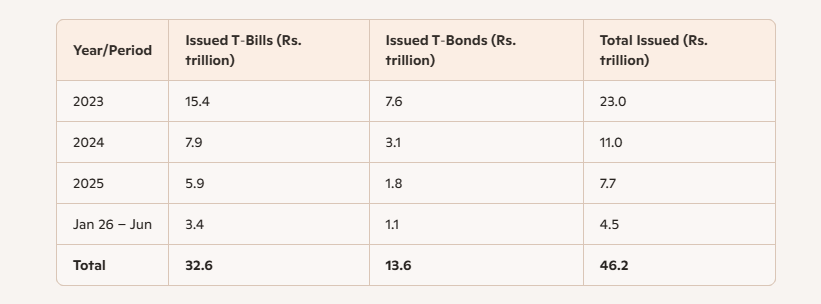
According to official auction data from the Central Bank of Sri Lanka (CBSL) and the Public Debt Management Office (PDMO), the government issued Rs. 32.6 trillion in Treasury bills and Rs. 13.6 trillion in Treasury bonds during the period. The bulk of these securities were purchased by major state banks, employee provident funds, and other institutional investors.
A legal paradox emerges
The scale of investment has triggered renewed debate over whether investors could face legal exposure under Sri Lanka’s anti‑corruption framework.
The concern stems from an ongoing case before a three‑judge High Court bench, where former CBSL Governor Ajith Nivard Cabraal and senior officials are accused of “knowingly” investing in Greek government bonds in 2011, despite Greece being at risk of financial collapse. At the time, Greece held a BB+ rating — significantly higher than Sri Lanka’s current CCC+ grade.
Legal analysts warn that the Bribery Commission’s argument in the Greek bond case could theoretically be applied to present‑day investors in Sri Lankan securities. If investing in a foreign government rated BB+ was deemed “corrupt,” then investing in domestic securities rated CCC — a category Fitch describes as “extremely vulnerable” — could expose tens of thousands of investors to similar allegations.
Debt issuance continues despite severe rating
The parts of the above image in Sinhala are shown in English below.
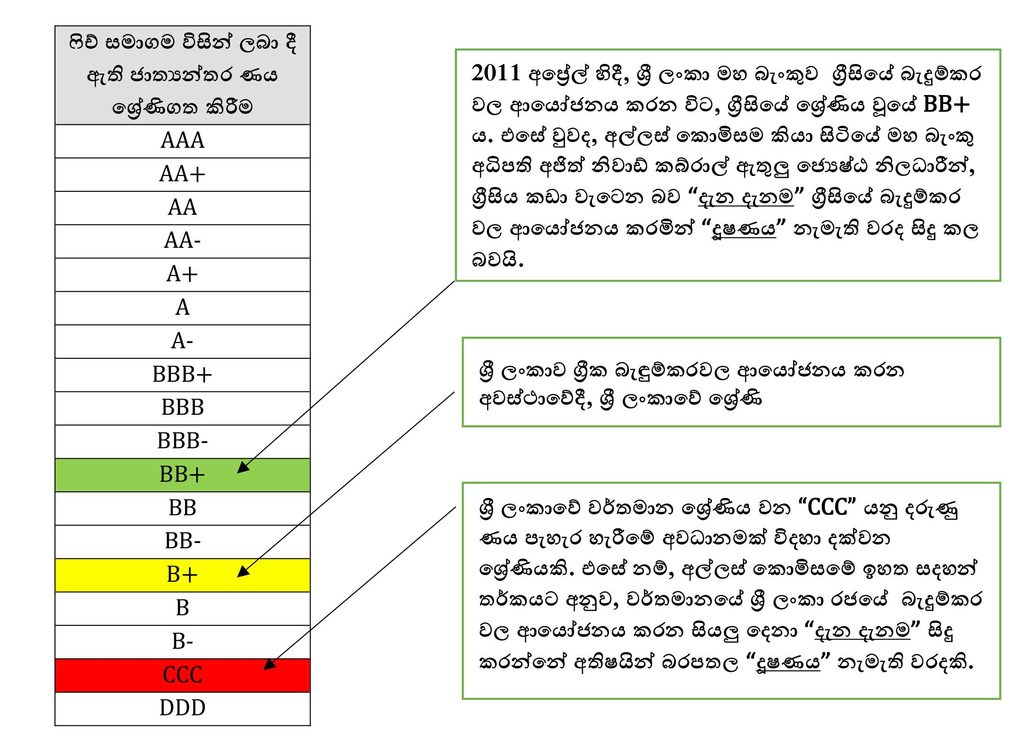
01 In April 2011, when the Central Bank of Sri Lanka invested in Greek bonds, Greece’s sovereign rating stood at BB+. Nevertheless, the Commission to Investigate Allegations of Bribery or Corruption stated that Central Bank Governor Ajith Nivard Cabraal and senior officials had committed the offence of “corruption” by knowingly investing in Greek bonds despite Greece being on the verge of collapse.
02 At the time Sri Lanka invested in Greek bonds, Sri Lanka’s own sovereign rating was
03 Sri Lanka’s current rating, “CCC”, indicates a severe risk of debt default. Therefore, according to the logic presented by the Bribery Commission in the above allegation, anyone who invests in Sri Lankan government bonds today is “knowingly” committing the extremely serious offence of “corruption.”
Sri Lanka’s sovereign rating fluctuated between CCC‑, CCC, and CCC+ from 2023 to 2026, never rising above the threshold that Fitch considers “highly vulnerable to default.” Yet the government continued to raise record‑breaking sums through domestic borrowing.
Experts call for legal clarity
Economists and legal scholars argue that the Bribery Commission must clarify whether its interpretation of “knowingly investing in a collapsing economy” applies universally or only to specific cases involving alleged misconduct.
Without such clarification, they warn, Sri Lanka risks creating a precedent where routine investment in government securities — the backbone of domestic financial stability — could be construed as a criminal act.
About the Author