
The introduction and rapid progression of Sri Lanka’s 22nd Constitutional Amendment has unfolded under a cloud of controversy, with each stage of the process revealing an unmistakable alignment between the country’s political leadership and Chief Justice P. Padman Surasena. From the moment the Bill was gazetted to the confidential Supreme Court determination being rushed to the Speaker today (02), the pattern has remained consistent — and increasingly alarming to legal experts, civil society, and segments of the judiciary itself.
A Judicial Process Marked by Unusual Speed and Unusual Choices
The first signs emerged when the Chief Justice appointed the bench to hear petitions challenging the constitutionality of the 22nd Amendment. Senior judges were sidelined, junior judges were elevated, and the petitions were taken up before the constitutionally provided 14‑day window had expired — an acceleration that raised eyebrows across the legal community.
Observers noted that at every procedural juncture, the Chief Justice’s decisions appeared to align with the political interests of President Anura Dissanayake and the government. Statements by the President, the Minister of Justice, the Cabinet Spokesman, and JVP leaders — amplified by media outlets such as Sirasa — consistently mirrored the direction in which the judicial process was moving.
Corruption Allegations Intensify Scrutiny
Compounding the controversy are ongoing corruption and fraud allegations involving Chief Justice Surasena. including matters connected to the Express Pearl disaster compensation case. Evidence circulating in public discourse suggests that close relatives — including his son — may have links to alleged misconduct. These allegations have heightened public concern over whether personal interests may be influencing judicial conduct at a moment of profound constitutional significance.
Under Sri Lanka’s Constitution, judicial power is part of the sovereignty of the people — inalienable and non‑transferable. Critics argue that the Chief Justice’s actions during the 22nd Amendment process have violated this foundational principle.
Courtroom Arguments Highlight the Stakes
Inside the Supreme Court, submissions reflected the gravity of the moment.
- President’s Counsel M.A. Sumanthiran made detailed submissions on the constitutional implications of the Bill.
- President’s Counsel Ali Sabry, appearing for petitioner Prof. G.L. Peiris, argued that even a government with a two‑thirds majority cannot influence judicial independence.
- President’s Counsel Sreenath Perera, representing several petitioners, countered that the Bill’s provisions would directly or indirectly exert influence on the judges of the Supreme Court.
These arguments underscored a central tension: whether the 22nd Amendment strengthens or undermines the independence of the judiciary.
Anti‑Corruption Act: A Standard the Judiciary Must Also Meet
The Anti‑Corruption Act No. 9 of 2023 introduced strict, internationally aligned standards for managing conflicts of interest among public officials — explicitly including judges of the Supreme Court, Court of Appeal, High Court, and all other judicial officers.
The Act requires:
- Full disclosure of personal or familial interests in matters before a public authority.
- Mandatory recusal from decisions where such interests exist.
- Criminal liability — including up to seven years’ imprisonment — for violations.
Legal analysts note that these provisions apply directly to the judges who issued the determination on the 22nd Amendment. Although the determination remains confidential until announced in Parliament, the trajectory of the process suggests it is likely to permit the Bill to pass with a two‑thirds majority.
A Crisis of Public Trust
The first ethical requirement of the Anti‑Corruption Act — that public officials act with public trust and accountability above personal interests — appears to have been breached, critics say, by the Chief Justice’s conduct throughout the 22nd Amendment proceedings.
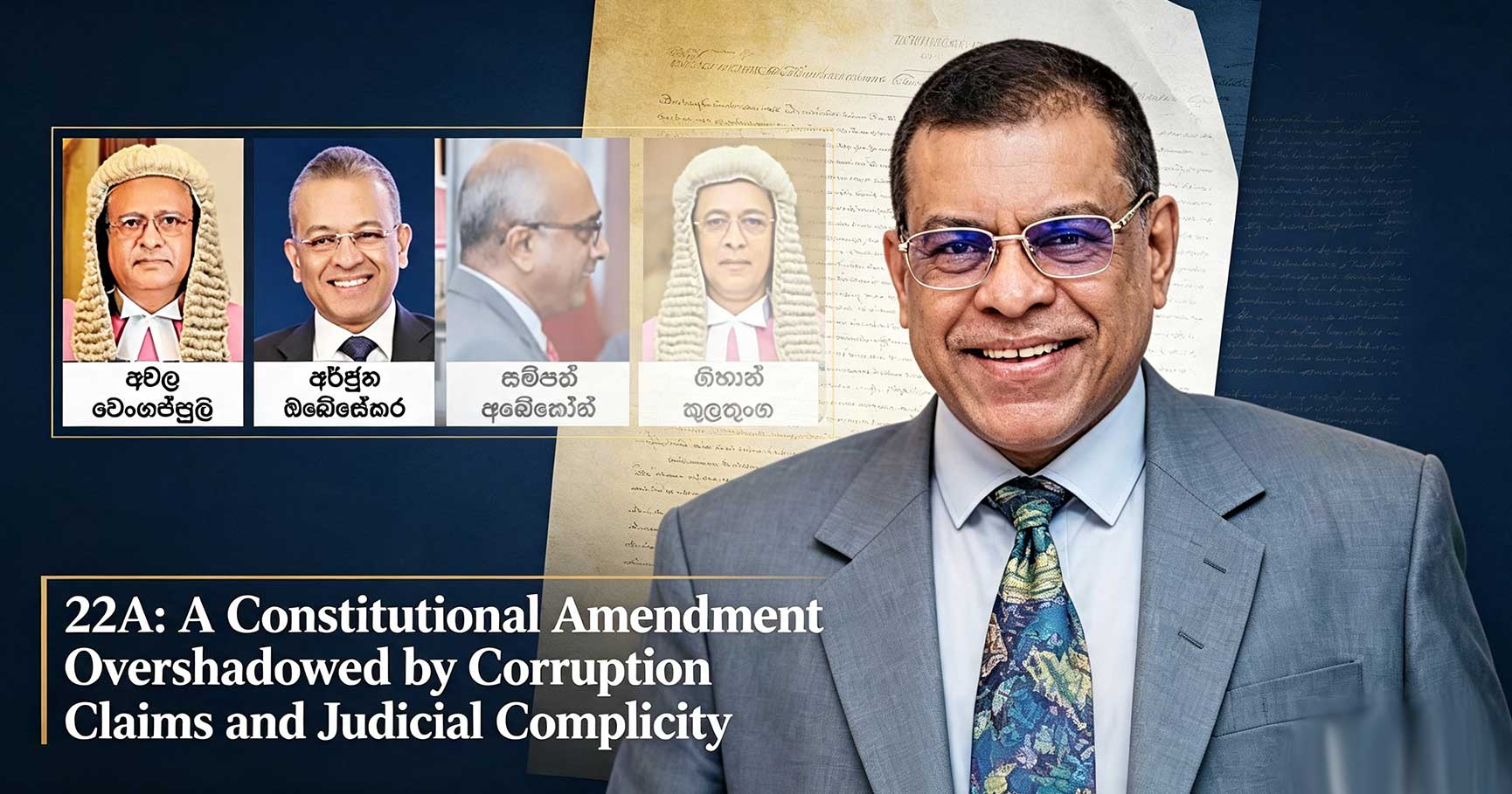
The extension of his own tenure by two years through the Amendment has intensified public suspicion. Analysts warn that such actions risk long‑term damage to the credibility of the judiciary, and that judges involved in the determination — Achala Wengappuli, Arjuna Obeysekera, Sampath Abeykoon, and Gihan Kulatunga — may face future accountability before both public opinion and a future independent Chief Justice.
A Constitutional Moment That Will Shape the Future
As the Speaker prepares to announce the Supreme Court’s determination, Sri Lanka stands at a critical juncture. The 22nd Amendment has become more than a legislative proposal — it has become a test of the country’s commitment to judicial independence, constitutional integrity, and the rule of law.
Whether this moment strengthens or weakens the judiciary will shape the nation’s democratic trajectory for years to come.
Anti-Corruption Act, No. 9 of 2023
(i) any written Constitution, or any provision made by or under legislation, applicable to the country or territory concerned; or
(ii) any judicial decision which is so applicable and is evidenced in published written sources.
- (1) Any person who, in the course of any economic, financial or commercial activity, offers, directly or indirectly, a gratification on behalf of himself or another person to any employee in any capacity or a director in a private sector entity, in order to commit any act or refrain from committing any act in breach of his duties, commits an offence of bribery under this Act and on conviction be liable to a fine not exceeding one million rupees or to a term of rigorous imprisonment not exceeding seven years or to both such fine and imprisonment.
(2) An employee in any capacity or a director in a private sector entity, in the course of economic, financial or commercial activities, solicits or accepts, directly or indirectly an advantage, for himself or for another person, in order to act or refrain from doing any act in breach of the duties of such employee or director, commits an offence of bribery under this Act and on conviction be liable to a fine not exceeding one million rupees or to a term of rigorous imprisonment not exceeding seven years or to both such fine and imprisonment.
- (1) Where a public authority in which a public official is a member, director, or employee proposes to deal with a person, company, partnership or other undertaking in which that public official or a relative or associate of such public official has a direct or indirect interest which interest is within his knowledge of that public official shall forthwith disclose to that authority the nature of such interest in the
(2) Where a public official or a relative or associate of such public official has a personal interest in a decision which partnership or other undertaking, that public official shall a public authority is to take regarding a person, company, not vote or take part in any proceedings of that public authority relating to such decision.
(3) Any public official who contravenes the provisions of subsection (1) or (2) commits an offence and shall on conviction by the High Court be liable to a fine not exceeding one million rupees or to a term of rigorous imprisonment not exceeding seven years or to both such fine and imprisonment.
(4) The Commission shall specify by way of rules the handling and management of conflict of interest of public officials.
Offences relating to sporting events
- (1) Any person who, directly or indirectly accepts or agrees or offers to accept any gratification from any other person, whether for the benefit of himself or for the benefit of that other person or of another person-
(a) in return for-
(i) engaging in any act which constitutes a threat to or undermines the integrity of any sporting event, including, in any way, influencing the run of play or the outcome of a sporting event, or
(ii) not reporting the act contemplated in this section to the managing director, chief executive officer or to any other person holding a similar post in the sporting body or regulatory authority concerned nearest police station; or
“public authority” includes a Government Minis Government Department, Provincial Counc local authority or public corporation;
“public corporation” means any corporation, board other body which was or is established by or under any written law other than the Companies A No. 07 of 2007 with capital partly or wholly provided by the Government by way of gran loan or other form, and includes all scheduled institutions under this Act;
“public international organisation” means an organisation whose members are
(a) countries or territories outside Sri Lanka;
(b) governments of countries or territories outside Sri Lanka; and
(c) a mixture of any of the above;
“public officer” shall have the same meaning assigned to such expression in the Constitution;
“public official” include the President, the Prime Minister, a Minister of the Cabinet of Ministers, a Minister appointed under Article 45 of the Constitution, Speaker, Deputy Speaker, Chairman of a Committee, Deputy Chairman of a Committee, a Deputy Minister, the Governor of a Province, a Minister of the Board of Ministers of a Provincial Council, a Member of Parliament, a Judge of the Supreme Court, a Judge of the Court of Appeal, Judge of the High Court or a Judge, presiding officer, or member of any other Court of first Instance, tribunal or institution created and established for the administration of Justice or for the adjudication of any labour or
About the Author