
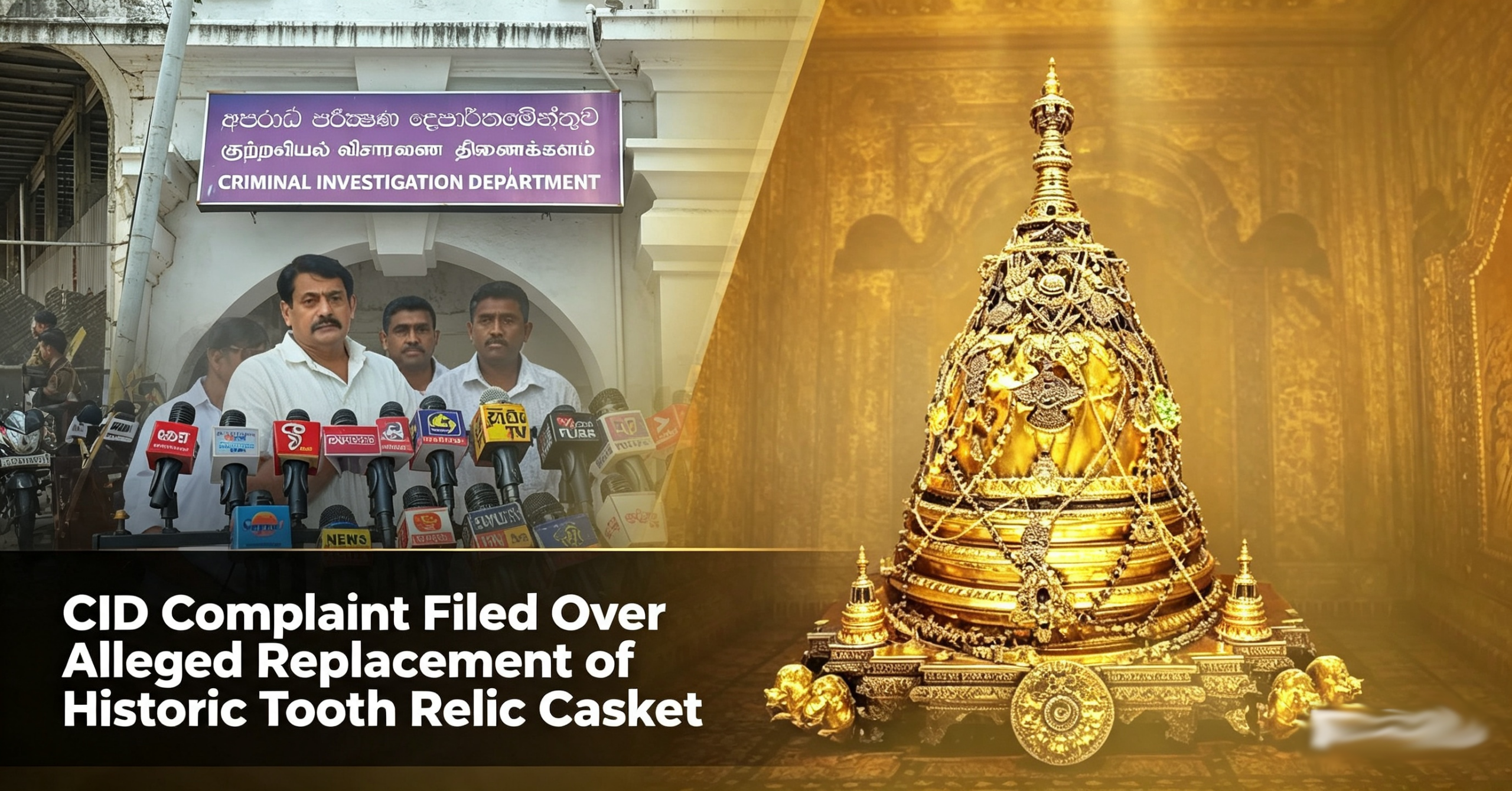
A social activist today lodged a complaint with the Criminal Investigation Department (CID) alleging that the removal of the historic Maha Karanduwa—the royal casket offered by King Keerthi Sri Rajasinghe for the protection of the Sacred Tooth Relic—and its replacement with a newly crafted casket made by a private businessman, is part of a wider conspiracy aimed at undermining the sentiments of the country’s Sinhala Buddhist majority.
The complaint was filed by astrologer and activist Achala Diwaka, who later addressed the media, questioning the rationale behind replacing a centuries‑old heritage object with a modern creation. “If someone brings an even heavier gold casket tomorrow, will that also be accepted?” he asked, stressing that the original casket is not merely an object of worship but a symbol of royal patronage and national heritage.
Diwaka argued that the historical value of the casket far exceeds its material worth, and highlighted that under Sri Lanka’s archaeological laws, altering or removing heritage items is strictly regulated. “The Tooth Relic casket is over 400 years old and recognised as part of world heritage. Everyone is bound to protect it. If a businessman is allowed to replace it, what will remain of its ancient authenticity?” he said.
He further claimed that the incident fits into a broader pattern aimed at weakening Buddhist heritage and identity. “If any harm comes to the Sacred Tooth Relic, who will take responsibility? One day the Mahavamsa will record that the king’s casket was removed and a businessman’s casket was placed instead,” he warned.
Civil activist Sanjeewa Dhammika also criticised the move, stating that even in a century‑old heritage building, “you are not allowed to remove even a single nail.” “Who wanted to insult this historical heritage? This is not only Buddhist heritage—it is national heritage,” he said, calling for a full investigation.
Authorities have yet to comment on the complaint, while cultural and religious organisations are expected to issue statements in the coming days.
It has been revealed that the removal of the sacred casket was carried out following a special request made by Mr. Kamantha Amarasekara, along with members of his family, relatives, and close associates.
According to reports, the process was executed with the official approval of the Dalada custodians. However, no complete official statement has yet been issued regarding the background of the approval, the reasons behind the request, or the exact procedure followed, and further clarification from the relevant parties is expected.
Questions have arisen concerning the coordination between the Dalada custodians, representatives of the family, and security officials, as well as the approved protocols and legal responsibilities related to religious artifacts. The incident has drawn significant attention within religious and cultural circles.
Details such as the specific reasons for the removal, the date on which it was carried out, and whether it was conducted in accordance with religious rituals have not yet been officially disclosed. Sources indicate that the Dalada custodians are expected to release a full explanation in due course.
This development has sparked new discussion regarding approved procedures for handling sacred religious items, family requests, and the authority of the custodians, with further responses from involved parties anticipated.
About the Author