
FDI stuck near 1% of GDP; policy uncertainty, bureaucracy and stalled major projects weigh on investment climate
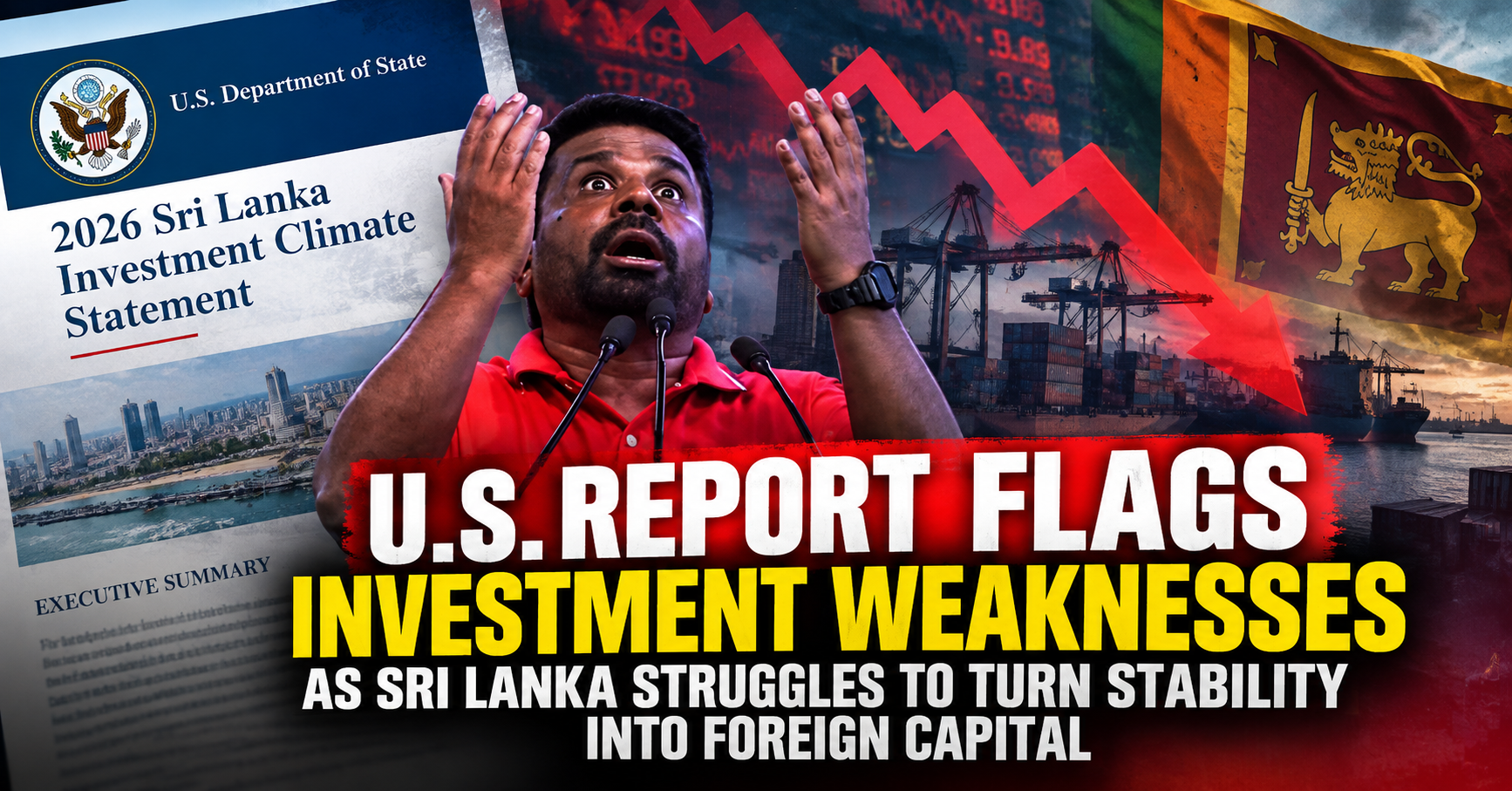
Sri Lanka’s recovery from the 2022 economic crisis has yet to translate into a strong investment revival, with a new U.S. Department of State assessment pointing to policy uncertainty, bureaucratic delays, regulatory unpredictability and difficulties in executing major foreign investment projects.
The 2026 Sri Lanka Investment Climate Statement, published by the U.S. Department of State in September, acknowledges that Sri Lanka recorded 5 percent economic growth in 2025 and that the electoral victories of President Anura Kumara Dissanayake and the National People’s Power (NPP) created political stability. However, it says the country’s investment climate remains challenging and that investors remain wary of mixed messages from the NPP leadership about market openness.
FDI only around 1% of GDP
One of the report’s clearest warning signs is Sri Lanka’s relatively weak foreign direct investment performance.
FDI amounted to just US$1.06 billion in 2025 — approximately 1 percent of GDP. The report notes that this is significantly below the 3–4 percent of GDP commonly seen in emerging economies.
It identifies policy stability, regulatory reform, availability of skilled workers, access to industrial land, efficient logistics and streamlined trade procedures as areas requiring greater attention if the government is to achieve its investment targets.
The report therefore draws a distinction between macroeconomic stabilization and the deeper reforms needed to attract long-term private capital.
“Doing business remains difficult”
Despite government rhetoric supporting foreign investment, the State Department says institutional capacity to create an open investment environment remains limited.
Investors continue to complain about project reversals, regulatory changes, slow decision-making and inadequate support for established businesses. Regulatory unpredictability, bureaucratic hurdles and selective transparency are also identified as barriers to wider foreign participation.
The Board of Investment, which is expected to function as the country’s principal investment facilitator, is also reported to face difficulties operating as an effective “one-stop shop”.
Fragmented authority among government institutions creates lengthy approval procedures, while investors have reported problems maintaining consistent and open dialogue with the BOI.
The report additionally identifies unnecessary regulations, legal uncertainty, poor bureaucratic responsiveness, high transaction costs, unpredictable policies and opaque procurement procedures as continuing obstacles.
Sinopec project still pending
The report highlights several high-profile investment decisions that illustrate the difficulties facing the government.
President Dissanayake committed in January 2025 to finalising the proposed US$3.7 billion Sinopec oil refinery at Hambantota, described in the report as potentially the largest FDI project in Sri Lankan history.
Yet, according to the State Department report, as of June 2026 the project remained pending because of disagreements between the government and Sinopec.
That is particularly significant because a project of this scale would dwarf Sri Lanka’s total FDI inflows of US$1.06 billion recorded in 2025.
Adani’s US$400 million project withdrawn
The report also points to the withdrawal of Indian company Adani Green Energy from its proposed US$400 million, 484 MW wind power project in northern Sri Lanka.
According to the report, Adani withdrew in February 2025, citing Sri Lankan government efforts to renegotiate a previously awarded contract.
It further says that in December 2025 the government ended negotiations with China Harbour Engineering Company over a proposed floating LNG terminal only days before the contract was expected to be signed.
Taken together, the cases illustrate the report’s broader concern about project reversals and policy predictability.
Structural reforms moving too slowly
The problems are not confined to individual investment projects.
Businesses frequently identify outdated regulations, broad administrative discretion and regulatory unpredictability as obstacles. Investment inflows also continue to trail regional competitors because of structural weaknesses such as restrictive labour regulations, complicated taxation, cumbersome contract enforcement and difficulties acquiring land.
Although the government intends to reform labour legislation, contacts cited in the report complained about the slow pace of reform and lack of transparency.
Trade facilitation presents another problem.
Strict import licensing, high duties and para-tariffs, complex labour rules and intellectual-property concerns continue to create difficulties, while manual procedures remain at institutions including Sri Lanka Customs, the Ports Authority and the BOI despite repeated calls for digitisation.
State enterprises remain a burden
The report also raises concerns about Sri Lanka’s extensive state-owned enterprise sector.
The government controls 527 SOEs, including 55 classified as strategically important. According to the report, these enterprises continue to strain public finances because of mismanagement, excessive staffing, inadequate financial disclosure and weak budgetary controls.
It also says SOE labour costs are substantially higher than private-sector equivalents and consume a disproportionate share of the national budget.
The previous administration had initiated a programme involving potential privatisation of several major SOEs. The current government suspended those privatisation efforts after taking office and instead opted for restructuring while maintaining state ownership.
Corruption and procurement concerns remain
The State Department report further warns that corruption and weak transparency in public procurement have historically caused substantial economic losses and discouraged FDI, particularly in major infrastructure.
Despite the government’s stated anti-corruption commitment, stakeholders continue to report corruption risks in some sectors, while concerns remain about politically connected interests. The report also describes conflict-of-interest provisions as vague and enforcement mechanisms as ineffective.
Stability has improved — but investment transformation has not followed
The report does record important improvements.
Sri Lanka’s overall economic environment has improved markedly from the depths of the 2022 crisis. The banking system strengthened in 2025, official reserves rose to US$6.8 billion, and workers’ remittances reached a record US$8.1 billion.
Those developments indicate that macroeconomic stabilization has progressed.
But the report’s investment assessment presents a more difficult picture: FDI remains low, major projects have stalled or been withdrawn, investors complain of unpredictable policy and bureaucracy, structural reforms remain incomplete, and state enterprises continue to burden public finances.
For the NPP administration, which came to office with a commanding parliamentary majority and promises of a different economic and governance model, the challenge identified by the report is therefore no longer simply stabilising an economy emerging from crisis.
It is turning that stability into investment, productive capacity and sustained economic growth — an area where the State Department’s 2026 assessment indicates substantial weaknesses remain.
About the Author