
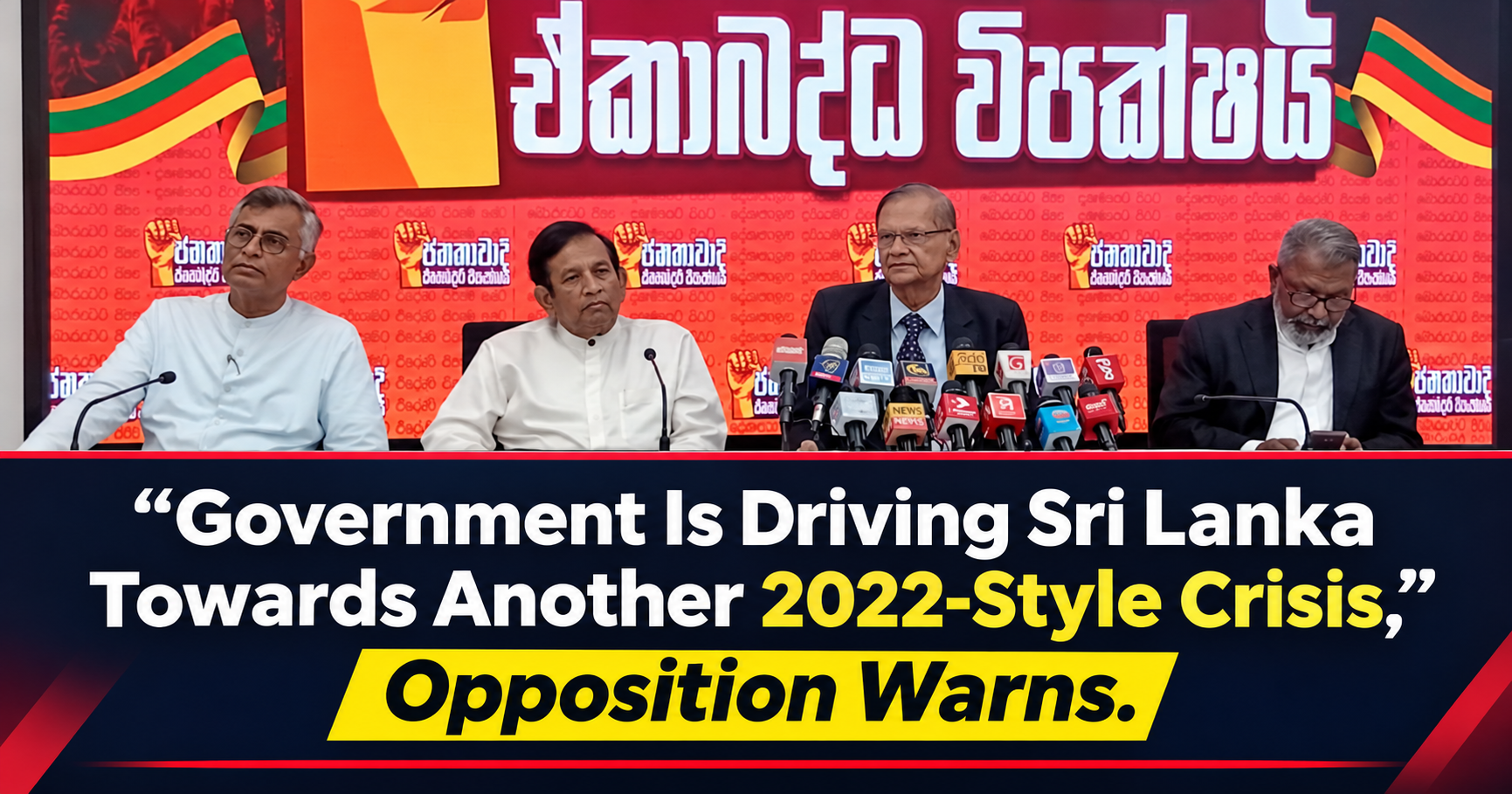
Sri Lanka’s economy is contracting rather than growing, Professor G. L. Peiris said at a media briefing held by the People’s United Opposition today (9) at its political office on Flower Road, Colombo. He stated that the growth rate had declined from 5.8% in the second quarter of 2025 to 4.2% in the second quarter of 2026, and that the economy was now 2% smaller than its size in 2008.
Furthermore, as inflation rises month after month, people’s ability to save and the purchasing power of their money are rapidly declining. Inflation, which stood at 6.3% in June, increased to 8% by August, while food inflation reached 8.5%. The severity of inflation means that, within nine years, people stand to lose 50%—half—of the value of their assets.
When the current government came to power, the exchange rate stood at Rs. 293 to the US dollar in October 2024. Today, it has risen to Rs. 337. This represents a depreciation of approximately Rs. 45 against the dollar. Consequently, importing essential goods such as fuel, lentils, onions, sugar and flour now costs approximately Rs. 45 more for every dollar spent. This increase also has a significant impact when calculating the country’s foreign debt.
The shrinking economy, inflation and foreign exchange difficulties have obstructed the creation of new jobs, while preserving existing employment has also become increasingly difficult. Unemployment among educated young people has risen to 43%, reportedly the highest youth unemployment rate in Asia.
Sri Lanka has five million people aged between 10 and 24. Although approximately 50% of unemployed graduates hope to leave the country, immigration restrictions in Western countries have also curtailed that option.
No major foreign investment has entered the country during the past two years. According to a report issued by the US Department of State, weak coordination between institutions, frequently changing and unclear policies, and unfavourable tax policies have created an adverse investment environment in Sri Lanka.
By the middle of this year, only 16.7% of the funds allocated in last year’s budget had been spent. By September, expenditure had reached only 28%—approximately a quarter of the allocation.
In May, amid sharp depreciation of the rupee, the Central Bank sold more than US$211 million on a net basis. This was reportedly its first monthly net sale of dollars in 22 months.
Similarly, only around 8% of the Rs. 500 billion allocated for people affected by the “Ditwa” disaster has been spent so far. The principal reason appears to be institutional inefficiency and weakness rather than a shortage of funds.
Instead of identifying around 100 small projects at village level and allocating money to areas that directly affect people’s lives, the government has allocated Rs. 2 trillion for highway development over three years. Large amounts of foreign exchange have been spent on items such as tiles, vehicles and cement, without providing relief to ordinary people. Only a handful of large companies benefit from this expenditure.
Although construction has grown by 14% and mining by 17%, several sectors that affect ordinary people have declined. Paddy cultivation has fallen by 15%, the apparel industry by 1.4%, the ornamental fish industry by 61%, marine fisheries by 10%, and the tea industry by 2%. These figures point to serious risks facing the country’s economy.
According to World Bank reports, extreme poverty in Sri Lanka has risen to 30%. Meanwhile, according to the World Food Programme, six million people in the country are currently unable to afford even one nutritious meal a day. Indirect taxes, such as the 18% Value Added Tax (VAT), place a burden on both the poor and the wealthy.
Vehicle imports were completely prohibited from 2020 until January 2025. However, in 2025, imports were reopened without any proper plan, unleashing a flood of vehicles. Even the world’s most luxurious vehicles, including Rolls-Royces of the type used by the British Queen, were allowed into the country without restrictions.
Although the government expected substantial tax revenue from this, vehicle registrations did not meet expectations, resulting in a significant loss to the government. Moreover, a considerable amount of the country’s foreign exchange flowed overseas.
What was this foreign exchange? It was money that could have been used to build our foreign reserves. Those reserves are needed to repay foreign debt at the end of the year. Retaining these dollars was a key means of strengthening our reserves, but that opportunity has been lost.
That revenue is now declining. In other words, we cannot depend on it indefinitely. It is neither a permanent nor a stable source of income. In 2025, Customs revenue from vehicle imports amounted to Rs. 2,551 billion. By September 2026, however, it had fallen to Rs. 2,000 billion. Next year, it will fall further. Why? Because new vehicle registrations have declined by 15.
Nevertheless, with the country heading towards a major economic crisis under these circumstances, we hope that the budget to be presented on November 12 will introduce a programme that addresses these pressing practical problems.
Former Minister Dr. Rajitha Senaratne, who also addressed the media briefing, said:
The failures and incompetence of the current government’s economic management are rapidly driving the country back towards the severe economic crisis and bankruptcy experienced in 2022.
A tendency to suppress protests through anti-terrorism legislation has emerged as the authorities seek to conceal their inability to govern. We strongly condemn the brutal attacks recently carried out against Buddhist monks by the police and certain individuals at Viharamahadevi Park and in the Anuradhapura area.
This repressive approach has also created a risk of losing the GSP+ trade concession, potentially placing the apparel industry and other export sectors in serious danger. Meanwhile, the country’s overall public debt has risen to an alarming level.
Central government debt, which stood at Rs. 29.5 trillion, has now increased to Rs. 32 trillion. Domestic debt has risen from Rs. 18 trillion to Rs. 19 trillion, while foreign debt has increased from Rs. 11.5 trillion to Rs. 12.7 trillion.
Increases in 12 different taxes have reduced the proportion of the population belonging to the middle class from 72% to 57%. Sri Lanka has also appeared in international reports as one of the countries with the highest tax burdens.
Inflation has risen to among the highest levels in Asia, while approximately 75% of small and medium-sized enterprises are facing severe difficulties. In addition, US$171 million in investment has been withdrawn from the stock market, and several large development projects are also withdrawing from the country. This is an extremely regrettable situation.
Prices of essential goods and fuel, which were lower under Ranil Wickremesinghe’s administration, have risen sharply under the current government.
When Ranil Wickremesinghe handed over the country, a litre of 92-octane petrol cost Rs. 320. Today, it costs Rs. 424—an increase of Rs. 104. A litre of 95-octane petrol, previously priced at Rs. 377, now costs Rs. 490.
Diesel, which cost Rs. 304 per litre, has risen to Rs. 397—an increase of around Rs. 90. A gas cylinder that cost Rs. 3,690 now costs Rs. 4,365. The US dollar, previously valued at Rs. 292, has risen above Rs. 330.
Unless appropriate reforms are implemented to address these economic conditions and the unfolding crisis, the country’s return within the coming months to the dark economic depths and bankruptcy experienced in 2022 will be unavoidable.
About the Author