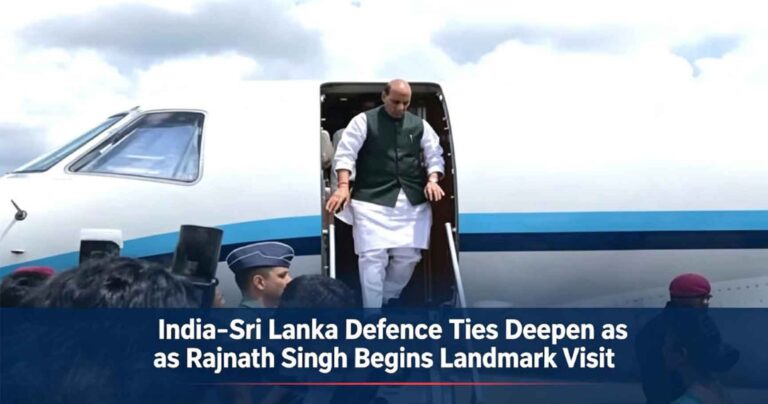

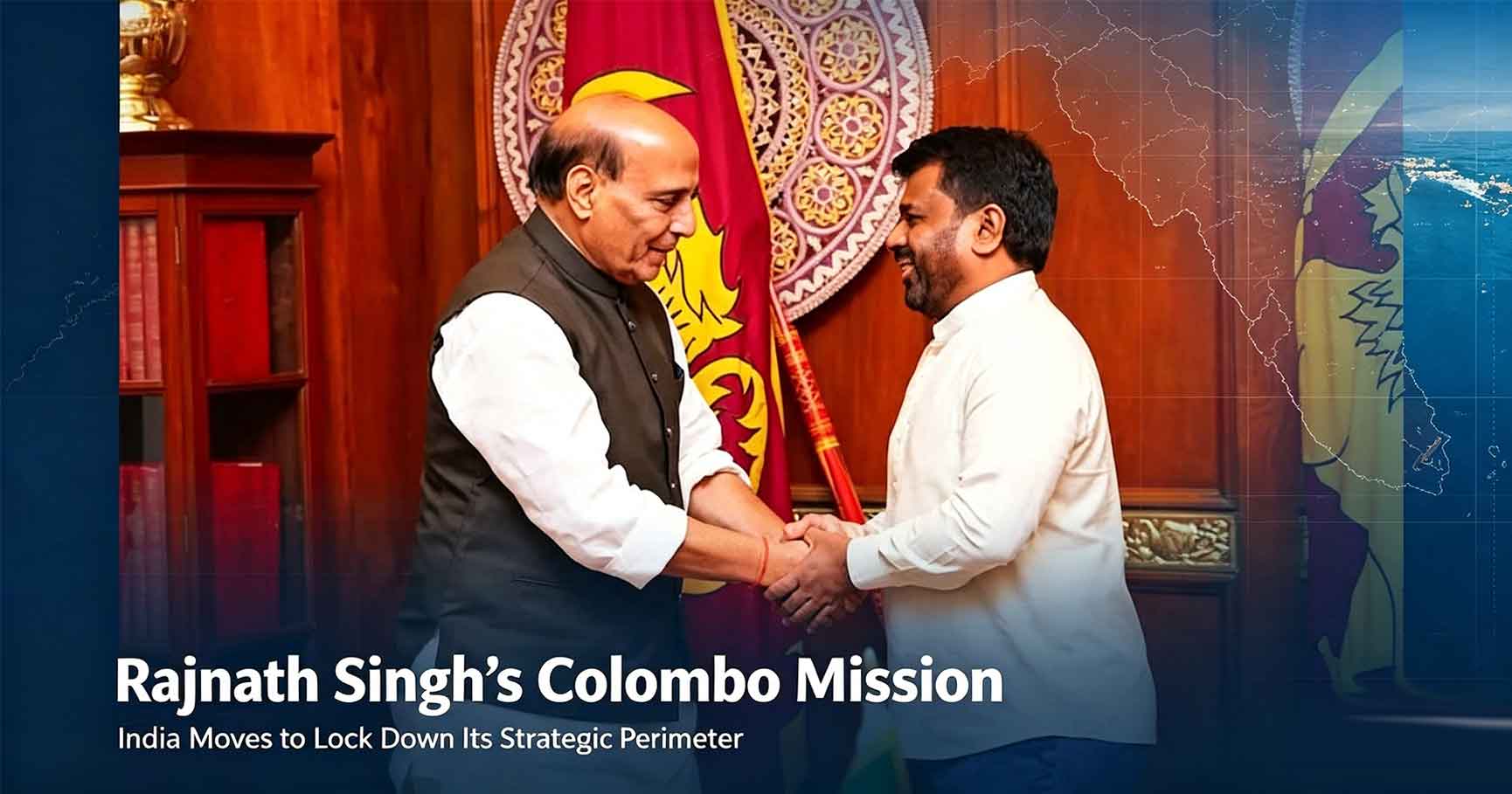
Colombo, Sri Lanka — India has once again sought firm assurances from Sri Lanka that its territory and waters will not be used in any manner hostile to Indian security interests, a position reaffirmed by President Anura Kumara Dissanayake during Indian Defence Minister Rajnath Singh’s recent visit to Colombo, defence sources told this publication.
Singh’s visit comes three years after a previously scheduled trip in September 2023 was abruptly cancelled at the last moment. At the time, the Indian High Commission in Colombo announced the cancellation just hours before the minister was due to arrive, citing unstable weather conditions. However, diplomatic sources noted that the cancellation coincided with China’s request to dock its Yuan Wang 6 tracking vessel in Colombo — a move India strongly opposed.
Under pressure from New Delhi, the Ranil Wickremesinghe administration withheld permission for the Chinese vessel, amid already strained defence relations between the two countries. The tensions prompted Wickremesinghe to impose a one‑year ban on all foreign research and tracking vessels in December 2023 — a temporary measure that expired at the end of 2024 and has not been extended by the current government.
India Seeks Clarity on Sri Lanka’s New Vessel Framework
New Delhi has repeatedly raised concerns with President Dissanayake over the absence of a clear, operational mechanism governing foreign military or research vessels entering Sri Lankan waters. Although Colombo recently submitted a draft framework to India, officials in New Delhi have described it as lacking clarity and specificity. The framework has not been presented to Parliament or made public.
During Singh’s visit, India sought renewed confirmation of Sri Lanka’s commitment to preventing any foreign power from using the island in ways that undermine Indian security. According to defence sources, Singh briefed the Indian central government before leaving Colombo, stating that he had “reaffirmed” this assurance directly with the Sri Lankan President.
India’s Strategic Concerns Intensify
India’s insistence on repeated assurances stems from what its strategic documents describe as Sri Lanka’s tendency to shift policy positions abruptly under global pressure. The current administration’s ideological leanings — viewed in New Delhi as China‑friendly — have further heightened Indian caution, despite Colombo’s growing economic reliance on India and the United States.
India’s broader regional concerns include expanding defence ties between Sri Lanka and countries such as China, Pakistan, Turkey, and Saudi Arabia. A new Turkey–Pakistan–Saudi defence pact, under which an attack on one is considered an attack on all, has added to India’s strategic anxieties. Meanwhile, Turkey is attempting to sell drones to Sri Lanka, Pakistan is exploring naval adjustments in the Bay of Bengal, and China is preparing to launch drone‑based transport services in Colombo.
These developments, coupled with rising concerns over AI‑driven surveillance, data security, and maritime intelligence, have made Sri Lanka a focal point in India’s MAHASAGAR doctrine — New Delhi’s strategic vision for expanding security and economic partnerships across the Indo‑Pacific and Global South.
A Visit Rooted in Regional Power Shifts
Rajnath Singh’s rescheduled visit — after a three‑year delay — reflects India’s need to secure its strategic perimeter amid shifting global and regional alignments. For New Delhi, ensuring that Sri Lanka remains neutral and not a platform for rival powers is more critical than establishing a physical presence on the island.
Diplomatic observers note that India views the current Sri Lankan administration as inexperienced and slow in decision‑making, making it essential for New Delhi to maintain close engagement to avoid strategic surprises.
As regional power competition intensifies, Sri Lanka’s position between major geopolitical actors continues to draw scrutiny — and India’s latest diplomatic push signals that Colombo’s choices will remain under close watch.
About the Author