
The Australian Advocacy for Good Governance in Sri Lanka (AAGGSL) has emphasised to the Sri Lankan government that the mandate it received from the people was not merely to change the name of the Prevention of Terrorism Act (PTA), but to dismantle the unchecked system of powers that has made the legislation susceptible to abuse.
The AAGGSL, chaired by Lionel Bopage, a former General Secretary of the Janatha Vimukthi Peramuna (JVP), has called on the JVP leader to immediately suspend the use of the PTA.
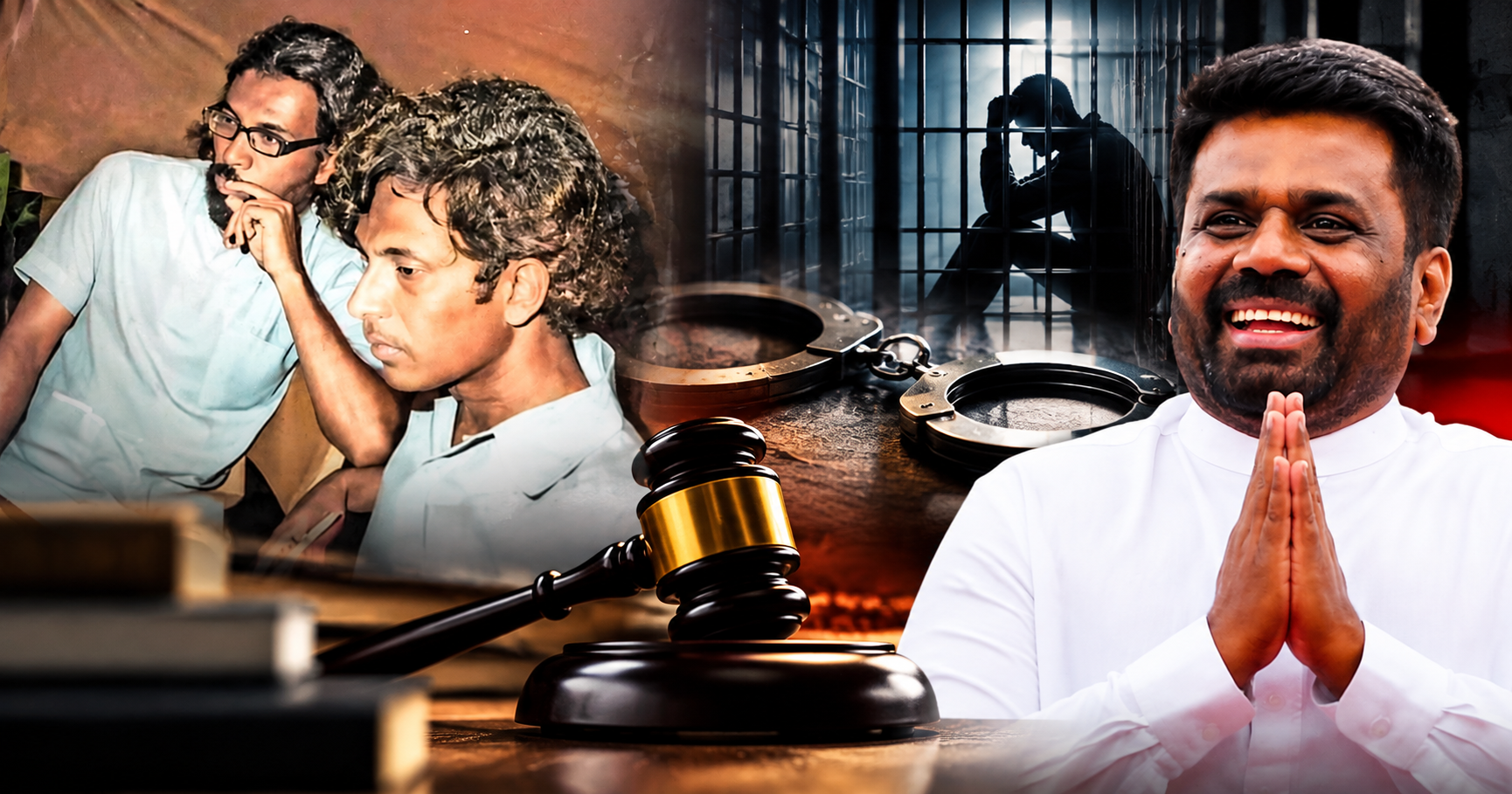
Lionel Bopage served as General Secretary of the Janatha Vimukthi Peramuna (JVP) from 1978 until February 1984. Following the failed April 1971 insurrection, he was the second accused in the principal case heard before the Criminal Justice Commission. He subsequently spent much of the next seven years imprisoned at Welikada Prison alongside the party’s founder, Rohana Wijeweera.
Together, they drafted the JVP’s policy manifesto. The sections concerning Tamil-speaking communities in the Northern and Eastern provinces and the plantation sector — including the party’s recognition of the Tamil people’s right to self-determination — were largely Bopage’s work.
In July 1983, the JVP Central Committee voted to abandon that commitment. Bopage was one of only two members who voted in favour of retaining it. He resigned from the party several months later.
During the second JVP insurrection and the state’s counterinsurgency campaign between 1987 and 1989, Bopage faced threats from both sides. He subsequently left Sri Lanka and eventually settled in Australia.
Statement on the ‘Protection of the State from Terrorism Bill’
Australian Advocacy for Good Governance in Sri Lanka (AAGGSL), representing Sri Lankan Australians committed to democracy, the rule of law and equal citizenship, respectfully urges every Member of Parliament—government and opposition alike—to reject the Protection of the State from Terrorism Bill in its present form. Although we welcome the Government’s intention to repeal the Prevention of Terrorism (Temporary Provisions) Act No. 48 of 1979 (PTA), the Bill preserves too many of the powers that enabled the PTA to serve as an instrument of abuse for 47 years.
1. The Government’s declared objective
The NPP manifesto (A Thriving Nation, A Beautiful Life, p. 129) promised the “Abolition of all oppressive acts including the PTA”. The Bill, presented to Parliament on 6 October 2026, formally repeals the PTA. That step must be assessed against the Government’s own assurances: in June 2026, the Minister of Justice said the new law would target terrorism alone, while the President promised precise definitions and safeguards against misuse. Sri Lanka has also undertaken to the UN and the EU, including as a condition of GSP+, to replace the PTA with legislation that meets international standards.
We accept these intentions, but the Bill does not fulfil them. Amnesty International, UN special procedures and the Centre for Policy Alternatives identify four key concerns: the definition of terrorism includes “unduly compelling” a government, potentially capturing ordinary political pressure; security forces may arrest without a warrant on “reasonable suspicion”; the Defence Secretary may order detention for up to a year without a magistrate being able to overturn it, and a person may be held without charge for up to two years; and the President may proscribe organisations while officials declare “prohibited places”, with little judicial oversight.
Exclusions for protest, advocacy, dissent, labour action and humanitarian work do not overcome the Bill’s central defect: the executive retains the power to determine who is detained and for how long. At the same time, access to effective judicial review remains limited. Magistrates’ visits to detention sites improve oversight, but they do not transfer control of detention from the executive to the courts.
2. Four decades of abuse
The PTA’s history demonstrates how exceptional powers introduced as temporary measures can become permanent and expand beyond their original purpose. Parliament enacted it in July 1979 as a three-year response to violence in the North. Certified as urgent, it gave the Supreme Court only hours for review and passed in a single day; in 1982, it was made permanent. It authorised detention for 18 months on a Minister’s order and made confessions to police admissible. Its first detainees were reportedly two Sinhalese opposition activists. After Tamil PTA prisoners were killed in Welikada Prison in July 1983, the Government proscribed the JVP, the Communist Party and the Nava Sama Samaja Party on an accusation since shown to be false.
Every government since 1979 has used the PTA, and none has published a full count of those detained. By 1990, some 6,700 suspected JVP members were held under emergency and anti-terrorism powers. In 2018, the Human Rights Commission of Sri Lanka (HRCSL) found that over half of PTA suspects had been held for 5 to 15 years without their cases being concluded. More than 600 people were arrested under the PTA between 2019 and 2022. Data released in 2024 showed high acquittal rates in PTA cases.
Behind these numbers are people: journalist J. S. Tissainayagam, sentenced to 20 years for his writing; Vasanthi Raghupathy Sharma, held over 15 years before acquittal; poet Ahnaf Jazeem, held 19 months over a book of Tamil poetry; lawyer Hejaaz Hizbullah, held about two years; and student leader Wasantha Mudalige, whose arrest the Supreme Court found had no legal basis. Because the PTA admits confessions to police, it invites torture and false accusations. Those later found innocent have received no apology or compensation.
3. The current Government’s own use of the PTA
The present Government’s own record shows why statutory safeguards must not depend on assurances of restraint. HRCSL records 46 PTA-related detentions in 2025 and 12 in the first quarter of 2026. In March 2025, shop worker Mohamed Rusdi, 22, was detained on a presidential order for pasting stickers critical of a foreign state; the HRCSL later found his detention unlawful and arbitrary. In June 2026, Tamil hip-hop artist Sangeethan Ganeshkumar was detained over a music video. Ministers say the PTA is now used against organised crime, yet the Supreme Court held in March 2026 that it cannot lawfully be used for ordinary crimes. A law is not safe merely because current officeholders promise to use it well.
4. A test of the Government’s own promise
For decades, the JVP—and, more recently, the NPP—campaigned to abolish the PTA; the JVP itself was proscribed, and its members were detained under such powers. This Bill is not abolition: it renames the PTA and keeps its core of executive detention, warrantless arrest, broad offences and limited judicial control. Critics labelled the 2018 and 2023 Bills and the Government’s December 2025 draft as repackaged versions of the PTA; none became law. Governments changed; powers remained. A parliamentarian who would not trust these powers in the hands of political opponents should not vote to create them.
5. Our appeal
We ask Parliament not to leave Sri Lanka unprotected, but to protect the country without repeating the injustices of the past 47 years. We therefore urge the Government and Parliament to:
- Impose an immediate moratorium on the use of PTA.
- Undertake further open and transparent consultation with PTA victims, affected communities, the Bar, civil society and the HRCSL, and table an amended Bill for parliament’s consideration.
- Define terrorism narrowly in accordance with the UN model definition.
- Place every detention under judicial control and bring the detainees promptly before a magistrate.
- Make confessions to police inadmissible and prosecute ordinary crimes under ordinary criminal law.
- Repeal the PTA immediately upon the passing of the new amended Bill.
- Acknowledge and remedy past harm by reviewing remaining PTA cases, releasing those held without charge or trial, and providing an apology and reparation.
The Government has a mandate not merely to rename the PTA, but to end the system of unchecked power that made it abusive. We stand ready to support a counter-terrorism framework that protects Sri Lankans from violence while also protecting liberty, due process and equal citizenship. A government that positively responds to community concerns will earn the people’s respect.
Signed
Lionel Bopage
President,
Australian Advocacy for Good Governance in Sri Lanka (AAGGSL)
Melbourne, Australia
About the Author