

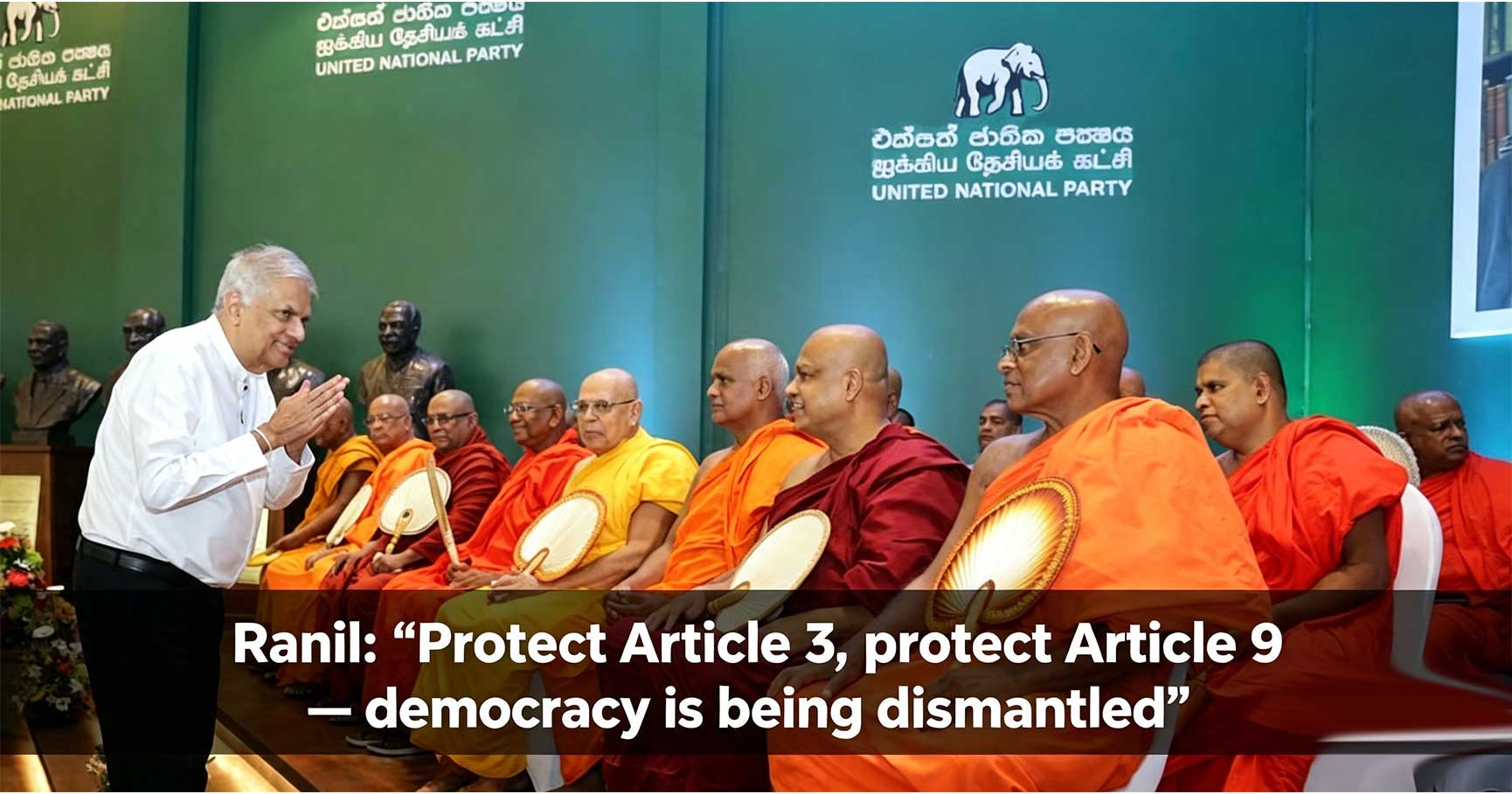
“Who governs this country today? Is it the Parliament, or is it Pelawatte? When such questions arise, the sovereignty of the people must be protected. Article 3 of the Constitution must be safeguarded. And according to Article 9, Buddhism must be protected,” says the 8th Executive President, Ranil Wickremesinghe.
This was stated by President Ranil Wickremesinghe at the 80th anniversary celebration of the United National Party.
“On 6 September 1946, D. S. Senanayake and a group of leaders founded the United National Party. When appointing officials, S. W. R. D. Bandaranaike took the chair and proposed D. S. Senanayake’s name for leadership.”
“Although the founding members are no longer here, their children and grandchildren continue to work with this party. Likewise, similar groups exist within other parties as well. Among the founding members was D. A. Rajapaksa. Two of his sons later served as Presidents of this country.”
“Today we begin the 80th anniversary. On 17 September, we will commemorate President J. R. Jayewardene’s 120th birth anniversary. Starting from here, we will hold a convention in December to educate the public about the service rendered to the nation.”
.png)
“By then, the modern United National Party will emerge. I hope to shape the ideology of this modern UNP according to today’s needs, introduce new faces, and build a Sri Lanka ready for the 21st century.”
“The theme we begin today is ‘Sovereignty’. In 1948, D. S. Senanayake, S. W. R. D. Bandaranaike and many leaders gained independence for this country. We functioned as a sovereign state.”
“Later, Queen Elizabeth II was legally recognized as the Queen of Ceylon. She held our final monarchical position.”
“In 1955, by becoming a member of the United Nations, we reaffirmed our status as a sovereign state. In 1970, Sirimavo Bandaranaike’s government was granted the authority to convene a Constituent Assembly. Accordingly, the Republican Constitution was drafted and implemented on 22 May 1972.”
“Through this Republican Constitution, sovereignty was vested in the people. But its exercise was entrusted to the National State Assembly. In the 1977 election, the UNP sought several amendments—most importantly, that sovereignty should be exercised directly by the people.”
“Since we won 140 seats, we introduced the Second Republican Constitution with the new amendments. Article 3 of that Constitution clearly states that sovereignty belongs to the people and cannot be alienated. Article 4 identifies the institutions that exercise sovereignty: Parliament, the President, and the Judiciary.”
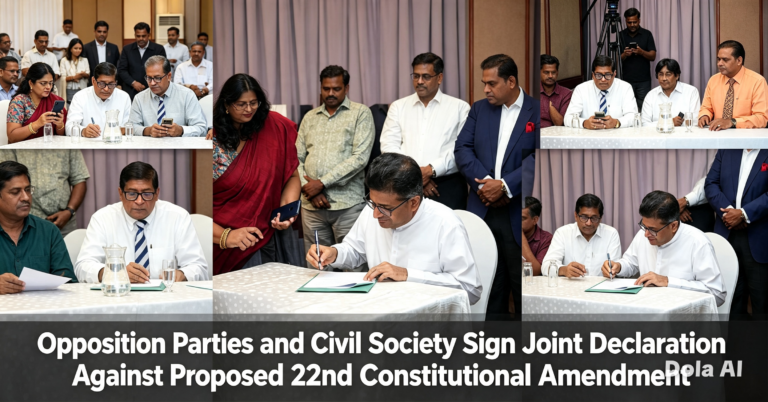
“Today, this system faces a major threat—the rejection of people’s sovereignty. As a party, we opposed the 22nd Amendment because it did not require a referendum. Therefore, we requested the Supreme Court to mandate a referendum to ensure its constitutionality.”
“But today, through various programs, we see restrictions and harassment against political parties, and politicians being arrested without cause. All of this aims to eliminate democracy and the opposition. It also seeks to suppress free trade unions.”
“Now they attack the Bar Association. They attack doctors. And a major concern is the campaign against the Buddhist clergy. All of this destroys the Constitution and the sovereignty of the people.”
“The opposition is not allowed to speak in Parliament. Opposition Leader Sajith Premadasa was not allowed to enter Parliament when Bar Association President Rajiv Amarasinghe was invited. Such actions have taken place.”
“Considering all this, who governs this country? Parliament—or Pelawatte? When such questions arise, we must protect people’s sovereignty. We must safeguard Article 3 of the Constitution. And according to Article 9, Buddhism must be protected.”
“Let us unite. In 1946, everyone came together to build a free Sri Lanka. Today, let us unite again to protect the sovereignty of the nation.”
“I especially invited Namal Rajapaksa, grandson of our founding member D. A. Rajapaksa, to the anniversary celebration. Unfortunately, Namal Rajapaksa was arrested. I strongly condemn this action—both personally and on behalf of the party.”
.png)
About the Author

I like this
An Engaging Blog Post