
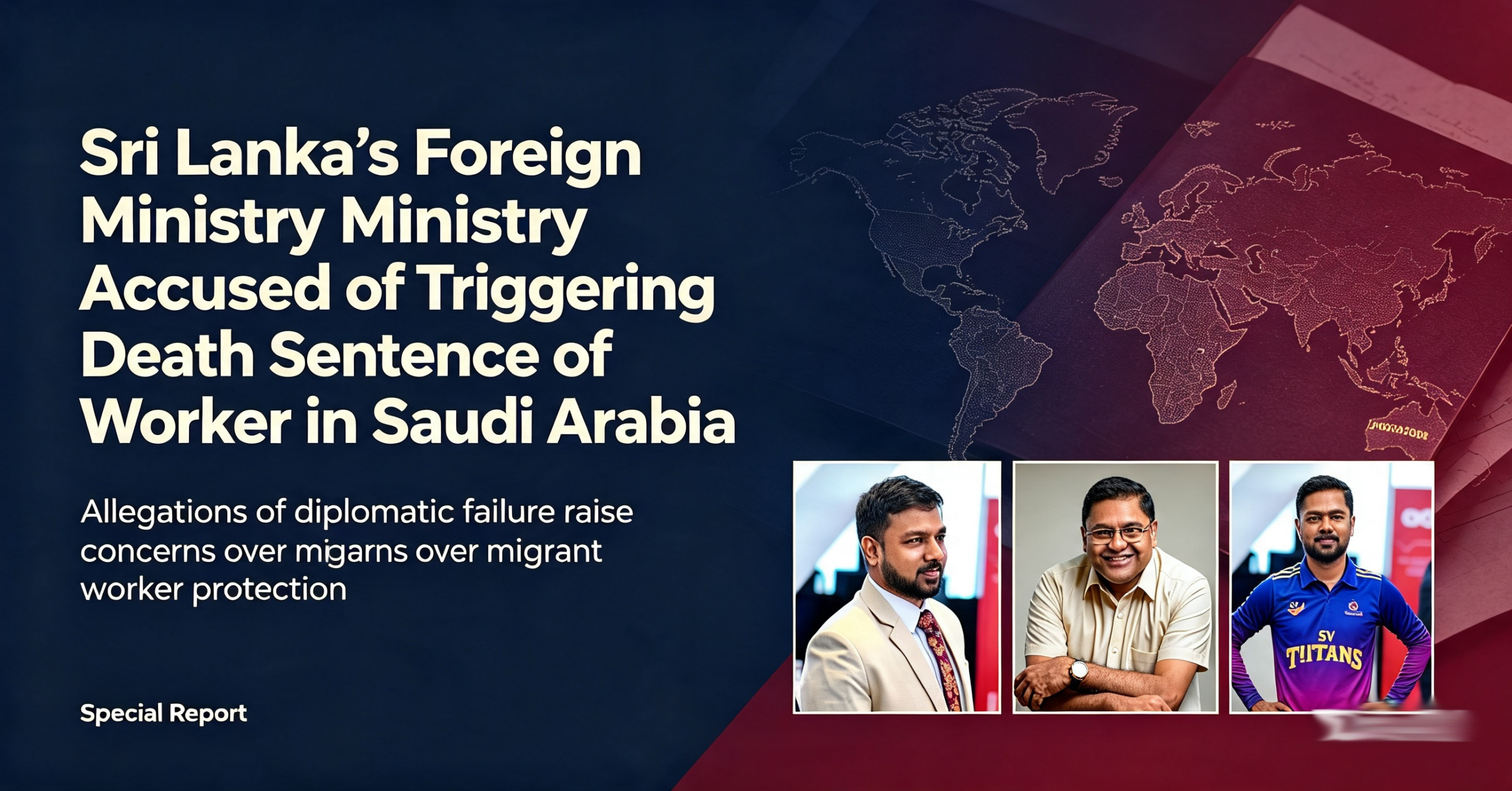
Colombo — Serious allegations have emerged that the Sri Lankan Ministry of Foreign Affairs played a direct role in worsening the legal situation of Sivarasa Anojan, a Sri Lankan national now sentenced to death in Saudi Arabia over a Facebook post referencing Prophet Muhammad.
According to internal accounts from senior officials, the Ministry—under Foreign Minister Wijitha Herath—pushed forward an appeal despite explicit legal advice warning that the chances of success were “extremely low” and that an appeal could expose Anojan to a harsher punishment under Saudi Arabia’s discretionary ta’zir sentencing system.
Five-Year Sentence Escalates to Death Penalty
Anojan had initially been serving a five-year prison term in Saudi Arabia for two offences:
Publishing content on social media deemed harmful to religious values and public morality.
Verbally insulting Prophet Muhammad, an offence punishable under Sharia law without a fixed statutory limit.
The first offence carries a maximum of five years’ imprisonment and a fine of three million Saudi Riyals under the 2007 Anti-Cyber Crime Law. Anojan received the maximum for both.
However, the second offence—insulting the Prophet—falls under ta’zir, where judges may impose any punishment, including death. Saudi Arabia’s Hanbali legal tradition treats such offences as extremely serious, sometimes comparable to apostasy.
Foreign Ministry Pushed Appeal Despite Warnings
A senior official revealed that Deputy Minister Arun Hemachandra insisted on filing an appeal, claiming it would showcase the government’s diplomatic strength if successful.
“We told him the risk was too high,” the official said. “But he spoke with Minister Wijitha and ordered us to proceed.”
The Ministry then instructed Anojan’s family to pay Rs. 1,890,766 (approx. USD 6,300) into an official government account to fund the appeal. The family complied, unaware that the appeal itself could worsen the sentence.
Appeal Filed Without Proper Legal Safeguards
The appeal argued only that the maximum penalties were excessive. It did not dispute Anojan’s guilt.
Crucially, it asked the appellate judges to reconsider the entire punishment—opening the door for the court to impose the harsher ta’zir penalty that the original judges had refrained from applying.
Saudi Arabia does not guarantee that an appellant cannot receive a harsher sentence, unlike Sri Lanka and many other jurisdictions.
Family Not Warned; Documents Sent Too Late
The Ministry sent the appeal documents to Anojan’s father on September 16, more than three weeks after filing and just one day before the appellate decision—too late for any intervention.
The family was never informed of the identity of the lawyer who appeared in court. Although one lawyer was named in official correspondence, a different lawyer represented Anojan during proceedings.
No Path to Clemency
In Saudi murder cases, victims’ families may forgive offenders, suspending the death penalty. Sri Lanka has previously used this mechanism to save citizens.
But in this case, forgiveness is not possible. Only the Saudi King can halt the execution after the sentence is confirmed by two separate five‑judge panels.
Political Reverberations in Sri Lanka
The case has triggered political shockwaves. Critics argue that the Foreign Ministry’s reckless decision-making directly endangered a citizen’s life.
The article also notes historical irony: in 2013, when Sri Lankan domestic worker Rizana Nafeek was executed in Saudi Arabia, JVP leader Anura Dissanayake accused then-President Mahinda Rajapaksa of failing to save her, claiming he would never have allowed such an outcome. Today, under Dissanayake’s own administration, another Sri Lankan faces execution abroad.
A Diplomatic Failure With Human Consequences
Anojan’s case highlights severe lapses in diplomatic judgment, transparency, and legal strategy within Sri Lanka’s Foreign Ministry. With the death sentence now pending final confirmation, the government faces mounting pressure to explain how an appeal intended to reduce a sentence instead placed a citizen on the brink of execution.
About the Author