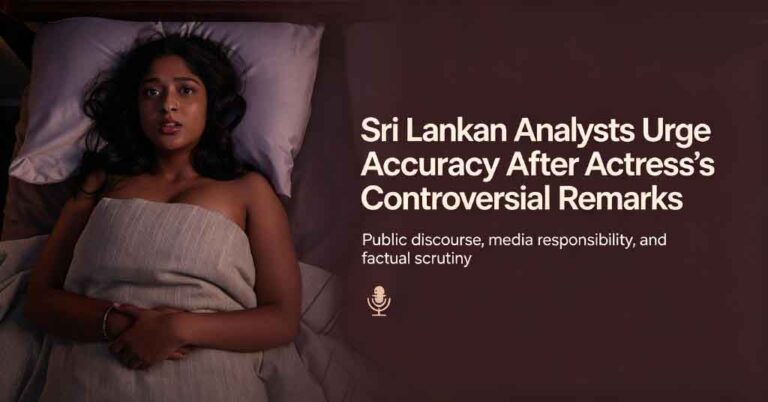

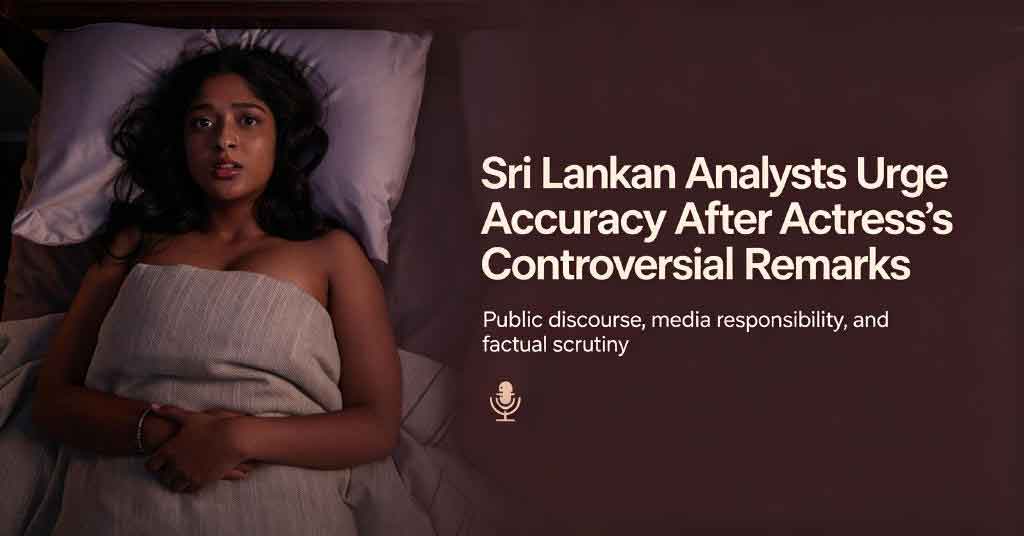
A statement made by actress Maitreyi Ramakrishnan, who appears in the Netflix short film Best of Best, has become a topic of intense discussion on social media. In a conversation, she said the following — you can watch the video below. She states:
“Correct Harry by saying I’m Tamil, which doesn’t technically disprove what part of India are you from, ’cause of course you can be Tamil Indian, right? So then we’re like, ‘Okay, let’s say I’m Tamil Sri Lankan,’ and I’m like, ‘Eh, that’s not really reflective of my identity.’ So you were really respectful to hear and give empathy to how I wanted my identity to be represented, which is saying, ‘I’m Tamil. My family’s from Sri Lanka.’ Which is the same way I, Maithreyi, as you know, Ta, I always say, ‘I’m Tamil of Sri Lankan origin, but I’m Tamil Canadian from Sri Lankan origin. My culture is Tamil. My country is Canada. My roots are from Sri Lanka.’ But — that’s where my parents grew up. That’s where they had to flee from, and I’ve never had a problem talking about that, you know? We can talk about genocide, guys. Don’t get me wrong.”
Maitreyi Ramakrishnan was born on 28 December 2001, in Canada. At that time, Sri Lanka was still suffering under the brutal Eelam war launched by the separatist LTTE militants to divide the country.
“I am Tamil as f”: Maitreyi Ramakrishnan gets candid about her roots in Best of the Best*
“I’m extremely Tamil”: Maitreyi Ramakrishnan speaks openly about her origins in Best of the Best
There is no issue with someone proudly saying “I am Tamil,” “I am Muslim,” “I am Sinhalese,” or “I am Sinhala Buddhist.” Anyone has the right to be proud of their identity.
But we wish to draw attention specifically to this part of her statement:
“My culture is Tamil. My country is Canada. My roots are from Sri Lanka. But that’s where my parents grew up. That’s where they had to flee from… We can talk about genocide, guys.”
Her remark “We can talk about genocide” is what has caused significant concern.
Not only that — she also said on Hasan Minhaj’s show Hasan Minhaj Does Not Know:
“As a Tamil Eelam woman, I love who I am.”
Maitreyi was born and raised in Canada. Her parents came to Canada as refugees during Sri Lanka’s civil war and later obtained Canadian citizenship. Her father, Ram Selvarajah, and mother, Kiruthika Kulendiren, migrated to Canada in the late 1980s as refugees, according to Canadian records.
Do you know how many lies your father told the Canadian government to obtain refugee status?
What we have to say to Maitreyi is simply this…
There is no country called Tamil Eelam in Sri Lanka. There never was. There never will be.
Perhaps you believe that dream will come true because Sri Lanka’s current president, Anura Dissanayake — who has long been supported by segments of the Tamil diaspora — is in power. But dreams seen by others cannot be imposed on us. You may continue dreaming until you wake up.
About your “genocide” claim…
You yourself have said that your mother took you and your brother to protests on the Gardiner Expressway when you were very young. At those protests, you would have repeatedly heard the word “genocide.” That is no secret.
For over 30 years, Sinhalese, Tamils (your own people), Muslims, and Buddhists, Christians, Hindus, and Muslims were massacred by the LTTE in the name of the “Tamil Eelam” you speak of. If you do not know this, you can easily read about it online. With your fluent English, it will not be difficult.
You have also said in an interview with the Georgetown Institute for Women, Peace and Security that participating in protests as a child shaped your understanding of social justice and the need to speak against injustice.
What genocide actually means
According to the United Nations and the 1948 Genocide Convention, genocide is defined as acts committed with intent to destroy, in whole or in part, a national, ethnic, racial, or religious group.
Examples include:
- The Holocaust – Nazi Germany’s systematic murder of six million Jews.
- The Rwandan Genocide (1994) – Hutu extremists killing around 800,000 Tutsis in 100 days.
- The Armenian Genocide (1915) – The Ottoman Empire killing around 1.5 million Armenians.
Genocide is one of the gravest crimes under international law — the “crime of crimes.”
Do you truly know why your father fled Sri Lanka?
He will never tell you. Your mother will never tell you.
The LTTE began extorting money from Tamil civilians. They built their power on Tamil civilians. For nearly ten years, they forced children as young as 10 into combat after poisoning them with cyanide indoctrination.
If your father had not fled in 2001, both he and your brother would likely have been forcibly taken into the LTTE’s Fourth Eelam War. That is the truth your parents will never tell you.
The Tamil diaspora will never tell you the truth either. You must seek it yourself.
We Sri Lankans fought only against LTTE terrorism, not against Tamil people. But the diaspora — funded by LTTE networks — refuses to accept this.
The Sri Lankan military took up arms to end the LTTE’s mass killings of civilians. Despite political betrayals, the Fourth Eelam War ended in 2009 with the death of your leader, Velupillai Prabhakaran, a man responsible for decades of terror.
The freedom gained was enjoyed by all Sri Lankans — including the people of the North.
But from 2019 onward, the country again began drifting into political betrayal, culminating in 2024 with a narrative that encourages forgetting the North–South divide.
Once again, what we have to say to you is this…
Be proud of being Tamil. Be even more proud of being Sri Lankan.
But be ashamed of calling yourself an “Eelam citizen” or speaking lightly about “genocide.”
A person who says anything for popularity is not a true actress — she is merely a performer on a stage.
The UN definition of genocide includes:
- Killing members of a group
- Causing serious bodily or mental harm
- Deliberately inflicting conditions to destroy the group
- Preventing births within the group
- Forcibly transferring children
The LTTE — designated a terrorist organization responsible for severe harm and human rights violations — committed many of these acts against civilians, including Tamils. Your parents know this. Ask them.
The humanitarian operation in Mullivaikkal
The Mullivaikkal humanitarian operation in May 2009 was a military and humanitarian effort by the Sri Lankan Armed Forces to rescue civilians trapped by the LTTE. It is written in Sri Lankan history in golden letters.
~ Panduka Herath ~
About the Author