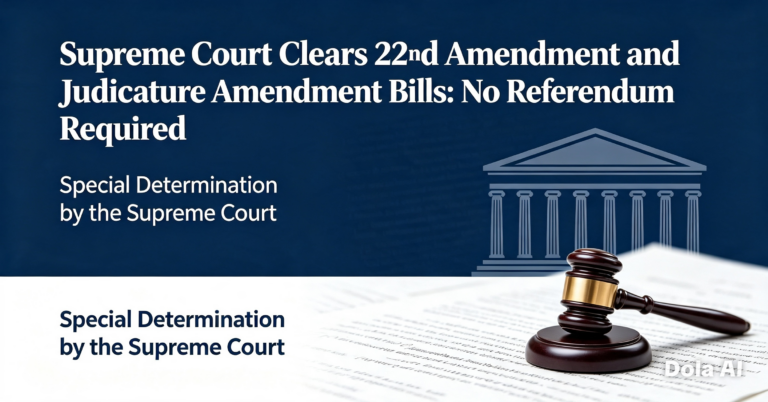

COLOMBO — The Supreme Court has ruled that neither the Twenty Second Amendment to the Constitution nor the Judicature (Amendment) Act requires approval by a referendum, determining that the proposed changes do not violate entrenched provisions of the Constitution, including Article 3 on the sovereignty of the people.
The five‑judge bench—Chief Justice P. Padman Surasena, Justices Achala Wengappuli, Arjuna Obeysekere, Sampath B. Abayakoon, and Gihan Kulatunga—delivered the 96‑page Special Determination following hearings on 72 petitions and 11 intervenient petitions challenging the constitutionality of the two Bills.
Key Amendments Upheld
The Court confirmed that Parliament may pass both Bills with a simple majority. The amendments include:
- Increasing retirement age
- Supreme Court Judges: from 65 to 67
- Court of Appeal Judges: from 63 to 65
- High Court Judges: from 61 to 63
- All other Judges & Magistrates: 62
- Increasing judicial cadre
- Court of Appeal Judges: from 19 to 24
- High Court Judges: from 110 to 120
- Introducing a fixed tenure for future Chief Justices
- A maximum six‑year term, or until age 67, whichever comes first
- The Court recommended adding a proviso ensuring this limit does not apply to the incumbent Chief Justice
Court Rejects Allegations of “Legislative Bribe” and Judicial Conflict of Interest
Several petitioners argued that extending retirement ages constituted an “inducement” or “legislative bribe” to sitting judges, thereby violating judicial independence and Article 3. The Court dismissed these claims as “unfounded, unrealistic and artificial,” noting:
“Any increase in retirement age cannot amount to conferring an inducement or favour to incumbent Judges.”
The bench also rejected arguments that judges should recuse themselves due to personal interest, invoking the Rule of Necessity, and citing past Sri Lankan and international jurisprudence.
Full Court Request Rejected
Petitioners sought a “Full Court” of all 13 Supreme Court judges, claiming conflict of interest. The Court unanimously rejected the motion, affirming that only the Chief Justice has constitutional authority to constitute benches under Article 132.
Non‑Compliance with Article 121(3)
The Court noted that five petitions failed to deliver copies to the Speaker on time, as required by Article 121(3), and should have been rejected in limine. However, they were still considered within the consolidated hearing.
About the Author