
The World Health Organization certified Sri Lanka as a country that had eliminated measles in 2019. However, the Epidemiology Unit reported that a measles outbreak that began in Colombo in May 2023 subsequently spread to other districts.
On 9 July 2019, the World Health Organization officially announced that Sri Lanka had eliminated measles. The announcement followed a detailed assessment of the country’s disease surveillance data and control programmes by an independent expert verification committee.
Epidemic Diseases | Investigative Report | 9 November 2026
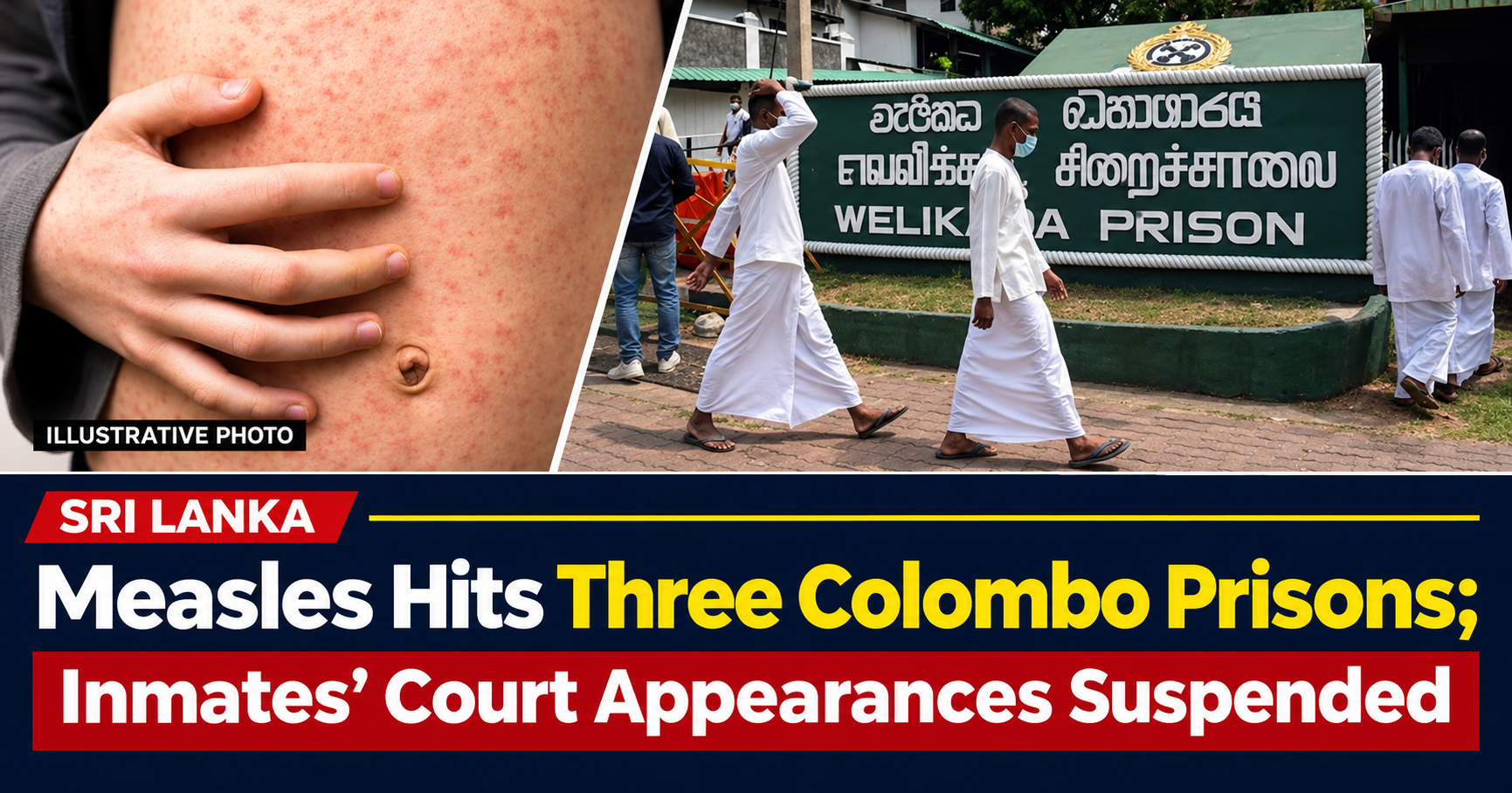
The Department of Prisons says that the production of inmates from Colombo Remand, Magazine and Welikada prisons before courts has been temporarily suspended following confirmed measles infections among prisoners.
Commissioner of Prisons and media spokesperson Senaka Palletenna said that no inmates from the three prisons were produced before courts on Monday. He added that the relevant courts had been informed of the decision in writing.
Neither the exact number of infected inmates nor a date for resuming their production before courts has been disclosed.
Consequently, inmates from these prisons were not brought before the Colombo High Court, Colombo Chief Magistrate’s Court or Fort Magistrate’s Court.
Palletenna said that several inmates at Magazine and Welikada prisons had been confirmed as having measles over the past few days. The precautionary measure was taken because the disease could spread rapidly among other prisoners.
Measles has begun spreading in three Colombo prisons where several politicians, including Namal and Chamara, are being held! No inmates were brought to court today!
A vaccination programme has begun inside the prisons, and arrangements are being made to resume producing inmates before courts as soon as possible, he said. However, neither the exact number of infected inmates nor a date for resuming court appearances has been disclosed.
Measles is a highly contagious airborne disease. Controlling its spread can be particularly difficult in crowded, enclosed spaces. Welikada, the country’s largest prison, is situated next to the Magazine Prison premises.
Sri Lanka’s prison system has previously faced serious crises arising from outbreaks of infectious diseases. During the COVID-19 pandemic, the first infected person at Welikada Prison was identified on 7 July 2020. According to the report provided, the prison-related COVID-19 cluster had recorded 4,395 infections and nine deaths by the end of January 2021.
Measles is a viral infection that spreads very easily through the air. An infected person can transmit the disease to others when coughing or sneezing.
The main symptoms include fever, cough, a runny nose, red eyes and, subsequently, a red, blotchy rash that begins on the face and spreads across the body. It can affect both children and adults and may sometimes cause serious complications, including pneumonia and inflammation of the brain. Receiving two doses of a measles-containing vaccine is the main protection against the disease.
According to statistics cited at the time, Welikada Prison, which had facilities for 2,000 inmates, was holding approximately 4,500 prisoners. These historical figures illustrate the challenges that overcrowding poses to infectious disease control.
On 29 November 2020, 11 inmates were killed and more than 100 others injured in shootings during a protest at Mahara Prison over rising COVID-19 infections. The report also states that, in 2023, a magistrate’s court ruled that the deaths resulting from those shootings constituted a crime.
The World Health Organization certified Sri Lanka as having eliminated measles in 2019. However, an outbreak that began in Colombo in May 2023 subsequently spread to other districts. The Epidemiology Unit had reported that the outbreak was largely under control by May 2025.
Containing the disease while minimising delays to prisoners’ court proceedings are now key challenges facing the authorities following the latest infections in prisons.
“Elimination of measles is achieved when a country interrupts transmission of indigenous virus for three years.”
This means that a country is considered to have achieved measles elimination when transmission of the indigenous measles virus has been interrupted for three years.
Source: World Health Organization — Announcement dated 9 July 2019
About the Author