
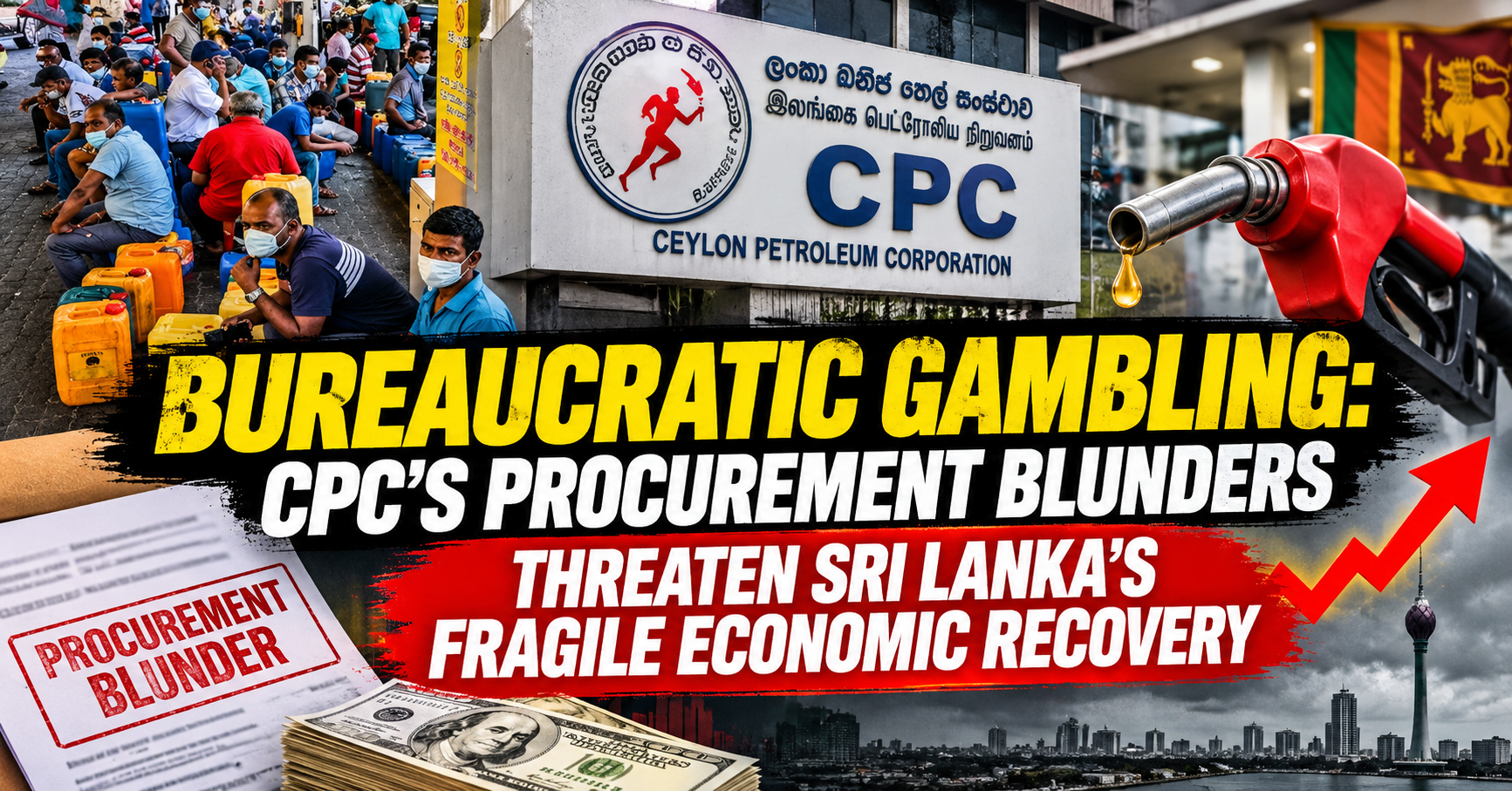
From a US$4.08 to a US$48 diesel premium to escalating crude supply disputes, a series of questionable decisions by the Ceylon Petroleum Corporation raises serious concerns over public finances, energy security and institutional accountability.
COLOMBO: Sri Lanka’s fragile economic recovery faces another potential setback as a series of controversial procurement decisions and contractual disputes involving the state-owned Ceylon Petroleum Corporation (CPC) threaten to undermine the country’s energy security and place additional pressure on already strained public finances.
At the centre of the controversy are an extraordinary increase in the premium paid for emergency diesel supplies, unresolved disputes over crude oil shipments, and questions about whether the corporation’s management prioritised contractual positions over the practical necessity of maintaining uninterrupted fuel supplies.
The dispute over a 700,000-barrel crude oil shipment scheduled for November is particularly concerning. According to the information presented in the controversy, the CPC’s own internal communications had identified the shipment as being of critical importance.
Yet, instead of securing a practical resolution to ensure the timely delivery of crude oil, the corporation appears to have become increasingly entangled in contractual disagreements with suppliers.
For a country that experienced a devastating fuel crisis in 2022, such developments raise uncomfortable questions about whether the lessons of that crisis have been adequately learned.
THE US$48 DIESEL PREMIUM: WHY WAS THE CPC PAYING ALMOST 12 TIMES MORE?
One of the most serious issues emerged from parliamentary disclosures made on 7 May 2026.
Under an existing term contract with a Singapore-based trading company, the agreed premium for auto-diesel was reportedly US$4.08 per barrel.However, on 30 and 31 March 2026, the CPC reportedly purchased an emergency diesel cargo from the same supplier at a premium of US$48 per barrel.
The difference amounts to US$43.92 per barrel, meaning the emergency premium was almost 12 times the contracted rate.This was not a comparison of the underlying crude oil price. It was a comparison of the additional premium paid to secure the supply.
The financial implications could be substantial, particularly when multiplied across large fuel shipments.
The CPC has reportedly justified the higher premium by referring to volatility in international energy markets caused by geopolitical tensions and disruptions to global supply chains.However, questions remain over the commercial rationale behind awarding an exceptionally expensive emergency contract to a supplier that had reportedly failed to deliver all its agreed shipments.
According to a report published by the Daily FT on 1 May 2026, the trader had delivered only two of five contracted shipments, citing international market disruptions.If those circumstances are accurate, the decision to award the same supplier an emergency contract at a premium nearly 12 times higher than the existing contractual rate demands a detailed explanation.
Who approved the transaction? What alternative suppliers were considered? Was a competitive procurement process followed? And what safeguards were in place to protect public funds?
These are questions that cannot be answered simply by referring to international market volatility.
THE CRUDE OIL DISPUTE: A CONTRACTUAL VICTORY AT THE EXPENSE OF ENERGY SECURITY?
The controversy extends beyond diesel procurement.
The CPC has also become embroiled in disputes involving two crude oil transactions: a March term cargo reportedly priced at approximately US$63.99 per barrel and a May spot cargo priced at around US$110.75 per barrel.The corporation reportedly pursued the delivery of the cheaper March cargo while cancelling the May spot shipment and encashing a US$1 million performance guarantee.
From a contractual perspective, recovering a performance guarantee may appear to protect the financial interests of the state.But the more important question is whether such action secured the physical supply of crude oil required to keep the Sapugaskanda refinery operating.
A performance guarantee cannot replace a crude oil shipment. Nor can a contractual dispute resolve an immediate shortage of essential petroleum products.The CPC must therefore explain whether it adequately assessed the operational consequences of cancelling the May shipment and whether alternative arrangements were secured to prevent interruptions to refinery operations.
The potential consequences are significant.
A disruption in crude oil supplies could affect domestic production of furnace oil, aviation fuel and diesel, increasing Sri Lanka’s dependence on imported refined petroleum products.Such a situation could force the country back into the international spot market, where emergency purchases may expose the state to substantially higher prices and additional premiums.
For an economy still attempting to rebuild its foreign exchange position, this would represent a serious financial and strategic setback.
Sri Lanka has already paid an enormous price for failures in energy governance. The country cannot afford to repeat that experience because of decisions made by the very institution entrusted with preventing another fuel crisis.
THE ECONOMIC CONSEQUENCES: WHO WILL PAY FOR THE CPC’S DECISIONS?
The consequences of questionable procurement decisions at a state-owned petroleum monopoly extend far beyond the corporation itself.
Ultimately, the financial burden is likely to be transferred to the Treasury, businesses and ordinary consumers.
1. Increased pressure on foreign exchange reserves
Paying substantially higher premiums for imported fuel increases the country’s foreign exchange requirements.
At a time when Sri Lanka must carefully manage its external financing position, unnecessary or poorly negotiated procurement costs could place additional pressure on the balance of payments and the country’s foreign exchange resources.
2. Higher fuel prices and cost-of-living pressures
Excessive procurement costs can eventually feed into domestic fuel pricing, depending on the applicable pricing formula and the timing of cost recovery.
Higher fuel prices also have wider economic implications, affecting transport, electricity generation, industrial production and food distribution.
The resulting increases in operating costs can ultimately be passed on to consumers.
3. Damage to Sri Lanka’s credibility in international energy markets
Contractual disputes, delivery failures and deteriorating supplier relationships could complicate future procurement negotiations.
If suppliers perceive Sri Lanka as a high-risk commercial counterparty, they may demand stronger payment guarantees, stricter contractual conditions or higher risk premiums.
That could make future fuel imports even more expensive.
WHO IS ACCOUNTABLE FOR THE FAILURE?
The CPC cannot treat these developments as ordinary administrative disagreements.
The corporation has a fundamental responsibility to ensure the uninterrupted supply of petroleum products while protecting public funds and maintaining the country’s energy security.The extraordinary difference between the contracted and emergency diesel premiums, the reported failure to complete agreed shipments, and the escalating crude oil disputes warrant independent scrutiny.
Parliament must demand a comprehensive explanation from the CPC’s management and the relevant ministry.The Auditor General should examine the procurement decisions, emergency approvals, contractual obligations and financial implications of the transactions.
Where evidence of misconduct, negligence or unlawful financial loss emerges, the relevant investigative and law enforcement authorities should determine whether further action is justified.
The investigation should establish who authorised the emergency diesel purchase, why the substantially higher premium was accepted, what measures were taken following the supplier’s reported delivery failures, and whether the decisions surrounding the crude oil shipments were consistent with the country’s national energy requirements.
SRI LANKA CANNOT AFFORD ANOTHER MAN-MADE FUEL CRISIS
Sri Lanka’s economic recovery remains vulnerable to external shocks, foreign exchange pressures and weaknesses in public-sector management.In such circumstances, the CPC should be exercising the highest levels of commercial discipline, transparency and operational foresight.
Instead, the reported procurement decisions and contractual confrontations have raised serious questions about the corporation’s ability to manage one of the country’s most strategically important institutions.The central issue is not whether the CPC can claim a contractual victory or recover a performance guarantee.It is whether the corporation can guarantee the physical supply of fuel at the most economically responsible cost to the country.
A million-dollar guarantee cannot run a refinery. A favourable contract cannot fill an empty fuel tank. And bureaucratic arguments cannot protect the public from the consequences of poor management.
About the Author