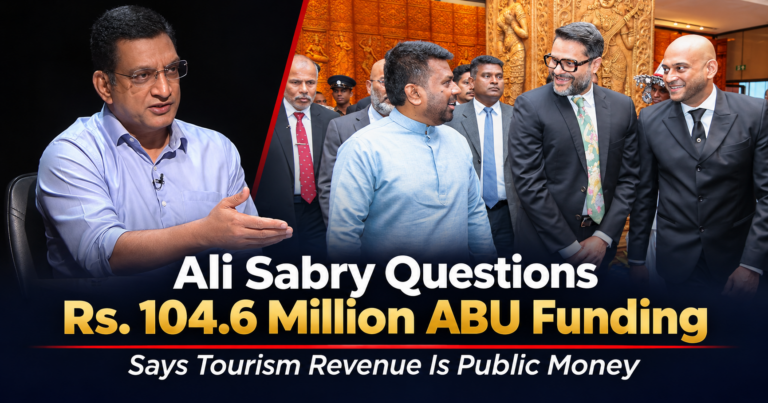

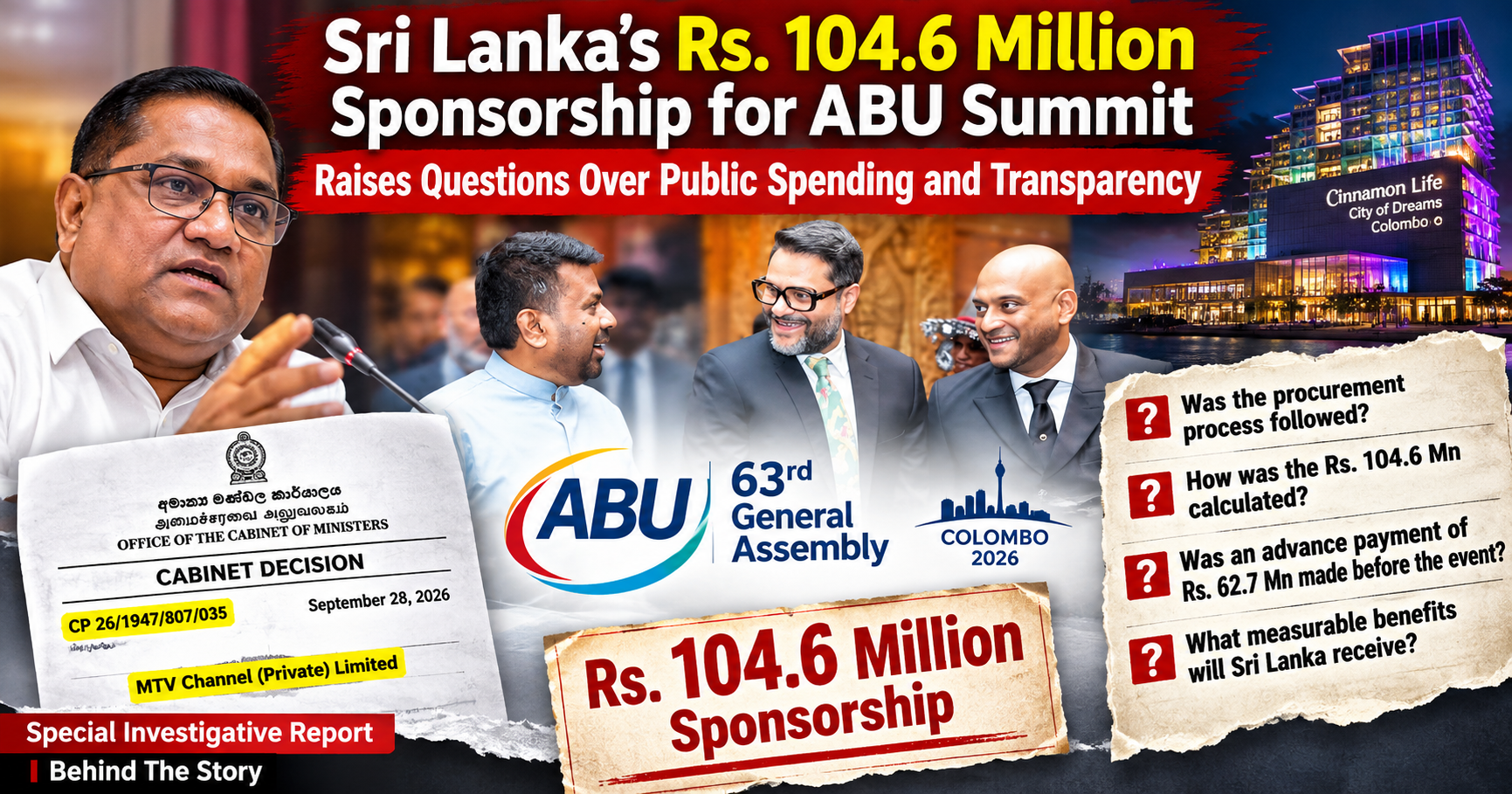
The Sri Lankan government is facing questions over its approval of Rs. 104.6 million in public funds for MTV Channel (Private) Limited to support the 63rd Asia-Pacific Broadcasting Union (ABU) General Assembly.
A Cabinet proposal submitted by Foreign Minister Vijitha Herath and approved in September 2026 has raised concerns about procurement transparency, budget reallocations and payment conditions.
The controversy intensified after documents reportedly revealed a proposed Rs. 62.7 million advance payment, despite Finance Ministry conditions requiring evidence of completed activities before payment.
The government also projected Rs. 250 million in international media exposure, but questions remain about how this benefit would be measured.
The key issue is whether public money was allocated transparently and in accordance with financial regulations.
Special Investigative Report | Behind The Story|COLOMBO, Sri Lanka — November 2, 2026
A Sri Lankan Cabinet decision to approve approximately Rs. 104.6 million in government sponsorship for MTV Channel (Private) Limited, the host broadcaster of the 63rd Asia-Pacific Broadcasting Union (ABU) General Assembly, has raised serious questions about public procurement procedures, financial accountability, budget reallocations and payment conditions.
According to Cabinet documents cited in an investigative report, the sponsorship was proposed by Minister of Foreign Affairs, Foreign Employment and Tourism Vijitha Herath and approved at a Cabinet meeting held on September 28, 2026.
The central concern is not the hosting of an international broadcasting conference in Sri Lanka, but whether the allocation of substantial public funds to a private media company was supported by adequate financial scrutiny, transparent procedures and measurable public benefits.
Cabinet Approval for Rs. 104.6 Million
According to the documents referenced in the investigation, Minister Vijitha Herath submitted the Cabinet memorandum on September 17, 2026, under reference number CP 26/1947/807/035.
The proposal sought approval to provide Rs. 104,603,876 through the Sri Lanka Tourism Promotion Bureau (SLTPB) to support activities associated with the ABU General Assembly.
The event was scheduled to take place from October 30 to November 3, 2026, at Cinnamon Life, City of Dreams, Colombo.
The proposed sponsorship covered the General Assembly and related meetings, the ABU Music Festival, and an excursion programme for international delegates.
While international conferences can contribute to tourism promotion and international visibility, the use of public funds to support a privately hosted event requires clear justification.
How Was the Rs. 104.6 Million Calculated?
The Cabinet memorandum reportedly indicates that the financial allocation was based on a budget estimate submitted by MTV Channel.
However, the available material does not establish whether that estimate underwent an independent financial assessment or whether alternative quotations were obtained.
Several questions remain unanswered:
- Was the proposed expenditure independently evaluated?
- Were competitive quotations obtained from alternative service providers?
- What procurement procedure, if any, was followed?
- Was a cost-benefit analysis conducted?
- What measurable returns were expected for Sri Lanka?
The absence of these details in the cited material does not establish wrongdoing. However, it highlights the importance of disclosing the underlying financial assessments and approval records.
Finance Ministry Conditions Raise Questions Over Advance Payments
One of the most significant issues concerns observations reportedly submitted by the Ministry of Finance, Planning and Economic Development on September 28, 2026, under reference MF/PE/CM/2026/232.
According to the investigation, President Anura Kumara Dissanayake, in his capacity as Minister of Finance, expressed agreement in principle with the proposal, subject to important conditions.
These included justifying the expenditure against measurable outcomes, establishing a formal agreement defining responsibilities and benefits, using approved budget allocations, and obtaining evidence that agreed activities had been completed before payments were made.
However, the Cabinet memorandum reportedly proposed an initial payment of Rs. 62,762,326 on or before September 30, 2026.
This was approximately one month before the scheduled commencement of the conference.
The apparent difference between the proposed advance-payment schedule and the Finance Ministry’s conditions raises an important question: how could an initial payment be processed before the completion of the activities for which supporting evidence was required?
The available material does not confirm whether the initial payment was actually made.
Establishing whether any payment occurred, and under what authorisation, would require access to the relevant agreements, payment vouchers, bank records and board approvals.
Was the Government Procurement Process Followed?
Another concern involves the procurement procedure associated with the sponsorship.
According to the investigative material, a section of the supporting documentation dealing with procurement decisions was marked “N/A”.
This raises questions about whether the sponsorship was treated as a transaction outside conventional competitive procurement requirements.
The documents described in the investigation do not independently establish that procurement regulations were violated.
Nevertheless, authorities should clarify the legal and administrative basis on which the sponsorship was approved and explain whether any procurement exemption was applicable.
The distinction between a sponsorship agreement and a conventional purchase of goods or services is particularly important when public money is involved.
Rs. 350 Million Tourism Promotion Budget Reallocation
The investigation also highlights a proposed reallocation of funds from an existing Rs. 350 million tourism promotion budget.
The original budget category was reportedly identified as:
“Promotion of Destination through Channels Coinciding with International Activities through TV Advertising (International).”
From this allocation, Rs. 104,603,876 was proposed for activities associated with the ABU conference, leaving a reported balance of Rs. 245,396,124.
The documents also refer to transferring funds into a domestic media budget category identified as “Local Media FAMS/Media Gatherings”.
This raises further questions about whether the reallocation was consistent with the intended purpose of the original budget and whether all necessary approvals were obtained.
Breakdown of the Proposed Expenditure
The financial estimate cited in the investigation identifies several major spending categories.
| Expenditure Category | Amount (LKR) |
|---|---|
| Conference venue and catering | 46,542,180 |
| Delegate excursion programme | 12,618,000 |
| Conference production | 24,685,254 |
| Contingency expenses | 2,514,553 |
| Government taxes | 18,270,890 |
| Reported total | 104,603,876 |
The investigation also identifies apparent arithmetic discrepancies in the supporting financial schedules.
Notably, the listed category amounts total Rs. 104,630,877, which is Rs. 27,001 higher than the reported overall figure.
These discrepancies may reflect transcription, calculation or documentation errors, but they warrant clarification before any definitive conclusion is reached.
Rs. 250 Million in Expected Media Exposure
The Cabinet proposal reportedly estimated that Sri Lanka could receive approximately Rs. 250 million in cumulative media exposure through the conference and associated international coverage.
Such exposure could potentially support tourism promotion and strengthen Sri Lanka’s international profile.
However, estimated media exposure is not equivalent to actual revenue or a guaranteed economic return.
Important questions include how the Rs. 250 million valuation was calculated, which international markets were targeted, how many viewers were expected to be reached and whether an independent assessment would verify the results.
A post-event performance report would be necessary to determine whether the anticipated benefits were delivered.
Why Was MTV Channel Involved?
The investigation also questions the potential role of Sri Lanka’s state-owned broadcasting institutions.
However, an important distinction must be recognised.
According to the material, the Asia-Pacific Broadcasting Union had selected MTV Channel to host the 2026 General Assembly in October 2024.
Therefore, MTV’s appointment as host should not be presented as a decision made solely by the Sri Lankan government.
The separate issue is the government’s decision to allocate public funds to support the event.
Authorities should clarify what services and promotional benefits were secured in exchange for the sponsorship and whether state broadcasting resources could have contributed to the programme.
Key Documents That Should Be Made Public
A comprehensive examination of the transaction would require disclosure of the SLTPB board meeting records, MTV Channel’s original financial proposal, budget transfer approvals, the signed sponsorship agreement, procurement assessments or exemptions, payment records and the final performance evaluation.
These records would help establish whether the transaction complied with applicable financial regulations and whether the government obtained value for money.
Public Accountability Remains the Central Issue
Sri Lanka’s government has a responsibility to ensure that public expenditure is transparent, lawful and justified by identifiable benefits.
International events can generate economic and reputational advantages, but those potential advantages do not eliminate the need for financial scrutiny.
The questions surrounding this Rs. 104.6 million sponsorship should therefore be addressed through documentary evidence rather than political accusations alone.
The available material raises issues warranting examination, but it does not conclusively establish corruption, unlawful procurement or improper payment.
The fundamental question remains: was the Rs. 104.6 million sponsorship approved, managed and paid in accordance with the applicable rules, and what measurable benefits did Sri Lanka receive in return?
Until the relevant financial records, agreements and performance assessments are made available, the full extent of public accountability surrounding this expenditure will remain unresolved.
Editorial note: This report is adapted from the supplied Sinhala investigative material. The underlying Cabinet documents, actual payment records and responses from the relevant authorities have not been independently verified for this English version. Allegations and unresolved questions should not be treated as established findings of misconduct.
About the Author