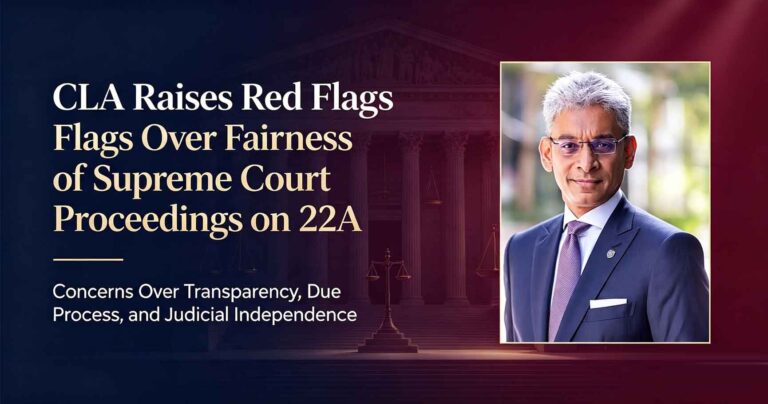

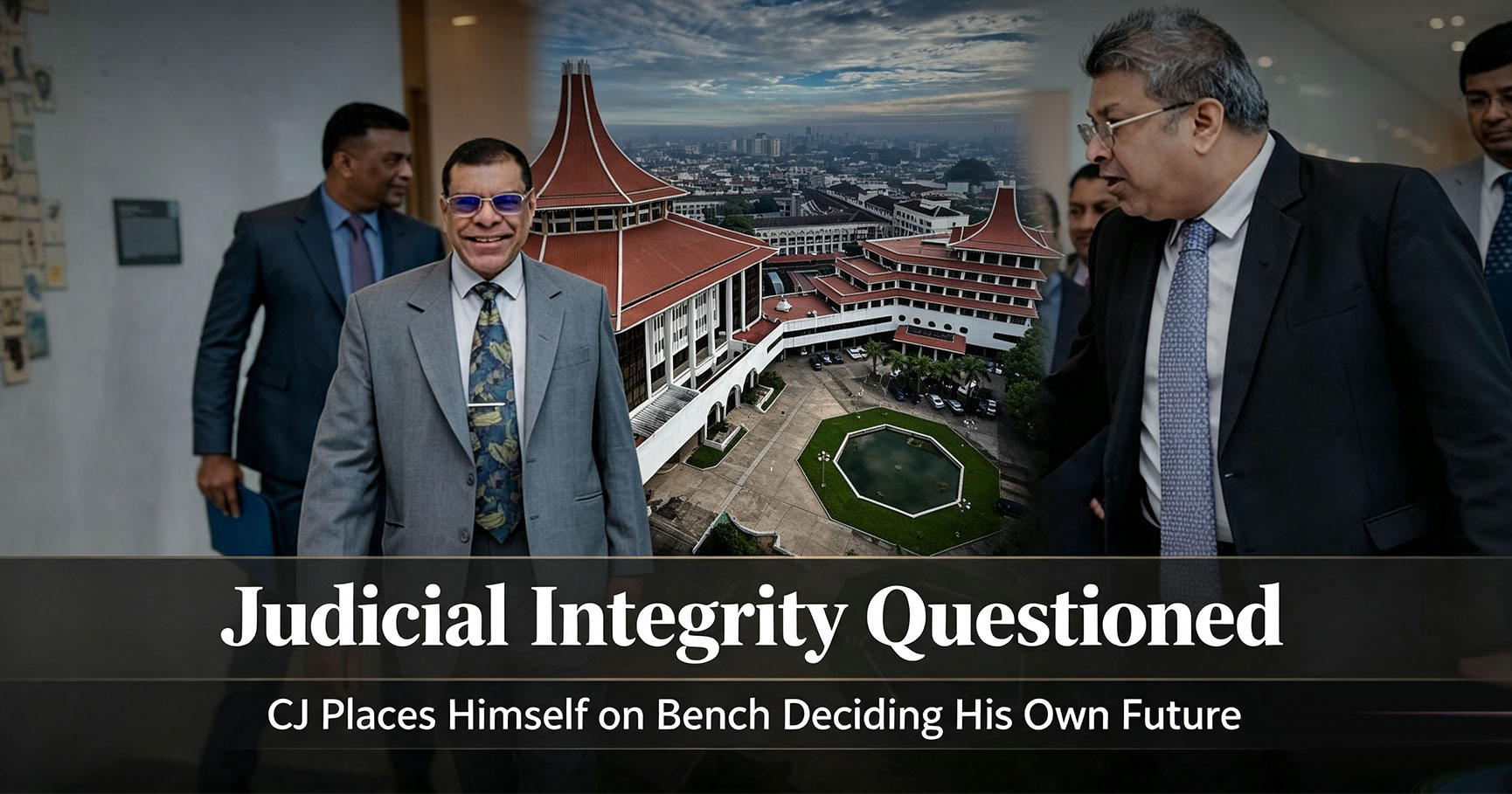
Multiple credible reports show that Chief Justice Surasena has repeatedly declined to convene a full bench for the 22nd Amendment—despite the amendment directly affecting the tenure of Supreme Court judges, including his own. Petitioners, including the Bar Association of Sri Lanka (BASL), have insisted that only a full bench can legitimately hear a matter of such constitutional gravity.
Instead, the Chief Justice has:
- Divided senior judges across three simultaneous amendment-related panels
- Selected junior judges—described as loyal to him—to hear the 22nd Amendment
- Placed himself as presiding judge, despite the amendment directly affecting his retirement age and term limit
- Rejected calls for recusal, even though BASL formally requested he step aside due to conflict of interest
This is not merely a procedural choice. It is a constitutional rupture.
The Contradiction: Condemning Bench Fixing While Practising It
In SC/FR/35/2024, Justice Surasena’s own words were unequivocal:
“In Bulugaha Pathirannehelage Sarith Maheeputhra Pathirathne v. Hon. Mahinda Yapa Abeywardena & Others, SC/FR/35/2024, Justice P. Padman Surasena stated that the practice, “whether it amounts to, or [is] known as, Bench Fixing or Bench Hunting or any other,” irrespective of whether it is done by a petitioner, counsel, instructing attorney or judge, “would undoubtedly be a practice which must be condemned in no uncertain terms and immediately stopped.”
Any practice amounting to bench fixing or bench hunting “must be condemned in no uncertain terms.”
Yet his actions in August 2026 mirror the very conduct he condemned:
1. Selective Bench Composition
The newly appointed five‑judge bench excludes several senior judges who would ordinarily sit on a constitutional matter of this magnitude. This contradicts long‑standing Supreme Court convention and raises legitimate suspicion of Bench Structuring.
2. Personal Stake in the Outcome
The 22nd Amendment proposes to raise the retirement age of Supreme Court judges and introduce a six‑year term limit for the Chief Justice. Surasena is the first beneficiary of the amendment. Natural justice demands that no one should be a judge in their own cause—yet he has chosen to preside.
3. Rejection of Full Bench Requests
Opposition parties and petitioners asked for a full bench of 12 judges, citing the amendment’s impact on judicial independence. The Chief Justice refused.
4. Accelerated Listing and Control of Procedure
The order to list all petitions on 01 September 2026, with the Chief Justice himself controlling the inquiry, further consolidates his influence over the outcome.
Why This Matters: Judicial Independence Is the Last Line of Defence
The 22nd Amendment is not a routine legislative proposal. It alters the structure and tenure of the judiciary itself. Critics—including BASL, former BASL President Saliya Peiris, and multiple civil society groups—warn that the amendment could:
- Undermine judicial independence
- Enable executive influence over the courts
- Constitute “abusive constitutionalism”
- Require a referendum under Article 83 due to its impact on the sovereignty of the people
When the Chief Justice personally shapes the bench that will decide a case affecting his own future, public confidence in the judiciary is not merely shaken—it is fractured.
A Pattern of Behaviour, Not an Isolated Incident
The controversy surrounding the 22nd Amendment bench is not an isolated event. It follows earlier concerns about:
- Selective appointment of junior judges
- Strategic division of senior judges across multiple panels
- Increasing political pressure on the judiciary
- Government figures defending the Chief Justice while attacking critics in Parliament
This pattern suggests a judiciary drifting away from independence and toward executive‑aligned consolidation.
Conclusion: A Verdict That Deepens the Crisis
The Chief Justice’s 31 August order is more than an administrative act—it is a constitutional statement. And it is a troubling one.
By appointing a lower bench and including himself in it, Chief Justice Surasena has:
- Violated the principle of natural justice
- Contradicted his own judicial pronouncements
- Ignored calls for recusal
- Undermined public trust in the Supreme Court
- Raised serious questions about judicial capture and institutional integrity
Sri Lanka’s judiciary now faces a defining test: Can it rise above individual interests and political pressures, or will it allow the erosion of its own independence from within?
The coming weeks will determine not only the fate of the 22nd Amendment, but the credibility of the Supreme Court itself.
About the Author