
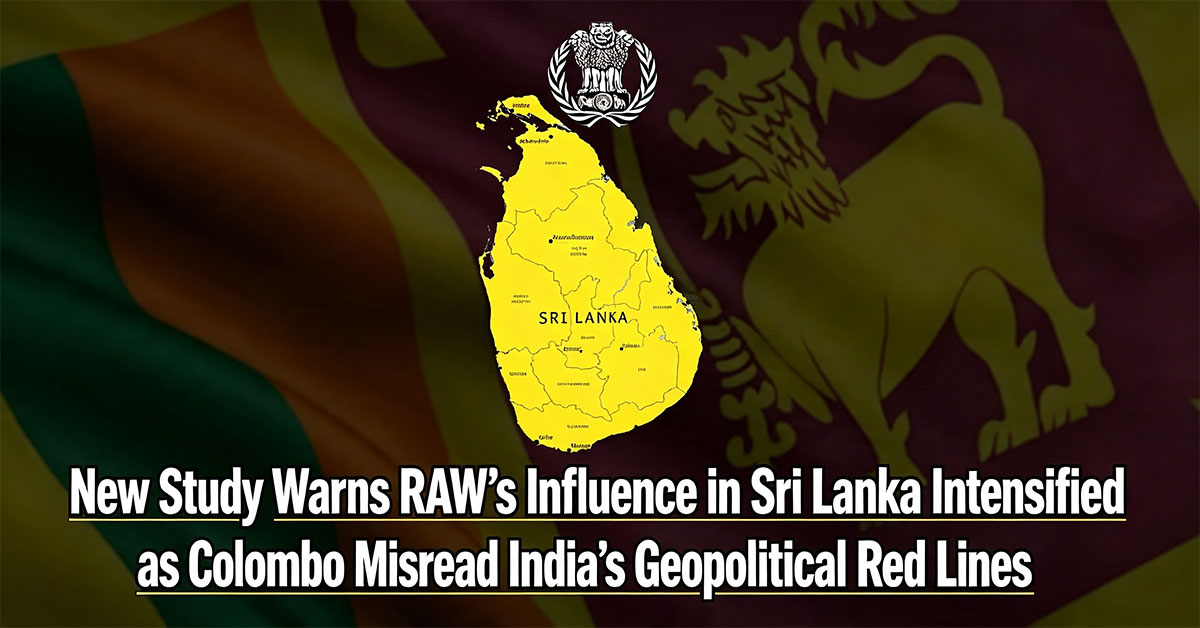
Colombo — A newly published academic analysis has traced the evolution of India’s external intelligence agency RAW’s activities in Sri Lanka, arguing that decades of political instability in the island were closely linked to Colombo’s repeated failure to grasp India’s strategic expectations.
The study, appearing in the Pak. Journal of International Affairs, asserts that RAW’s interventions—ranging from covert support for Tamil militant groups in the 1980s to alleged political influence during the 2015 presidential election—were driven by India’s national security concerns and fears of rival powers gaining a foothold in Sri Lanka.
Citing RAW founder R.N. Kao, the article notes that India’s apprehension grew whenever Sri Lanka appeared to drift from India’s orbit: “Sri Lanka became a seat for outside influences which we consider not very friendly towards us.”
Cold War Era: Westward Tilt Triggered RAW’s Covert Operations
The paper argues that President J.R. Jayewardene’s pro‑Western foreign policy in the late 1970s and early 1980s—combined with Sri Lanka’s openness to U.S. and Israeli military assistance—triggered RAW’s covert support for Tamil militant groups. According to the study, only a handful of Indian officials were aware of the secret operation, which aimed to pressure Colombo back into alignment with India’s regional interests.
Post‑2009: China’s Rise Reshapes RAW’s Strategy
Following the defeat of the LTTE, the article says RAW’s focus shifted dramatically as China expanded its footprint through major infrastructure projects such as Hambantota Port and Colombo Port City. The study describes China’s presence as a long‑term strategic challenge for India, noting that Beijing’s investments placed it “within breathing distance of India’s southern coast.”
2015 Election: Allegations of RAW’s Political Influence
The paper revisits claims that RAW played a role in Sri Lanka’s 2015 presidential election, including the recall of RAW station chief K. Illango after allegations of involvement in unifying opposition forces against then‑President Mahinda Rajapaksa.
Conclusion: Sri Lanka Repeated the Same Strategic Mistake
The study concludes that Sri Lanka’s leaders—from Jayewardene to the Rajapaksas—miscalculated India’s geopolitical red lines, first by leaning toward the West and later toward China. It warns that RAW’s future operations may face greater resistance due to China’s entrenched presence in Sri Lanka’s strategic landscape.
About the Author