
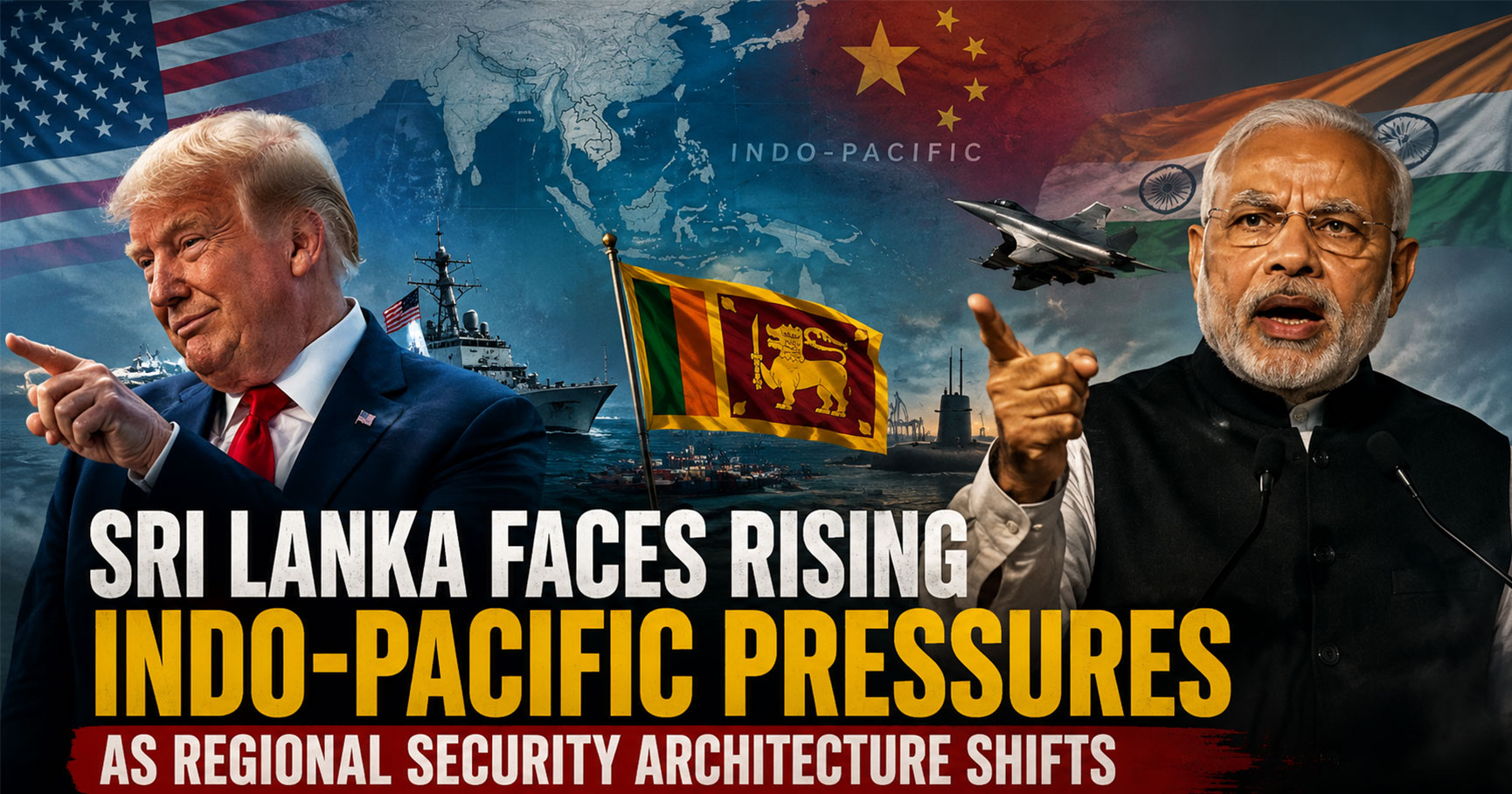
Colombo — Sri Lanka’s position at the heart of the Indian Ocean is drawing renewed attention as Indo‑Pacific security structures undergo rapid transformation, with regional flashpoints expanding and major powers recalibrating their strategies. The Indo‑Pacific is no longer defined by isolated crises but by “simultaneous military conflicts and a broader set of geopolitical issues,” according to the document, which warns that policymakers must now confront multi‑layered threats rather than single‑scenario planning.
Sri Lanka has already felt the impact of this shifting landscape. The document highlights that instability has spilled into the Indian Ocean itself, noting the “military blockade in the Strait of Hormuz, which spilled over into the Indian Ocean after a US submarine sank an Iranian military ship off the coast of Sri Lanka.” This incident underscores how global tensions can rapidly reach Sri Lanka’s maritime doorstep.
Anchors and Chokepoints: Why Sri Lanka Matters
While Sri Lanka is not listed among the four “anchors” shaping the Indo‑Pacific architecture, the document makes clear that these anchors — India, Japan, Australia, and France — rely on critical island territories to secure chokepoints stretching from the Middle East to East Asia. It notes that these islands provide reach to “the most critical chokepoints of the Indo-Pacific… covering the eastern coast of Africa, through the Indian Ocean and the Western Pacific.” Sri Lanka sits directly between these arcs, making its waters strategically indispensable.
A Region of Partnerships — and Sri Lanka’s Role
The emerging Indo‑Pacific framework is described not as a new institution but as “an operational network that links geography, partnerships, and existing agreements into a resilient regional system.” For Sri Lanka, this matters because the island is increasingly tied into regional maritime cooperation, intelligence sharing, and logistics arrangements — even if informally.
The document stresses that “a network of partnerships can generate regional resilience across multiple simultaneous scenarios,” a model that aligns with Sri Lanka’s own defence posture, which often relies on collaboration with India, the United States, Japan, and others for maritime surveillance, training, and capacity building.
Why Sri Lanka Cannot Ignore the Indo‑Pacific Shift
The Indo‑Pacific’s evolving architecture is driven by the reality that “no single power can address every contingency,” making smaller states like Sri Lanka part of a broader web of strategic coordination.
For Colombo, this means:
- Greater exposure to external military activity in surrounding waters
- Increased reliance on partnerships for maritime domain awareness
- A need to navigate competing interests of major powers
- Pressure to align with regional security norms without compromising autonomy
A New Organising Principle — and Sri Lanka’s Strategic Dilemma
The document concludes that the Indo‑Pacific “does not need more new institutions. It needs a new organising principle” to connect geographies and partnerships. Sri Lanka, positioned at the crossroads of these geographies, will inevitably be drawn into this emerging architecture — whether through maritime surveillance cooperation, logistics agreements, or crisis‑response coordination.
As the Indian Ocean becomes increasingly contested, Sri Lanka’s challenge will be balancing its strategic autonomy with the demands of a region moving toward deeper operational integration.
About the Author