
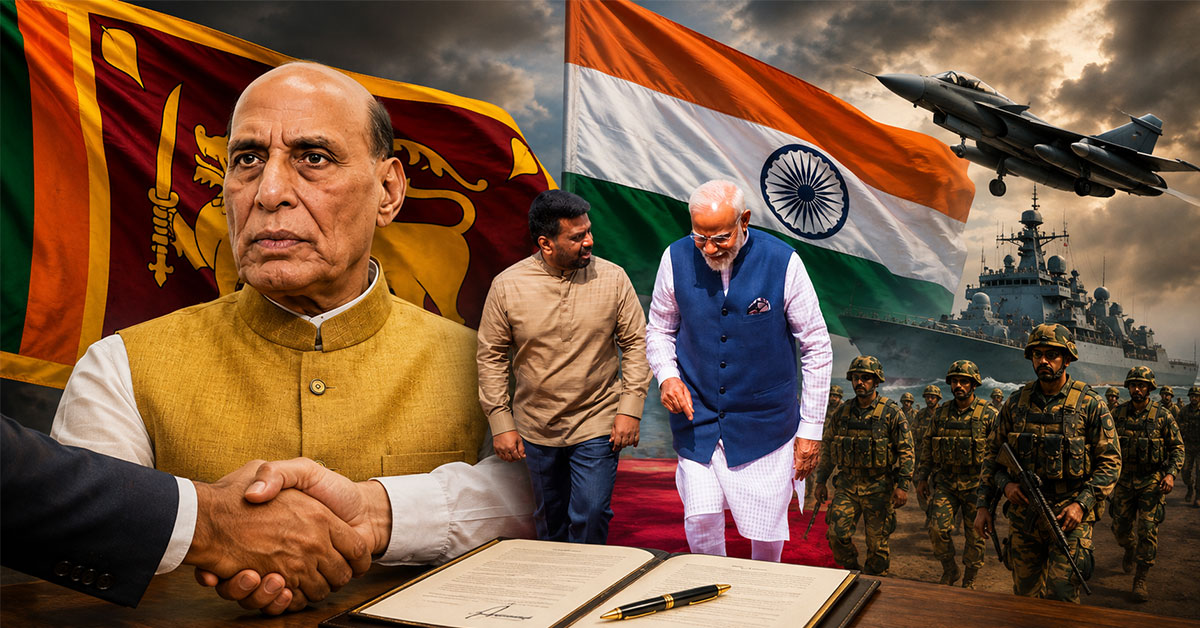
Colombo — India’s Defence Minister Rajnath Singh is set to arrive in Sri Lanka for a high‑level official visit during which New Delhi is expected to exert significant pressure on the Sri Lankan government regarding several pending political and defence commitments, senior security sources told [publication].
According to intelligence briefings, India is preparing to push Colombo on three key fronts:
Provincial Council elections,
Implementation of the 22nd Constitutional Amendment, and
Activation of agreements signed after President Anura Kumara Dissanayake assumed office.
India seeks timeline for full implementation of Defence MoU
During the visit, Minister Rajnath Singh is expected to finalize a Time Line implementation framework for the rapid operationalisation of the Defence Cooperation MoU signed between the two countries in April 2025. Both sides are scheduled to formally endorse this timeline.
The MoU, signed during Indian Prime Minister Narendra Modi’s state visit to Colombo, was presented as a partnership built on “shared defence aspirations” and “mutual trust.” Under this framework, seven defence agreements were concluded. Although the government claims Cabinet approval was obtained, members of the ruling NPP have stated they were not informed of the contents. None of the agreements have been tabled in Parliament or disclosed to the public.
The MoU is valid for five years, with either party able to terminate it with three months’ notice. However, Article 10 prohibits referring disputes to international courts, arbitration panels, or third‑party mediation, raising concerns about transparency and accountability.
SPP agreement with the U.S. complicates Indian MoU rollout
Government sources say Sri Lanka has come under subtle pressure due to the recently signed State Partnership Program (SPP) MoU with the United States. The SPP, formalised in late 2025 with the Montana National Guard, expands military cooperation in joint training, maritime security, and disaster response, with activities planned for 2026.
Officials say the U.S. partnership has created overlapping obligations, slowing the rollout of the Indian MoU despite nearly two years having passed since its signing.
What the Indian MoU contains
Although the full document remains undisclosed, Indian government sources describe it as a comprehensive framework for organising defence cooperation. Key components include:
High‑level military exchanges
Joint military exercises
Capacity‑building programs
Humanitarian assistance and disaster relief (HADR)
Naval ship sustainability visits
Exploratory discussions on defence industrial cooperation
Expanded naval and military linkages
Beyond defence, the MoU also touches on pharmaceutical regulation, biometric data, and electrical power transmission systems, indicating a broader strategic scope.
Indian Foreign Secretary Vikram Misri recently stated:
“The President of Sri Lanka has clearly affirmed that Sri Lankan territory or its surrounding waters will never be used in a manner harmful to India.”
India frames the MoU within its Neighbourhood First and Vision MAHASAGAR policies, though analysts widely view it as part of New Delhi’s response to China’s growing influence in the Indian Ocean.
Historical sensitivities resurface
The ruling JVP–NPP, long critical of Indian regional influence, signed the MoU 40 years after the 1987 Indo–Sri Lanka Accord, which led to the deployment of the Indian Peace Keeping Force (IPKF). The IPKF’s presence triggered widespread unrest and remains a sensitive memory, particularly among Tamil communities.
Key concerns raised by analysts
Security experts highlight several serious issues within the MoU:
Undefined “classified information” allows India to designate any material as sensitive.
The term “Material” is not defined, potentially covering weapons, aircraft, or other physical assets requiring confidential storage and transport in Sri Lanka.
Article 7.3 prohibits disclosure of such information even after the MoU expires.
Article 3.2.2 obligates Sri Lanka to provide military medical facilities for injured personnel during conflict, resembling a service‑provision clause.
A visit with far‑reaching implications
Rajnath Singh’s visit is expected to be one of the most consequential defence‑related engagements between the two nations in recent years. With competing strategic pressures from India and the United States — and longstanding sensitivities surrounding Indo‑Sri Lankan defence cooperation — Colombo faces a complex diplomatic balancing act.
Short Summary of the Sri Lanka–India Defence Cooperation MoU
The Memorandum of Understanding (MoU) signed on 5 April 2025 between Sri Lanka and India establishes a five‑year framework to expand and formalise defence cooperation. It covers personnel exchanges, joint training, defence industry collaboration, technology sharing, and protection of classified information.
Key Points
Scope & Principles:
Both countries commit to defence cooperation while respecting sovereignty, territorial integrity, and UN Charter principles. Neither party may allow its territory to be used in ways harmful to the other.
(“Neither Party shall allow the use of its territory for activities harmful to the national security of the other.”)
Personnel & Training:
Includes visits, exchange of instructors, joint exercises, peacekeeping training, HADR programs, and cooperation in ship design, UAV development, and engineering practices.
Other Exchanges:
Covers think‑tank interactions, military medical cooperation, logistics, defence infrastructure, and cultural engagements.
Annual Staff Talks:
Army‑to‑Army, Navy‑to‑Navy, Air Force talks, plus Tri‑Service discussions held alternately in both countries.
Defence Industry Cooperation:
Joint ventures, technology acquisition, repairs, maintenance, infrastructure upgrades, technical training, and participation in defence trade fairs.
Technology & Research:
Collaboration in science, defence technology, R&D, including scientist exchanges and technology transfer, with mechanisms to protect intellectual property.
Classified Information:
Strict rules on handling and safeguarding classified material; no disclosure to third parties without consent.
(“There will be no disclosure of such information to any third party without the prior written consent of the originating Party.”)
Dispute Resolution:
Any disputes must be settled only through consultations and diplomatic channels; cannot be referred to national or international courts or third parties.
Validity:
Effective for 5 years, renewable for 3‑year periods, with three months’ notice required for termination.
About the Author