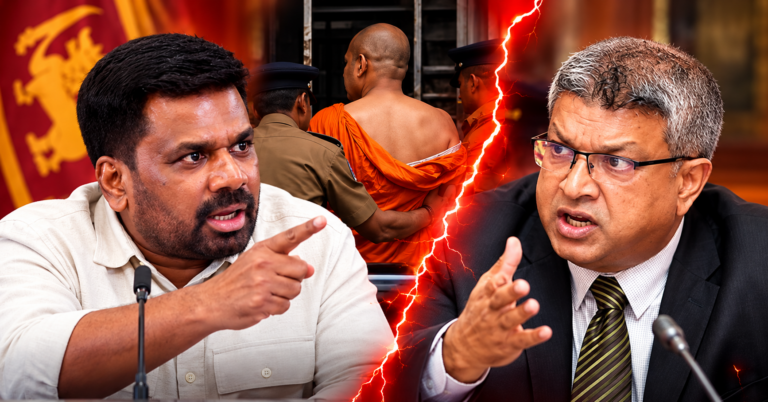

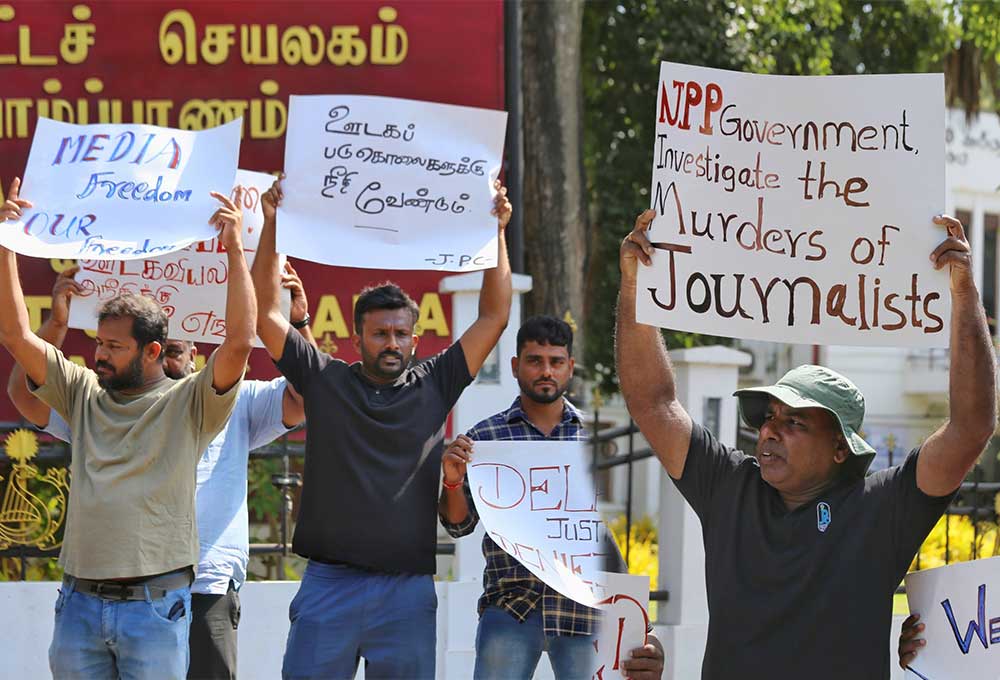
Tamil journalists in Jaffna staged a forceful demonstration on Friday, boycotting a government‑organised media workshop attended by Deputy Minister of Mass Media Kaushalya Ariyarathne and demanding long‑delayed justice for colleagues killed or forcibly disappeared during Sri Lanka’s armed conflict and its aftermath.
The protest, led by the Jaffna Press Club, unfolded outside the Jaffna District Secretariat, where the workshop for journalists from the Jaffna and Kilinochchi districts was being held. As demonstrators chanted slogans at the main entrance, Ariyarathne avoided the gathering and entered the building through a separate gate, declining to meet the journalists.
A heavy police presence prevented protesters from entering the secretariat to present their demands directly. Journalists continued to call for accountability for Tamil media workers who were assassinated or abducted over the past three decades.
‘Government has abandoned its promises’
Jaffna Press Club president K. Selvakumar criticised the deputy minister’s refusal to engage, saying it exposed the National People’s Power (NPP) government’s lack of commitment to justice.
“Two years have passed since this administration took office, yet investigations have not been expedited,” Selvakumar said. He contrasted Ariyarathne’s conduct with previous media ministers who, he noted, had at least been willing to meet journalists and discuss stalled cases.
Selvakumar accused the government of reneging on pre‑election promises to pursue justice for murdered journalists and alleged that the Jaffna district secretary had instructed police to remove demonstrators, acting in support of the government despite knowing the trauma journalists had endured.
“The deputy minister was not even prepared to listen to our demands or our grievances,” he said, adding that the workshop was being used to create an appearance of engagement while excluding those seeking justice.

Journalists confront deputy minister inside workshop
Although the Jaffna Press Club boycotted the event, more than 25 journalists from the Vadamarachchi Media House and the Jaffna Media Forum attended and directly challenged Ariyarathne over the lack of progress on emblematic cases.
They reminded her that President Anura Kumara Dissanayake had pledged justice for Tamil journalists who were murdered or disappeared, yet no tangible developments had been seen.
Ariyarathne insisted that old case files were being revisited and that justice would be delivered during the current government’s tenure. Her response was met with dissatisfaction, with journalists stressing that Tamil media workers in the North‑East were deliberately targeted for documenting wartime abuses.
They highlighted that at least 58 journalists in the North alone were killed or disappeared, and questioned why cases involving Sinhala journalists—such as Lasantha Wickrematunge and Prageeth Eknaligoda—appeared to receive more attention than those involving Tamil victims, including Isaipriya, Mylvaganam Nimalarajan and Dharmeratnam “Taraki” Sivaram.
Journalists argued that the disparity reflected a reluctance to pursue cases that could implicate members of the Sri Lankan military. Ariyarathne rejected the allegation, saying investigations were not prioritised by ethnicity and that authorities operated independently.
Pressed repeatedly on when concrete investigations would begin, the deputy minister declined to provide a timeline, saying only that the NPP government would act “more honestly” than its predecessors. She attempted to end the session early, citing another engagement, but journalists insisted that justice for slain and disappeared colleagues must take precedence over discussions on media development or accreditation.
Sri Lanka’s deadly record for journalists
Sri Lanka remains one of the most dangerous countries in the world for journalists. At least 41 media workers—most of them Tamil—are known to have been killed by the state or allied paramilitaries during and after the conflict. No perpetrator has ever been held accountable.
The cases raised by journalists on Friday are among the most symbolic of the culture of impunity:
Isaipriya, a Tamil broadcaster executed during the final days of the war in 2009;
Mylvaganam Nimalarajan, a BBC and Ravaya correspondent shot dead in Jaffna in 2000;
Dharmeratnam “Taraki” Sivaram, a veteran political analyst abducted and murdered in Colombo in 2005.
The Jaffna Press Club vowed to continue its campaign until justice is secured, saying the government must demonstrate genuine political will rather than offer repeated assurances without action.
About the Author