

Seven years after the Easter Sunday massacre plunged Sri Lanka into grief, the wounds remain painfully fresh.
Families continue to mourn loved ones who never returned home. Survivors continue to carry scars, both visible and invisible while the nation continues to ask the same agonising question of accountability.
The reecent verdict against former security officials has been hailed by many as a breakthrough in the search for accountability. However, beneath the public emotion lies a far more profound question, one that reaches beyond this case and into the future of Sri Lankan law itself. It is whether a person be punished as a murderer for failing to prevent a tragedy, even when there is no evidence that they intended it to happen. The answer could shape not only this case but every future case involving public officials, national disasters and state accountability.
No One Questions the Failure. The Question Is the Law.
There is little debate that the Easter Sunday attacks exposed one of the gravest failures in Sri Lanka’s modern history. Intelligence warnings existed but the communication channels failed and the necessaru decisions were not made. A chain of inaction culminated in a catastrophe,
The public’s anger is understandable, however courts are not established to measure anger but they are are established to measure guilt. Across the world, criminal law has always recognised a critical distinction between “intentionally causing death” and “failing to prevent death”. That distinction is not a legal technicality but it is the very foundation upon which justice systems stand.
If negligence, incompetence or dereliction of duty become legally indistinguishable from murder, then the boundaries of criminal responsibility begin to shift in ways that could affect every public servant, regulator, police officer, military commander, doctor and government official entrusted with making difficult decisions.
When South Korea Faced a National Tragedy
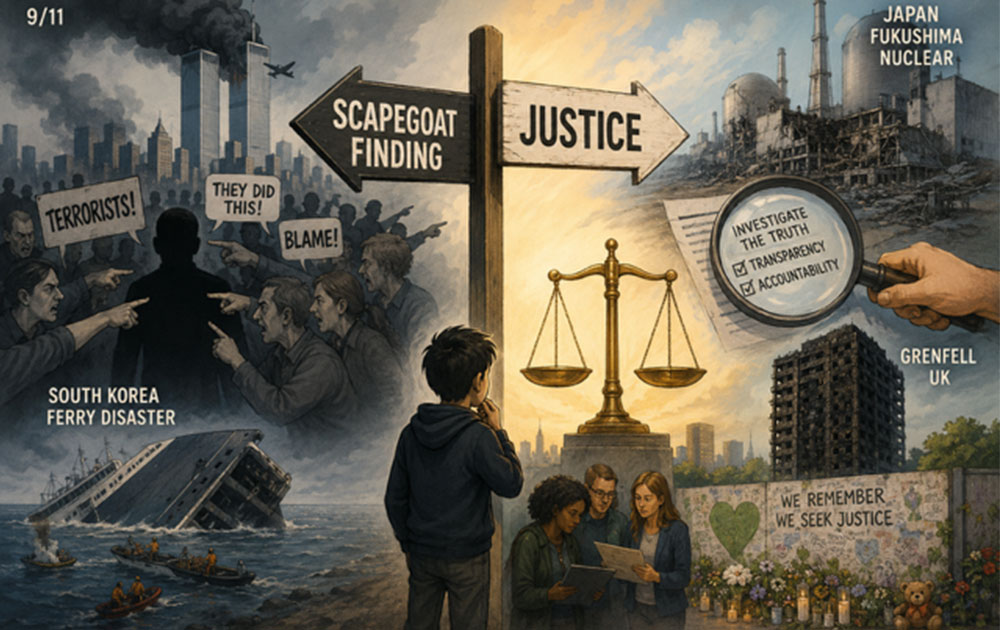
In 2014, South Korea witnessed one of the most painful disasters in its history when the Sewol ferry sank, killing more than 300 passengers, most of them schoolchildren. Investigations revealed a shocking combination of ignored warnings, poor decisions and failures in rescue operations. Public anger demanded accountability.
Officials were prosecuted. Careers were destroyed. Senior figures were jailed. But South Korea stopped short of treating those state failures as intentional murder. Instead, the country fundamentally transformed maritime safety standards and emergency response systems.
The lesson was clear: punishment alone could not honour the dead. Only reform could.
When America Failed Before 9/11
The September 11 attacks killed nearly 3,000 people. Subsequent investigations found that fragments of intelligence existed within the CIA and FBI. Information that might have disrupted the plot was sitting within the system and the failure was undeniable. However, no intelligence chief was prosecuted for murder. Instead, America asked a different question: “How do we stop this from ever happening again?” The result was the creation of the 9/11 Commission, a complete restructuring of intelligence-sharing mechanisms and the establishment of the Department of Homeland Security. The United States understood that locating blame was only one part of justice. Fixing the system was the other.
France, Japan and Italy Faced the Same Dilemma
France confronted devastating consequences when HIV-contaminated blood products were distributed to patients.
Japan faced public fury after the Fukushima nuclear disaster exposed years of ignored warnings and regulatory failures.
Italy struggled with questions of responsibility after the deadly L’Aquila earthquake.
In every case, societies demanded answers and courts had to balance grief against legal principle whilst judges wrestled with the same question confronting Sri Lanka today whether the catastrophic failure automatically become criminal intent. Most concluded that accountability must exist, but legal systems must also preserve the distinction between negligence and murder because without that distinction, justice itself becomes vulnerable.
Grenfell: A Warning About Systemic Failure
Perhaps the most powerful modern example is Britain’s Grenfell Tower fire where seventy-two people lost their lives. Years of ignored warnings, weak regulation and institutional complacency were exposed. The inquiry revealed failures at almost every level but the response did not stop with identifying individuals. The deeper objective was transforming an entire system that had failed the public.
Because societies do not become safer simply because someone is punished. They become safer when the causes of failure are eliminated.
The Danger of Finding a Scapegoat
History teaches us something uncomfortable. When nations suffer immense trauma, there is often a temptation to believe that justice can be achieved by finding one person, one official or one institution to carry the blame. But national tragedies are rarely that simple.
The Easter Sunday attacks were not merely the failure of individuals. They exposed weaknesses in intelligence-sharing, inter-agency coordination, political leadership, crisis management and institutional accountability. If those deeper weaknesses remain untouched, then the harshest verdict in the world cannot guarantee future safety.
A verdict may punish the past but only reform can protect the future.
The Verdict Beyond the Courtroom
The true test of this moment is not whether Sri Lanka has found people to punish, but whether it has the courage to confront the deeper failures that made the Easter Sunday tragedy possible. The attacks claimed 269 lives, injured more than 500 people, and shattered the confidence of an entire nation. History shows that nations are not ultimately judged by the severity of their verdicts, but by what they do in the aftermath.
Sri Lanka now stands at a crossroads. The families of the victims deserve justice, but they also deserve the assurance that no other family will suffer the same fate. That requires more than identifying who failed. It requires intelligence agencies that act on warnings, institutions that work together effectively, and leaders committed to fixing the weaknesses that allowed the tragedy to occur. If this verdict becomes a catalyst for stronger national security, greater accountability and meaningful reform, then the lives lost on Easter Sunday will leave behind a legacy that protects future generations.
Justice is not measured solely by how many people are punished. It is measured by how many lives are saved afterwards. The true test of Sri Lanka’s response will not be whether it punished the failures of the past, but whether it had the courage to ensure those failures can never happen again.
History’s final judgement will be simple: did Sri Lanka merely assign blame, or did it transform its greatest tragedy into its greatest reform?
tc,
The Catalyst
About the Author