
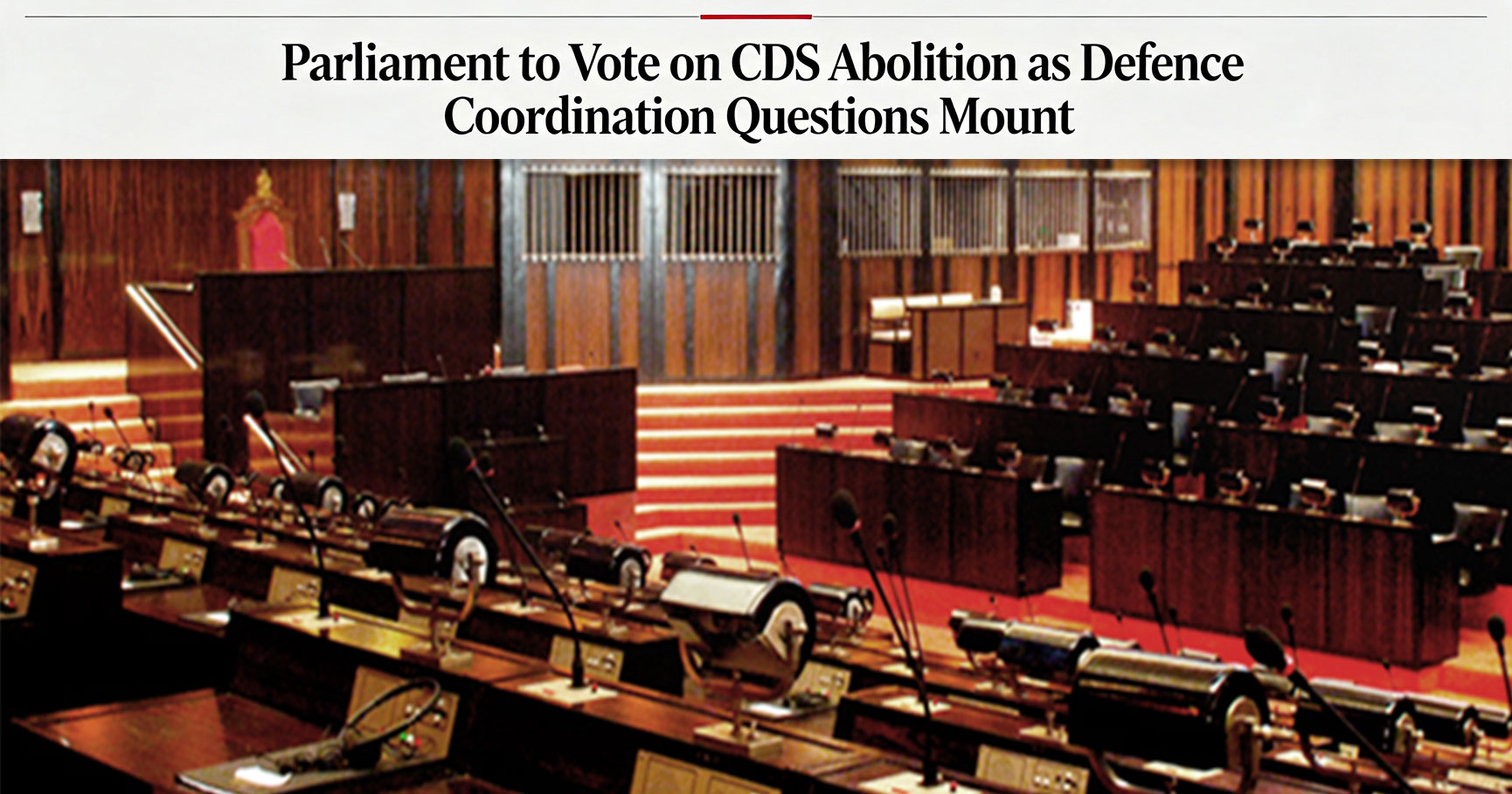
COLOMBO — Parliament is set to vote on a Government Bill to abolish the office of the Chief of Defence Staff (CDS) on September 9, a move officials say reflects changing defence priorities and efforts to streamline military expenditure. But lawmakers and defence analysts warn that removing the post without a clear successor structure could weaken coordination among the armed forces at a time of rising regional security pressures.
Established in 2009, the CDS was designed to ensure cooperation between the Army, Navy and Air Force, particularly in joint operations and crisis response. The Government now argues that Sri Lanka’s post‑war environment no longer requires a dedicated office for tri‑service coordination, especially as defence spending and force structures are being reassessed.
“There is a reasonable case for reviewing institutions created during or immediately after the war,” officials say, noting that the country’s security landscape in 2026 differs significantly from that of the final years of the conflict.
However, critics caution that abolishing the CDS raises its own strategic concerns.
Modern defence operations — from maritime surveillance and cyber security to disaster response and intelligence sharing — increasingly rely on integrated command structures. Without a clear replacement, observers fear coordination could become fragmented across individual services.
Parliamentarians are expected to press the Government on who will assume the CDS’s responsibilities once the office is dissolved, and whether any new arrangement will strengthen accountability or simply shift duties elsewhere within the defence establishment.
The debate comes as Sri Lankan forces continue monitoring Iranian vessels beyond the island’s coastline and as the Indian Ocean grows more contested, with major powers expanding their presence and influence.
Reducing unnecessary defence expenditure is widely supported. But defence experts warn that weakening joint command mechanisms would be counterproductive.
As the Bill heads for a vote, lawmakers say the Government must explain not only why the office should be abolished, but what comes next.
About the Author