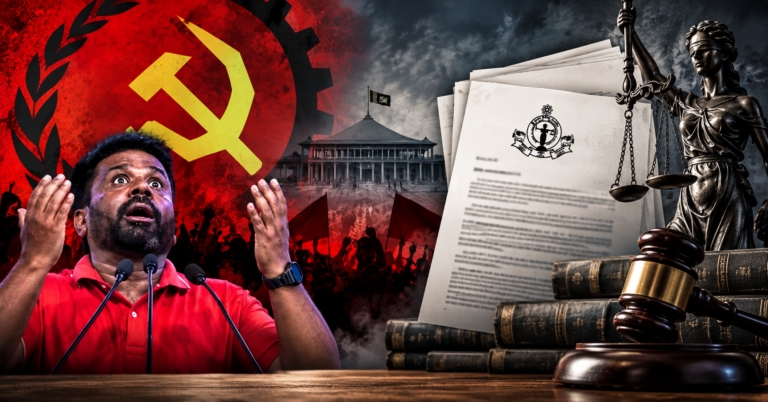

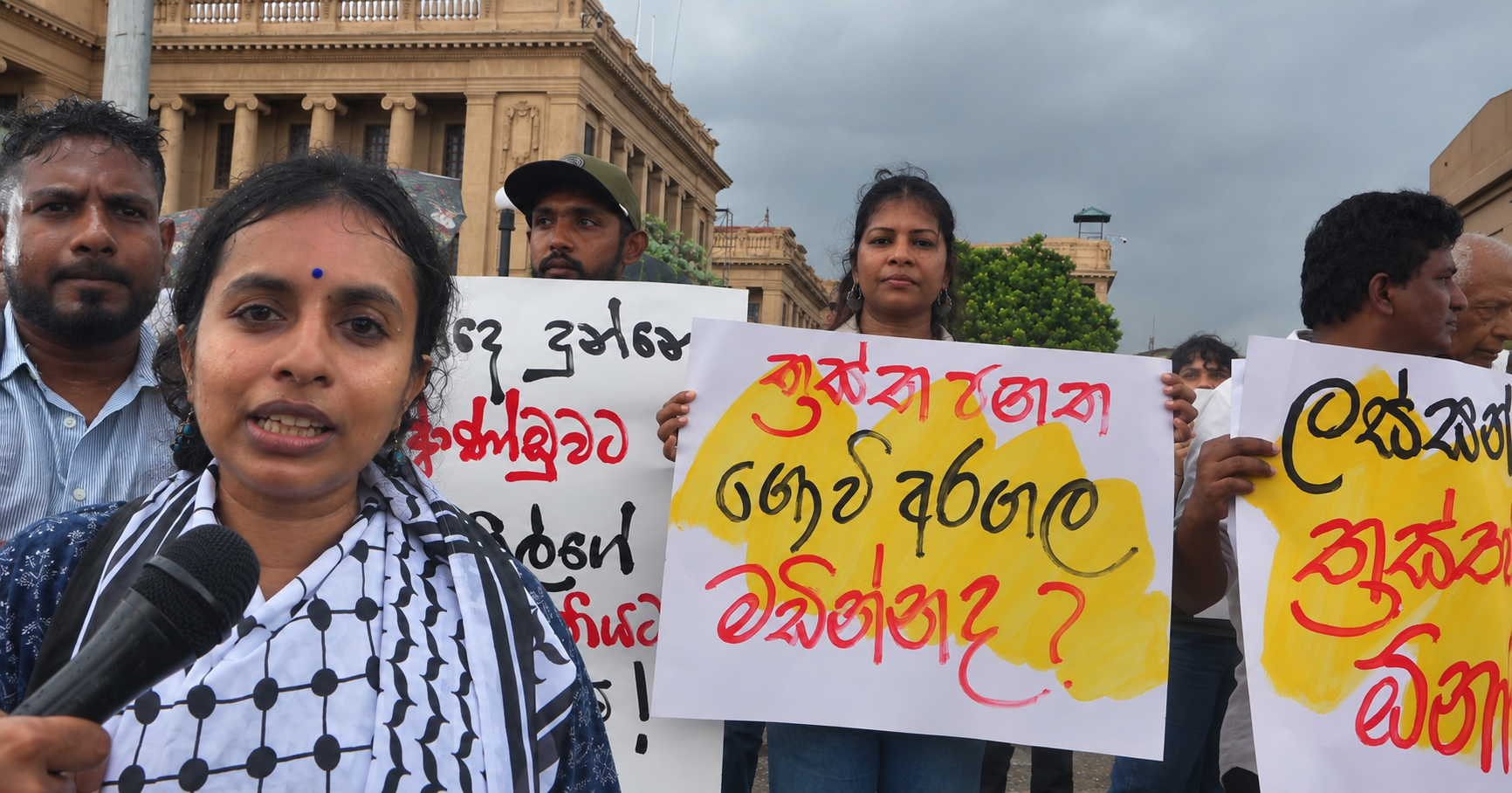
“There is very little difference between the NPP, Ranil Wickremesinghe and Rajapaksa governments when it comes to suppressing people’s movements,” says United Federation of Labour President Swasthika Arulingam.
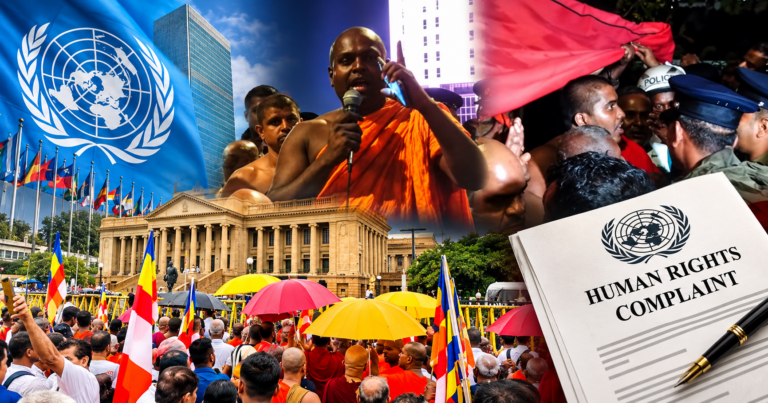
COLOMBO, October 13, 2026 — Civil society organisations, trade unions and political activists staged a protest outside the Presidential Secretariat in Colombo on Tuesday, demanding the immediate withdrawal of the proposed Protection of the State from Terrorism Bill (PSTB), accusing the National People’s Power (NPP) government of introducing legislation that could be used to criminalise public dissent and suppress resistance to its economic policies.
Addressing the protest, United Federation of Labour President Swasthika Arulingam strongly criticised the government for attempting to introduce new anti-terrorism legislation despite its earlier commitment to repeal the controversial Prevention of Terrorism Act (PTA).
She warned that the proposed legislation could be even more repressive than the existing PTA, potentially expanding detention powers, allowing military involvement in arrests and creating what she described as a permanent state of emergency within Sri Lanka’s legal system.
“The Same Government That Promised to Repeal the PTA”
Arulingam accused the NPP government of betraying its political commitments by introducing legislation that retains and potentially expands the extraordinary powers associated with previous anti-terrorism laws.
“This has been tabled by the NPP government after promising us that they would repeal the PTA,” she said.
Recalling the political positions taken by senior figures associated with the NPP in 2017, Arulingam said they had previously maintained that Sri Lanka did not require special anti-terrorism legislation.
“I very clearly recall that in 2017, very senior members of the NPP, central members of the NPP, took the position that we do not need any anti-terror laws,” she stated.
She questioned why the same political movement, now in government, was seeking to introduce legislation that she argued closely resembled the counterterrorism frameworks proposed by previous administrations.
“Little Difference Between NPP, Wickremesinghe and Rajapaksa Governments”
In one of her strongest criticisms, Arulingam argued that the NPP government’s approach to public protests and political dissent was fundamentally similar to that of the administrations it had previously opposed.
She claimed the proposed legislation was almost identical to earlier counterterrorism proposals, including the Counter Terrorism Act (CTA) and Anti-Terrorism Act (ATA).
“There is very little difference between the NPP government, the Ranil Wickremesinghe government and the Rajapaksa government,” she declared.
According to Arulingam, these similarities were particularly evident in how successive governments sought to control citizens, restrict public mobilisation and portray protest movements as potential terrorist threats.
She argued that changing governments had not fundamentally changed the state’s approach to political dissent.
New Bill Could Allow Detention Until the End of Trial
Arulingam rejected suggestions that the proposed PSTB represented an improvement over the existing PTA.
She maintained that the new legislation retained controversial detention provisions while introducing additional powers that could severely undermine individual liberties.
“People say PSTA is slightly better than the PTA. Actually, it’s not,” she said, referring to the proposed legislation.
“Detention orders are still intact.”
She further alleged that the proposed law would establish a mechanism through which individuals could remain in detention until the conclusion of their trials.
“In fact, PSTA introduces a system where a person can be kept under detention till the end of trial. This does not even exist in the PTA,” she claimed.
Arulingam argued that such provisions could expose suspects to prolonged deprivation of liberty and undermine established safeguards within the criminal justice system.
The claims concerning the scope and operation of these detention powers require examination against the precise wording of the proposed legislation.
Military Arrest Powers Raise Serious Concerns
The trade union leader also raised concerns about provisions she said would empower military personnel to arrest civilians.
“PSTA introduces a system where the military can make arrests. This did not exist in the PTA,” she stated.
She warned that expanding military involvement in civilian law enforcement could have serious implications for civil liberties and democratic accountability.
“Through the PSTA, a permanent state of emergency is being introduced into our legal system,” Arulingam argued.
Her remarks reflected concerns that exceptional security powers, traditionally associated with emergency situations, could become embedded in ordinary legislation.
“Why Introduce Repressive Laws When There Is No Real Terrorist Threat?”
Questioning the government’s justification for the proposed legislation, Arulingam argued that Sri Lanka was not currently facing a terrorist threat that warranted such sweeping powers.
“There is no real threat of terrorism right now. So why is the government attempting to do this?” she asked.
She suggested that the legislation was motivated less by immediate national security concerns than by fears of future public opposition to government policies.
According to Arulingam, the authorities were increasingly concerned about the possibility of renewed public mobilisation against economic hardship and the government’s response to the cost-of-living crisis.
IMF Economic Policies at the Centre of the Controversy
A central allegation raised during the protest was that the proposed anti-terrorism legislation could be used to suppress opposition to economic policies associated with the International Monetary Fund (IMF).
Arulingam accused the government of disregarding the economic and material difficulties faced by ordinary citizens while preparing stronger legal mechanisms to contain public resistance.
“The government is worried about people’s uprising against repressive economic policies, against the government’s callous attitude towards real economic and material issues which the people are protesting against,” she said.
She further alleged that the government wanted to portray ordinary citizens and their movements as security threats.
“The government wants to frame ordinary people’s movements, ordinary people as terrorists, and crush any resistance which is coming against the government’s policies which the government is putting forward under the behest of the IMF,” she stated.
Her remarks drew a direct connection between the government’s economic agenda and the proposed expansion of national security powers.
However, the allegation that the legislation is specifically intended to suppress opposition to IMF-backed policies remains Arulingam’s interpretation of the government’s motives, rather than an independently established fact.
Opposition to Organised Crime Legislation
Arulingam also called for public resistance to other proposed laws, including legislation addressing organised crime.
She argued that such measures could potentially be used against ordinary citizens and protest movements rather than exclusively targeting serious criminal activity.
“These are not there to protect people. These are there to frame people as criminals, frame people as terrorists,” she claimed.
She warned that the combined effect of these legislative proposals could be to strengthen the state’s capacity to suppress political opposition and grassroots mobilisation.
Trade Unions Call for Nationwide Resistance
Concluding her address, Arulingam urged citizens, trade unions, civil society organisations and political activists to oppose the proposed legislation.
“We are here to say: resist the PSTA,” she declared.
She emphasised that the protest outside the Presidential Secretariat was intended to demonstrate organised opposition to legislation that protesters believe threatens democratic rights and fundamental freedoms.
“We are here to show our resistance and dissent, and we call all people to do the same,” she said.
A Major Test of the NPP Government’s Democratic Commitments
The protest highlights an emerging confrontation between the NPP administration and sections of Sri Lanka’s trade union and civil society movements over the future of counterterrorism legislation.
The government came to power amid expectations of political reform, institutional accountability and a departure from controversial practices associated with previous administrations.
The proposed replacement of the PTA has therefore become an important test of whether those commitments will translate into meaningful changes to the country’s national security framework.
For critics such as Arulingam, the central issue is not simply whether the PTA is formally repealed, but whether the exceptional powers that made it controversial are removed or reproduced under another name.
Her criticism also raises a broader question about the relationship between national security legislation, economic policy and the constitutional right to peaceful protest.
As opposition to the proposed bill gathers momentum, the government faces demands to explain why the proposed powers are necessary, how they would be exercised and what safeguards would prevent their misuse against political activists, trade unions and ordinary citizens.
The central demand from Tuesday’s protesters was clear: withdraw the proposed anti-terrorism legislation and protect the democratic rights of the people.
About the Author